


Retail Signage South Africa: Design Signs That Sell
Most retail shops in South Africa are losing foot traffic not because their product is wrong, but because their signage is invisible, confusing, or simply forgettable. Retail signage South Africa has become a genuine competitive battleground, especially in high-density retail corridors across Gauteng where a shopper's attention is pulled in dozens of directions before they even reach your door. Research compiled by Shopify shows that 60% of businesses reported average sales increases of 10% or more simply by adding or updating their signs. That number should settle any debate about whether signage is worth the investment.
Table of Contents
- Why Retail Signage Drives Sales
- Types of Retail Signage and Where Each Belongs
- Design Principles That Make Shop Signs Work
- Point of Sale Signage: The Most Underused Revenue Tool
- Signage for Franchises and Corporate Identity
- Comparing Signage Types for South African Retail
- Frequently Asked Questions
- References
Why Retail Signage Drives Sales
There is a tendency among retail business owners to treat signage as a once-off setup cost rather than an active selling tool. That mindset is expensive. A shopper walking past your store makes a split-second judgment about whether it is worth entering. Your exterior signage is your first, and often only, opportunity to change the outcome of that judgment.
Research cited by Shopify South Africa found that digital signage alone can increase average purchase amounts by around 29.5%. Even static signage, when well-designed and correctly positioned, shifts buying behaviour in measurable ways. In-store displays were recalled by 69% of retail shoppers surveyed in research by Inmar Intelligence, confirming that signage is not just decoration. It is active communication that stays in the customer's mind.
In a Gauteng retail environment, where malls, strip centres, and high streets compete aggressively for the same customer base, the businesses that treat their signage as a sales tool consistently outperform those that treat it as an afterthought. This is not an opinion. It is the pattern every experienced signage professional sees repeated across retail categories.
"Signs, graphics and displays are everywhere in a modern retail store environment for one simple reason: they work."
Types of Retail Signage and Where Each Belongs
One of the most common mistakes retail owners make is buying signage without a clear plan for where each type belongs in the customer journey. Every sign category serves a specific moment in that journey, and mixing them up wastes money.
Exterior and Fascia Signs
Your fascia sign is your storefront identity. It tells passing traffic who you are before they have any other interaction with your brand. For Gauteng retailers, this sign needs to work across three conditions: daytime sun, overcast weather, and low-light evening hours. Illuminated channel letters and LED-backlit fascia signs address all three. Built-up illuminated letters create a dimensional, high-quality appearance that reads well from a distance and communicates permanence, which matters enormously for new businesses trying to establish trust quickly.
Pylon signage works particularly well in locations set back from the road or in shared commercial parks, where a street-facing pole sign draws traffic that would otherwise miss the store entirely. Banners and suspended signage serve promotional purposes at the exterior level and are ideal for seasonal campaigns that do not justify permanent sign production costs.
Window Graphics and A-Frame Signs
Window space is prime retail real estate that most shop owners leave completely unused. Window graphics communicate promotions, reinforce brand identity, and create visual interest that slows pedestrian traffic. Correctly used, they work alongside your fascia sign rather than competing with it. A-frame pavement signs serve a different purpose: they intercept foot traffic at eye level and give you an opportunity to communicate something specific, such as a daily special, a new arrival, or a time-sensitive offer.
Indoor Directional and Informational Signs
Once a customer is inside, signage takes on a navigational function. Shoppers who cannot find what they came for are unlikely to return. Departmental signs, category headers, and directional arrows reduce friction and keep customers moving through the store rather than leaving in frustration. These signs do not need to be elaborate. They need to be clear, consistent with your brand palette, and placed at decision points where customers would naturally look for guidance.

Design Principles That Make Shop Signs Work
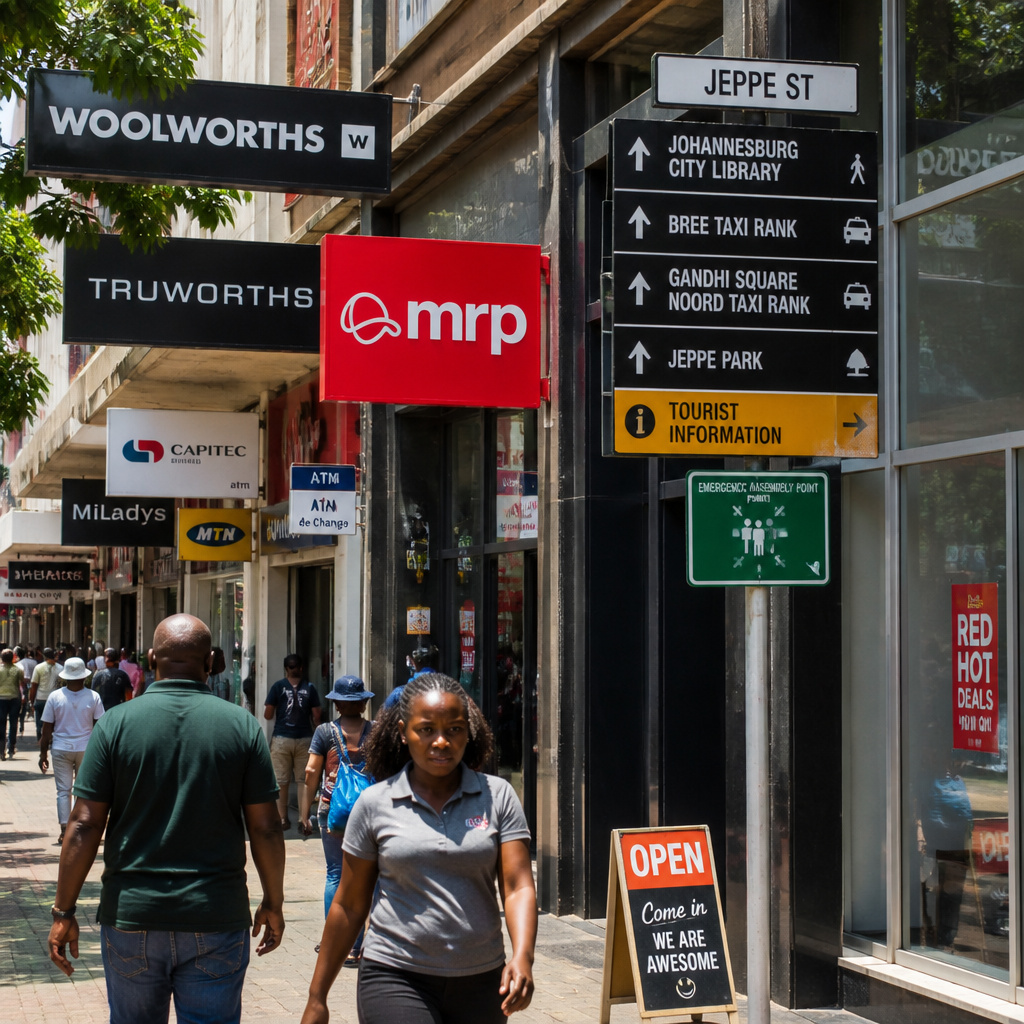
Good sign design is not a matter of personal taste. It follows rules that are grounded in how the human eye processes information at speed. Breaking these rules consistently results in signs that look professional in isolation but fail completely in a real retail environment.
Font Size and Reading Distance
A commonly cited rule among signage professionals is that lettering should be approximately one inch tall for every ten feet of intended viewing distance. This means a sign intended to be read from twenty metres away needs far larger lettering than most clients initially specify. Outdoor shop signs in Gauteng's high-traffic areas need to work at speeds and distances that most designers underestimate. When in doubt, go larger. Oversized lettering almost never fails to communicate. Undersized lettering almost always does.
Colour Contrast
Contrast is not a stylistic preference. It is a legibility requirement. High-contrast colour pairings, such as dark text on a light background or vice versa, allow the eye to separate the message from the background instantly. South African signage professionals have consistently demonstrated that white backgrounds work well for retail, office, and pylon applications, with strong contrast colours including navy, deep red, and dark green performing reliably. Where brand guidelines dictate specific colour combinations, a qualified signage partner can test those combinations for contrast before committing to production.
Message Discipline
Every word on a sign that is not essential is a word that competes with the words that are. Exterior signs should carry your brand name and, at most, one supporting statement. Point of sale signs should communicate one offer or benefit. The discipline of stripping copy to the absolute minimum is uncomfortable for most business owners, but it is what separates signs that register instantly from signs that require effort to decode. Effort is the enemy of impulse purchase.
Pro tip: Test your sign copy by showing it to someone unfamiliar with your business for three seconds, then asking them to repeat what they read. If they cannot, the sign has too many words or insufficient contrast.
Point of Sale Signage: The Most Underused Revenue Tool
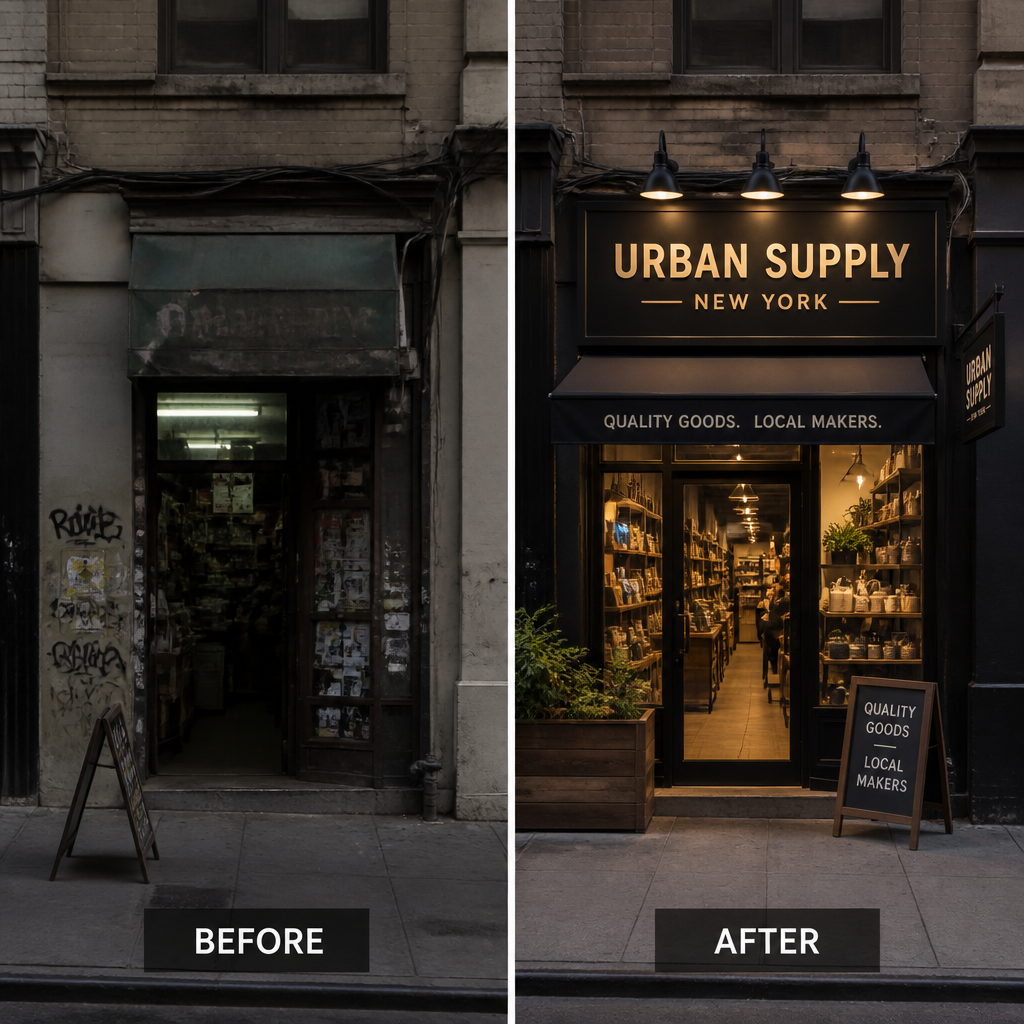
Point of sale signage covers any sign placed near or at the checkout area, or adjacent to a specific product, with the explicit purpose of influencing a purchase decision. In South African retail, this category is dramatically underused relative to its proven effectiveness.
A Mood Media survey found that 58% of shoppers actively notice in-store displays, and nearly half of those say their purchase decisions were influenced by those displays. Yet walk through the majority of independent retail shops in Gauteng and you will find the checkout area either unmarked or carrying generic brand materials that communicate nothing of specific commercial value in that moment.
What Point of Sale Signs Should Do
Effective POS signage accomplishes one of three things: it introduces a product a customer did not know existed, it creates urgency around a time-limited offer, or it communicates a price or promotion clearly enough to trigger an impulse add-on purchase. Signs that try to do all three simultaneously do none of them well.
Snapper frames and poster systems are practical solutions at this level because they allow rapid content changes without reprinting the frame itself. For higher-impact POS environments, LED-backlit lightboxes draw the eye in a way that static frames cannot. The right choice depends on your product category, average transaction value, and how frequently your promotions rotate.
Placement Logic for POS Signs
POS signs work best when placed at the exact moment of decision. That means adjacent to the product being promoted, at eye level, and no further than arm's reach from where the customer will either pick up or pass the item. Signs placed above products or more than a metre away from them produce measurably lower response. In retail environments with longer checkout queues, additional POS signage placed at intervals along the queue path captures attention during dwell time and increases conversion on promotional products.
Pro tip: For shop signs in Gauteng's mall environments, remember that your POS signage must compete with ambient noise and visual clutter from surrounding tenants. A sign that works perfectly in a quiet independent shop may need higher contrast, larger type, or illumination to perform in a busy mall corridor context.
Signage for Franchises and Corporate Identity
Franchise signage operates under a different set of constraints from independent retail. The franchisor's corporate identity manual governs everything from Pantone colour references to letter spacing, approved materials, and minimum size requirements. Deviation from these specifications is not a creative choice. It is a compliance failure that carries legal and financial consequences for the franchisee.
The most frequent point of failure in franchise signage projects is the gap between what the corporate identity document specifies and what a local sign producer actually delivers. Achieving exact colour matching across different substrate materials, ensuring that illumination is even and without hotspots, and maintaining consistent letter spacing across a fascia sign at scale all require a level of production discipline that not every signage supplier maintains.
What Franchisees Should Verify Before Signing Off
Before accepting any franchise sign installation, verify the following: colour accuracy against the specified Pantone or CMYK reference under both daylight and artificial light, structural integrity of the mounting method and its compliance with local authority bylaws, and whether illuminated signs have been wired to meet electrical safety standards. In Gauteng, local municipalities have specific by-laws governing sign size, illumination intensity, and placement on certain building types. A signage partner who understands these requirements will flag potential compliance issues before installation, not after.
For businesses operating across multiple locations in Gauteng and beyond, a single signage provider who can manage production consistency across sites is worth considerably more than using different local suppliers at each location. Inconsistency in signage across franchise locations erodes the brand recognition value that the franchise model is built on.
Comparing Signage Types for South African Retail
Choosing the right sign format is a practical decision that depends on your location type, budget, and whether your business operates primarily in daylight hours or extends into the evening. The table below compares the most common formats used by South African retailers.
| Sign Type | Best Application | Key Consideration for South African Retail |
|---|---|---|
| LED-Backlit Fascia Signs | Shopfronts, restaurants, fitness centres, hotels | Works day and night; energy-efficient for always-on businesses; handles Gauteng's variable weather well with sealed units |
| Channel Lettering | Corporate offices, franchise storefronts, high-street retail | High-end, dimensional appearance; individually illuminated letters create strong brand presence; preferred by franchisors for flagship locations |
| Pylon Signage | Commercial parks, roadside businesses, shopping centres set back from traffic | Essential where the shopfront is not visible from the road; size must comply with local municipality by-laws in Gauteng |
| Neon or Neon-Effect Signs | Restaurants, bars, boutiques, event venues | Strong visual identity tool for businesses where atmosphere is part of the product; LED neon alternatives are more durable in South African climate |
| POS and Display Stands | Checkout areas, product displays, trade shows and events | Low cost per campaign; high ROI when updated regularly; snapper frames allow rapid seasonal refresh without frame replacement |
The decision between illuminated and non-illuminated signage is not purely aesthetic. If your business is open after dark, or if your shopfront is in a shaded arcade or covered walkway, non-illuminated signs lose their effectiveness for a significant portion of your trading hours. In Gauteng's retail environment, where trading hours commonly extend into the evening, illuminated options protect your visibility investment across the full day.
Frequently Asked Questions
How much does retail signage cost in South Africa?
Sign costs vary widely depending on materials, size, illumination, and complexity of installation. A basic non-illuminated fascia sign is significantly less expensive than a full channel letter installation with electrical wiring. The more useful question is not what a sign costs but what it costs per customer it converts. A well-designed illuminated fascia sign that drives an additional ten customers per day pays for itself rapidly. Requesting a quote based on your specific requirements from a professional signage supplier is the only way to get an accurate figure, since material and labour costs shift with exchange rates and supply conditions.
What are the most effective shop signs for Gauteng retail environments?
For street-facing shopfronts in Gauteng, illuminated channel letters or LED-backlit fascia signs consistently outperform non-illuminated alternatives because they remain visible across all weather and light conditions. For businesses in commercial parks or set back from main roads, pylon signage is often the difference between being found and being missed. The most effective combination is an exterior identity sign paired with window graphics and indoor directional signage that guide the customer from the pavement to the point of purchase.
Do franchise signage requirements differ from independent retail?
Yes, significantly. Franchisees are bound by the franchisor's corporate identity standards, which specify exact colours, fonts, materials, and often approved suppliers. Independent retailers have more freedom but still benefit from professional design guidance to ensure their signage communicates clearly and is built from materials that will last. In both cases, the sign must comply with Gauteng's local municipality by-laws on signage size, illumination, and placement.
What is point of sale signage and why does it matter?
Point of sale signage refers to any sign placed at or near the checkout area or adjacent to a specific product with the purpose of influencing a purchase decision in that moment. It matters because it captures attention at the highest-intent moment of the shopping journey. Research consistently shows that in-store displays influence nearly half of shoppers who notice them. In South African retail, this type of signage is frequently underprioritised relative to exterior signs, despite offering a strong return on investment through increased basket size and impulse purchase rates.
How often should retail signage be updated?
Exterior brand identity signs do not need frequent replacement if they are built from quality materials and maintained correctly. However, promotional signage, POS displays, and window graphics should rotate with your campaign calendar. Leaving seasonal or promotional signs in place long after the promotion has ended creates confusion and signals to customers that the business is not actively managed. A practical approach is to use sign systems that allow content replacement without replacing the frame or housing, which keeps update costs low and makes regular rotation financially feasible.
Can signage rental be a viable option for events and temporary retail locations?
Yes, and it is often the smarter financial decision for temporary setups. Signage rental allows event organisers, pop-up retailers, and exhibition participants to access professional-quality display stands, banners, and branded structures without committing to a purchase that has limited use after the event. For businesses testing a new location or operating a short-term promotional space, rental signage provides full brand presence at a fraction of the capital cost of permanent sign production.
We would love to hear what has worked for your retail signage setup, or what challenges you are currently facing. Share your experience in the comments below.
We would love your feedback and any insights you would share with others. What perspective would you add?
References
- Shopify South Africa: How retail signage impacts sales and brand awareness
- Shopify South Africa blog: Designing effective retail signs for your store
- Taylor: The five rules for effective in-store retail signage
- Signkor South Africa: Colour contrast best practices for signage
- Artisan Colour: Best practices for outdoor signage design and legibility