


Directional Pylon Signs South Africa: Gauteng Guide
If your business sits inside a Midrand business park, a Sandton mixed-use development, or a Fourways retail precinct, the single biggest barrier between you and a paying customer is not your product or your price. It is the five seconds a driver spends staring at a confusing entrance wondering whether this is the right turn. Directional pylon signs South Africa businesses install in high-density commercial zones exist to close that gap, turning hesitation into foot traffic. This guide covers what makes a directional pylon work, where it needs to be placed in Gauteng's busiest commercial corridors, which materials hold up best, and how to specify a system that actually earns its installation cost back.
Table of Contents
- Quick Takeaways
- What Directional Pylon Signs Actually Do
- Gauteng Commercial Zones Where Wayfinding Fails
- ACM Pylon Directional Signs: Material and Construction
- Design Rules for Directional Pylon Signs
- Indoor vs Outdoor Directional Pylons: Comparison
- Installation Planning for Gauteng Sites
- Frequently Asked Questions
- References
Quick Takeaways
| Key Insight | Explanation |
|---|---|
| Height determines read distance, not just visibility | A directional pylon at 3 metres gives drivers approximately 4-6 seconds of reading time at 60 km/h. That is enough time for one clear message, not four. |
| ACM is the dominant outdoor cladding choice in Gauteng | Aluminium composite material handles UV intensity, thermal cycling, and Highveld hailstorms better than plain aluminium sheet at a fraction of the fabrication cost. |
| Wayfinding signage Gauteng must account for gate complexes | Multi-tenant business parks in Midrand, Centurion, and Woodmead use boom-gate entry points that require pre-gate directional pylons so visitors do not queue at the wrong access point. |
| Internal and external pylons serve different cognitive tasks | External pylons announce and orient. Internal pylons navigate. Using only one type leaves visitors stranded mid-journey. |
| Corporate identity compliance is non-negotiable for franchises | Franchise networks in South Africa face CI audits. Every directional pylon must match brand colour standards (Pantone or RAL) and approved typefaces exactly. |
| Illuminated directional pylons extend revenue hours for hospitality | Hotels, restaurants, and entertainment venues in Rosebank and Sandton draw evening traffic. An unlit directional pylon is invisible after 18:00 in winter when darkness falls early. |
| Permit requirements vary by municipality | Johannesburg, Tshwane, and Ekurhuleni each have their own bylaws for sign height and placement near roads. A professional signage supplier will confirm compliance before installation. |
What Directional Pylon Signs Actually Do
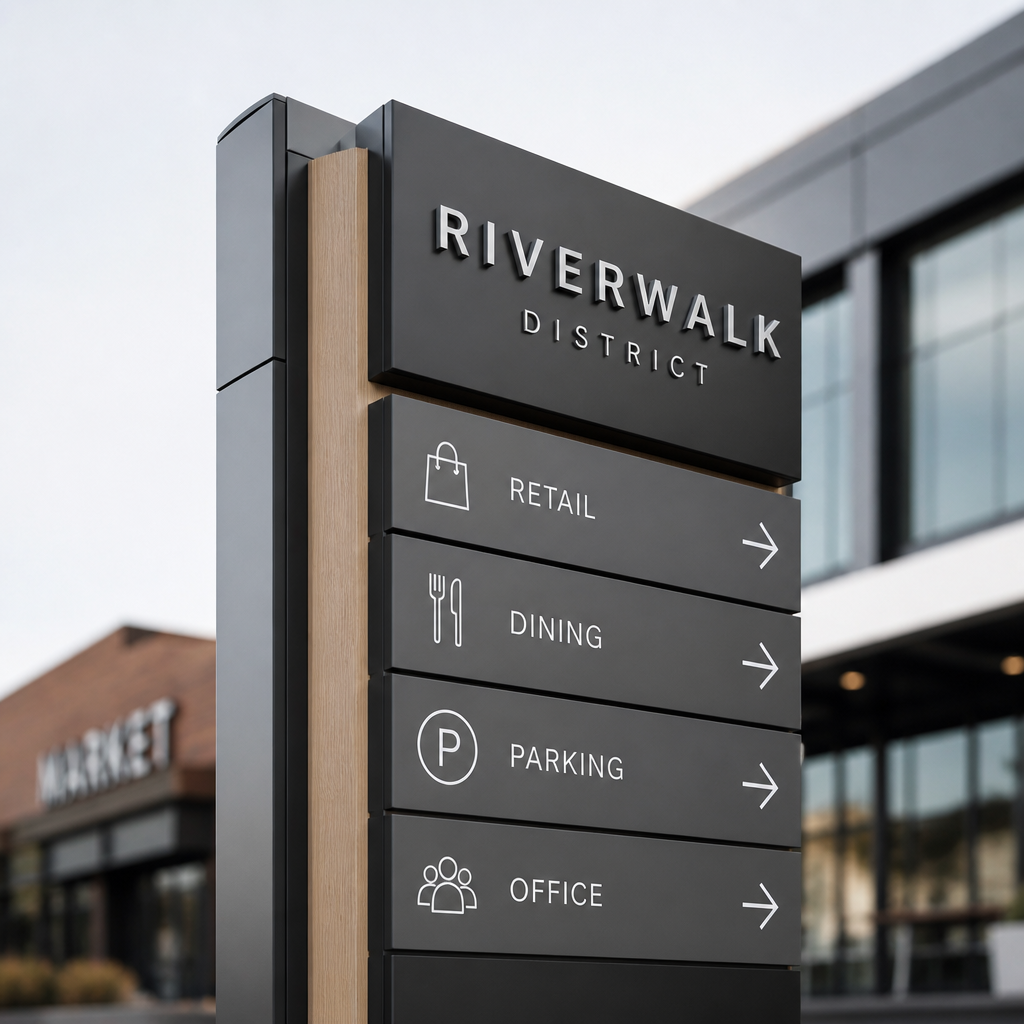
A directional pylon sign is a freestanding vertical structure whose primary job is not brand awareness. It tells a person who has already decided to visit you exactly where to go and how to get there. That is a fundamentally different task from a roadside advertising pylon, and confusing the two leads to signs that do neither job well.
Directional pylon signs can be configured for both internal and external use. A well-planned wayfinding system typically uses both: external units bring visitors from the public road to the correct entrance, and internal units guide them through parking, across a campus, or between buildings once they are on site. Any gap in that chain is a frustration point, and frustrated visitors leave or call reception for help, which is a measurable operational cost.
Effective wayfinding is not about putting up more signs. It is about placing the right message at the exact moment a person needs to make a decision, and nowhere else.
For corporate campuses, shopping centres, hotels, and event venues across Gauteng, wayfinding signage must account for multiple user types arriving simultaneously: delivery vehicles, staff, visitors, and emergency services. A professional directional pylon system segments these flows clearly so that a courier truck and a first-time client never end up competing for the same access point.
Gauteng Commercial Zones Where Wayfinding Fails
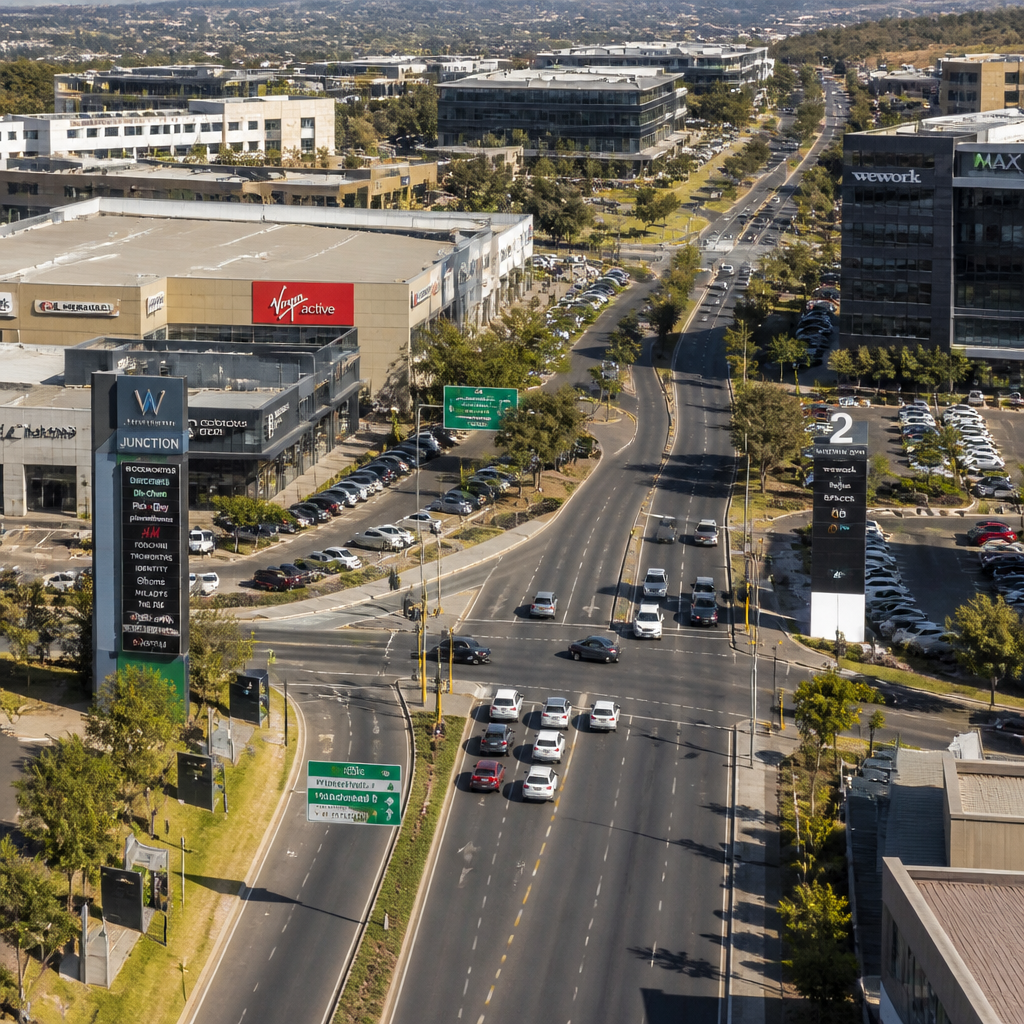
Gauteng's commercial geography creates specific wayfinding challenges that businesses in other provinces do not face at the same scale. The Sandton CBD, Rosebank, Midrand's Allandale Road corridor, Centurion, and the Woodmead retail precinct are all characterised by dense stacking of developments behind arterial roads, where properties are not directly visible from the main road and signage at the perimeter is the only thing connecting a brand to passing traffic.
Business Parks on Arterial Routes
Developments along routes such as Allandale Road in Midrand or Witkoppen Road in Fourways typically house dozens of tenants behind a single entrance. Without directional pylons specifying which businesses are accessible via which entrance, visitors default to calling ahead, often abandoning the visit entirely if the call goes unanswered. A directional pylon positioned before the entrance decision point, listing tenants by gate number or building block, removes this friction entirely.
Hospitality and Entertainment Precincts
Hotels and restaurants in the Sandton and Rosebank precincts face a specific problem: multiple venues, underground parking entrances, and valet drop-off points all competing for the same narrow street frontage. Directional pylons with illuminated arrow panels, placed at the last practical decision point for a driver, consistently reduce parking congestion and improve first impressions.
Event Venues and Temporary Configurations
Large event venues, conference centres, and outdoor festival sites in Gauteng often need temporary directional pylons that can be repositioned or swapped out between events. This is exactly the use case where rental signage solutions make financial sense, rather than purchasing a fixed configuration for a layout that changes monthly.
Pro tip: Before briefing a signage supplier, walk or drive the approach route to your premises at the speed a first-time visitor would travel. Every point where you feel uncertain about which way to turn is a location that needs a directional pylon. Document these points with photos and share them during the briefing. This saves significant revision time during the design phase.
ACM Pylon Directional Signs: Material and Construction
ACM pylon directional signs are built using aluminium composite panels: two thin aluminium sheets bonded to a polyethylene core. This sandwich construction gives the panel its primary commercial advantage, a high stiffness-to-weight ratio that allows large, flat sign faces to be fabricated without the warping, oil-canning, or panel flex that affects thinner plain aluminium sheet in outdoor conditions.
Why ACM Performs Well in Gauteng's Climate
Gauteng's Highveld climate is harder on exterior signage than it looks. Summer afternoon temperatures can push surface temperatures on dark-coloured panels well above ambient air temperature, while hailstorms in the November-to-February peak season can cause significant surface damage to inferior materials. ACM's aluminium skin handles both thermal expansion and impact stress far better than alternatives such as plain dibond or lightweight PVC foamboard, neither of which should be used for permanent outdoor pylon cladding at commercial scale.
UV degradation is the other major factor. Printing applied directly to ACM must be protected with a UV-stable overlaminate to maintain colour fidelity over a realistic five-to-seven-year service life. Vinyl graphics applied without laminate protection will chalk and fade within 18 months in Gauteng's sun exposure levels, which makes a corporate directional pylon look neglected long before it needs replacement.
Structural Considerations for Pylon Height
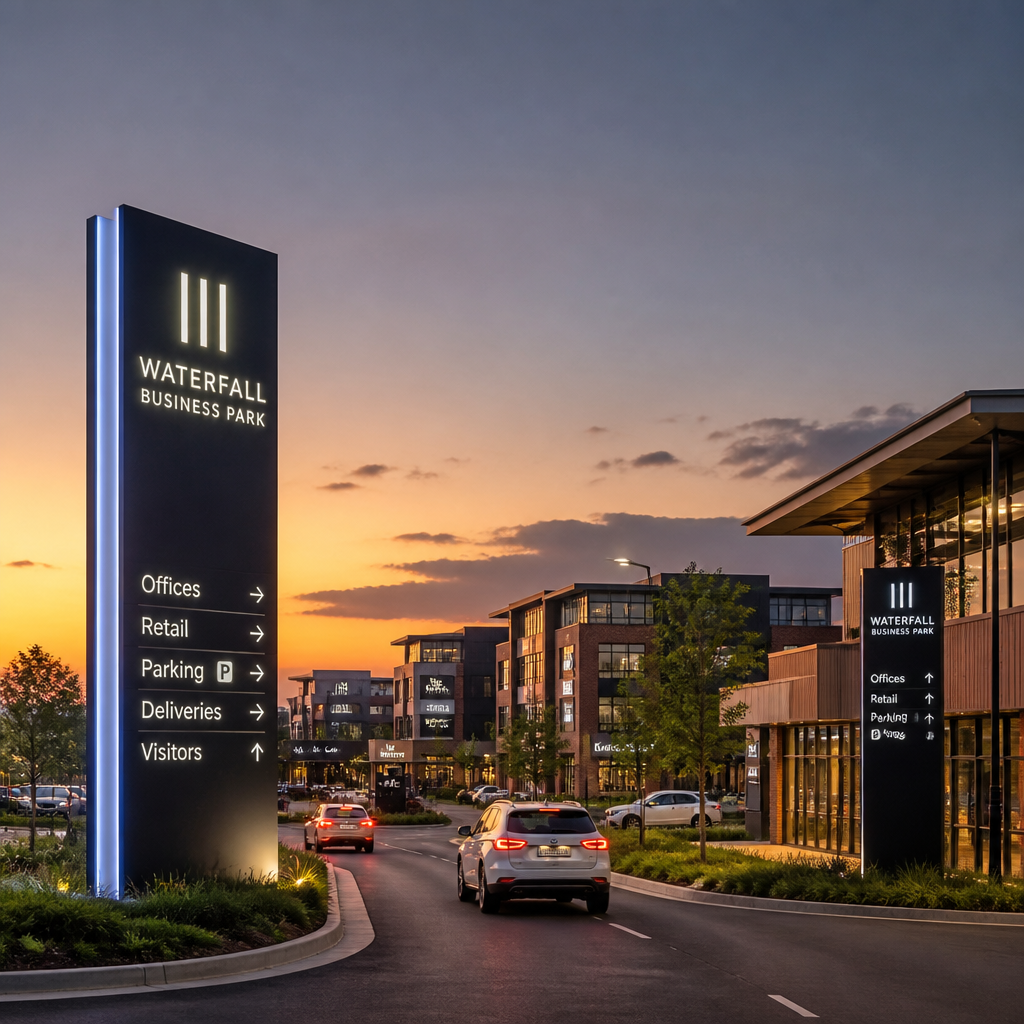
Directional pylons for commercial sites in South Africa range from compact ground-level units at around 1.5 metres, suited to pedestrian routing and parking bay guidance, up to tall roadside pylons exceeding 7 metres for high-speed arterial routes. The structural steel subframe must be engineered for the wind load associated with the panel area, not just the height. An ACM-clad pylon with a large panel face in an exposed position on a Highveld ridge requires a substantially heavier footing and frame specification than the same height structure in a sheltered courtyard.
Pro tip: Specify a hot-dip galvanised steel subframe rather than painted mild steel for any directional pylon installed outdoors in Gauteng. The cost difference is modest at the fabrication stage, but painted mild steel in an outdoor environment typically begins to show rust bleed at weld points within two to three years, creating a maintenance liability that affects the professional appearance of the sign.
Design Rules for Directional Pylon Signs
Wayfinding design is not branding design, and a common mistake is treating the two as interchangeable. A brand pylon can afford to prioritise visual impact, colour, and imagery. A directional pylon must prioritise legibility, decision-relevant information, and correct reading sequence above everything else.
Text Hierarchy and Character Count
Each directional panel on a pylon should carry a maximum of one destination name, one directional arrow, and one qualifier if necessary (such as "Staff Parking" or "Gate B"). If a panel carries more information than that, it is performing two jobs and will do both poorly. Visitors reading a pylon at speed or under stress process information top-to-bottom, left-to-right. Place the most critical decision information at eye level, not at the bottom of the panel stack.
Contrast and Legibility for South African Light Conditions
Bright midday sunlight in Gauteng creates glare and colour wash-out that dramatically reduces legibility on low-contrast sign panels. Dark backgrounds with light lettering, particularly navy on white or black on yellow, retain legibility under direct sunlight far better than pale backgrounds with medium-tone text. Avoid reversed-out text on mid-tone colours such as grey or olive green. These combinations fail legibility tests under strong sunlight even when they look acceptable on a screen or in a print proof viewed indoors.
Corporate Identity Integration
For franchise networks and corporate campuses operating across multiple Gauteng sites, every directional pylon in the system must use exactly the same typeface, colour specification, and arrow symbol style. Variation between sites, even subtle variation, degrades the professional appearance of the brand and creates confusion for frequent visitors who use the sign system as a memory aid. Specify all brand colours in both Pantone and RAL codes so that the fabricator can match them precisely across different panel production runs.
Indoor vs Outdoor Directional Pylons: Comparison
Choosing between indoor and outdoor configurations, or specifying a system that integrates both, starts with understanding what each type is built for and where each type fails when used outside its intended environment.
| Feature | Outdoor Directional Pylon | Indoor Directional Pylon |
|---|---|---|
| Primary material | ACM-clad steel frame, UV-stable vinyl or direct print graphics | Acrylic, aluminium extrusion, or ACM panels on lighter frames |
| Illumination | LED backlit panels or external spotlighting; essential for evening visibility | Ambient interior lighting usually sufficient; LED options available for prestige environments |
| Height range | 1.5 m to 7+ m depending on application and municipal permit | 1.2 m to 2.5 m for pedestrian wayfinding; ceiling-mounted variants also used |
| Panel update flexibility | Vinyl graphic replacement or interchangeable panel inserts; full replacement less common | Snap-frame inserts or slide-in panel systems allow frequent updates without full replacement |
| Typical use cases in Gauteng | Business park entrances, arterial roadside, parking approach routes, hotel drop-off zones | Office lobbies, shopping centre interiors, hospital corridors, hotel reception areas, event halls |
| Structural requirement | Engineered steel subframe with concrete footing; wind-load calculated per panel area | Floor plate or base-weighted frame; no footing required in most interior installations |
In practice, the most effective wayfinding systems for large commercial properties in Gauteng use outdoor pylons to handle approach and entry, and indoor pylons to continue the navigation journey once a visitor is inside the building or campus. Treating them as an integrated system, with a consistent visual language, produces a noticeably more professional result than specifying each independently.
Installation Planning for Gauteng Sites
Installation of directional pylon signs in Gauteng requires coordination across several practical domains: site access, underground service confirmation, municipal compliance, and, for multi-tenant properties, body corporate or landlord approval. Skipping any of these steps creates delays that are costly and, in the case of non-compliant installations, can result in removal notices from the relevant municipality.
Underground Services and Concrete Footings
Before any pylon footing is excavated, the installation team must confirm the location of underground services including electrical conduit, water pipes, and telecommunications cabling. In densely developed Gauteng commercial sites, these services are rarely mapped accurately. A site-specific dig inspection is not optional. The footing specification itself depends on the pylon height, panel area, and soil type. Clay soils common in parts of Johannesburg and Pretoria require deeper footings than sandy soils to achieve equivalent bearing capacity.
Municipal Approval for Roadside Pylons
The City of Johannesburg, City of Tshwane, and Ekurhuleni Metro each have their own advertising sign bylaws governing maximum heights, setback distances from road edges, and permissible illumination levels. These bylaws are not identical, which matters for businesses operating across multiple Gauteng nodes. A directional pylon that is compliant in a Centurion business park may require a different specification to comply with Johannesburg zoning rules on a Sandton site. A supplier with established Gauteng experience will handle this compliance process as part of the installation scope, not as an afterthought.
Rental vs Purchase for Event and Temporary Configurations
For event venues, conference facilities, and retail activations where the site layout changes regularly, rental signage solutions for directional pylons are a practical alternative to purchased fixtures. Rental configurations typically use modular base systems with interchangeable graphic panels, allowing the same structural investment to serve multiple event configurations without replacement fabrication costs. This model is particularly relevant for exhibition venues, outdoor markets, and seasonal retail activations operating across different Gauteng locations.
Pro tip: For any directional pylon installation adjacent to a road or public thoroughfare in Gauteng, request written confirmation of municipal approval before the installation date, not after. Unconfirmed installations are occasionally flagged during routine municipal inspections and can result in removal at the property owner's expense, even when the sign itself is professionally manufactured.
Frequently Asked Questions
What is the difference between a directional pylon sign and a standard pylon sign?
A standard pylon sign is primarily used for brand identification and advertising, typically facing traffic to display a business name, logo, or promotional message. A directional pylon sign is designed to guide movement, carrying destination names, arrows, distances, or gate references that help visitors navigate to a specific location. The two can be combined on a single structure, but they serve different functions and should be designed with different visual priorities.
How tall should a directional pylon sign be for a Gauteng business park?
For a roadside approach on a 60 km/h arterial road, a directional pylon needs to be readable from at least 50 to 80 metres away, which typically requires a minimum panel height of around 2 to 3 metres above the sightline of a vehicle driver. For a pedestrian wayfinding context inside a complex, 1.5 metres is generally sufficient. Heights above 4 metres on private property typically require a municipal permit in most Gauteng metros, so the practical ceiling for unpermitted installations is around 3.5 metres depending on panel area.
Why is ACM the preferred material for outdoor directional pylon signs in South Africa?
ACM (aluminium composite material) combines weather resistance, dimensional stability, and a smooth surface suitable for high-resolution printing into a panel that is lighter and easier to fabricate than solid aluminium sheet. In Gauteng specifically, ACM panels resist the UV degradation, thermal expansion cycles, and hail impact that shorter-lived materials such as PVC or unprotected mild steel face in outdoor applications. A properly manufactured ACM directional pylon with UV-stable graphics should maintain its appearance for five to seven years with minimal maintenance.
Do directional pylon signs need to be illuminated?
Not always, but for any commercial site that receives visitors or customers after sunset, illuminated directional pylons are a practical necessity rather than a luxury. Hospitality venues, restaurants, entertainment precincts, and petrol-station-adjacent retail in Gauteng all have significant after-dark traffic. An unlit directional pylon is effectively invisible at night, which means the entire investment in the sign stops working for a large portion of the day. LED backlighting is the most cost-effective and energy-efficient illumination option for directional pylon panels.
Can directional pylon signs be rented rather than purchased?
Yes, and for specific use cases rental is the smarter option. Event venues, conference facilities, and businesses undergoing renovation or temporary relocation benefit from modular directional pylon rental systems that can be repositioned and re-panelled without replacement fabrication. For permanent commercial premises, purchasing is generally more cost-effective over a three-to-five year horizon, but rental provides flexibility that a purchased fixed installation cannot match.
How do franchise businesses ensure directional pylon signs comply with their corporate identity standards?
Franchise networks should provide their signage supplier with a full corporate identity manual that specifies approved typefaces, Pantone and RAL colour codes, logo sizing ratios, and approved arrow symbol styles. The supplier should produce a design proof, often including a photomontage on an image of the actual site, before any fabrication begins. For multi-site rollouts, a pre-approved sign standard document ensures every installation across the franchise network matches, regardless of which site or city the sign is installed in.
How long does it take to install a directional pylon sign on a Gauteng commercial property?
A single outdoor directional pylon on a new footing typically requires one to two days of installation time, not including the lead time for fabrication (which is generally two to four weeks from approved design to delivery). The process includes excavating and pouring the concrete footing, allowing adequate curing time (usually a minimum of three to five days before the pylon structure is bolted into place), and applying or fitting the graphic panels. Properties requiring municipal permits should factor in an additional two to six weeks for approval, depending on the relevant municipality's current processing times.
If you have a directional signage project in Gauteng or have recently installed a pylon sign system for your business, we would love to hear what worked and what you wish you had done differently.
References
- Directional pylon wayfinding signage solutions for indoor and outdoor commercial use
- Overview of pylon sign types, sizes, and customisation options for South African businesses
- Guide to ACM aluminium composite sign construction, applications, and outdoor performance in South Africa
- Directional and wayfinding signage design and manufacture for South African commercial environments
- Pylon and directional wayfinding signage for South African business premises