


Light Box Signs South Africa: Full Specification Guide
Specifying a light box sign in South Africa looks straightforward until you receive a fabrication quote and realize the manufacturer is talking about a completely different cabinet depth, face material, or LED driver than you expected. That mismatch is expensive: rework, delayed launches, and a finished sign that washes out under Gauteng's fierce midday sun or yellows within eighteen months. This guide cuts through the confusion. Whether you are outfitting a franchise rollout, a hotel lobby, or a Sandton retail frontage, the specifications below are the ones that actually determine whether your illuminated light box survives, performs, and stays on-brand.
Table of Contents
- Quick Takeaways
- What Is a Fabricated Light Box Sign?
- Cabinet Construction and Depth Specifications
- Face Material: Acrylic vs. Polycarbonate
- LED Lighting Specifications for South African Conditions
- IP Ratings: Outdoor vs. Indoor Use
- Comparison of Light Box Sign Types
- Corporate Identity and Franchise Compliance
- Installation and Structural Requirements
- Maintenance and Lifespan Expectations
- Frequently Asked Questions
- References
Quick Takeaways
| Key Insight | Explanation |
|---|---|
| Cabinet depth affects light uniformity | A cabinet shallower than 100 mm with standard LED strips will show hot spots on the face. Minimum 105 mm depth is the practical starting point for single-sided boxes. |
| Polycarbonate outperforms acrylic outdoors | In high-UV Gauteng conditions, UV-stabilised polycarbonate resists yellowing and impact far better than standard acrylic over a five-year period. |
| IP65 is the outdoor minimum in South Africa | Gauteng's summer storms deliver intense rain and dust. An IP65-rated LED system seals against water jets and dust ingress, protecting both driver and strip. |
| DC 12V or 24V drivers are the standard | Most fabricated light box signs in South Africa use 12V or 24V DC LED strip systems, which reduce heat build-up inside sealed cabinets and simplify transformer sizing. |
| Corporate identity files must be supplied in vector format | Rasterised logos printed on translucent vinyl degrade under continuous LED backlighting. Vector artwork ensures sharp, colour-accurate output on the sign face. |
| Powder-coated aluminium is the preferred cabinet material | Aluminium extrusion profiles with powder coating resist the corrosive combination of UV radiation and Highveld humidity that degrades cheaper steel cabinets. |
| LED strip lifespan planning matters for franchise networks | Quality LED strips carry a rated lifespan of 30,000 hours or more, meaning a sign running 12 hours per day should not need re-stripping for approximately seven years. |
What Is a Fabricated Light Box Sign?
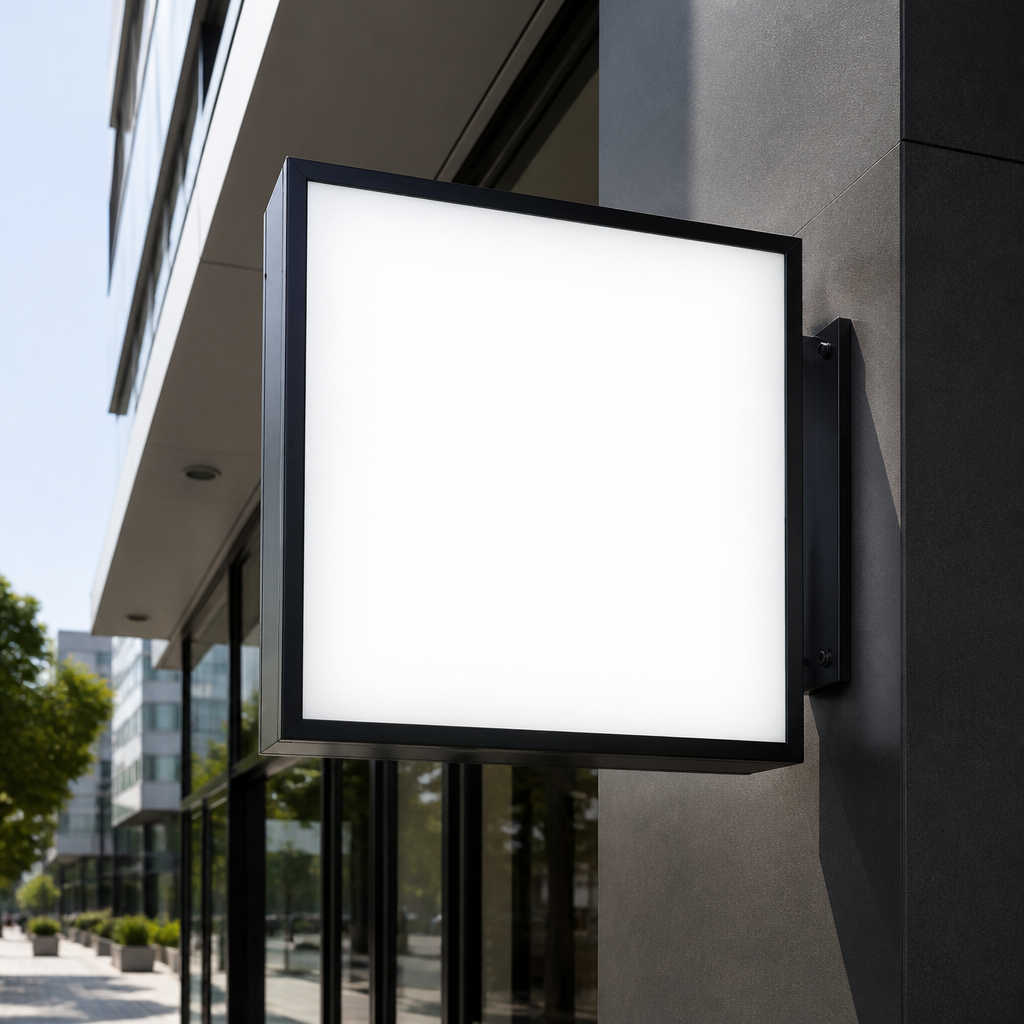
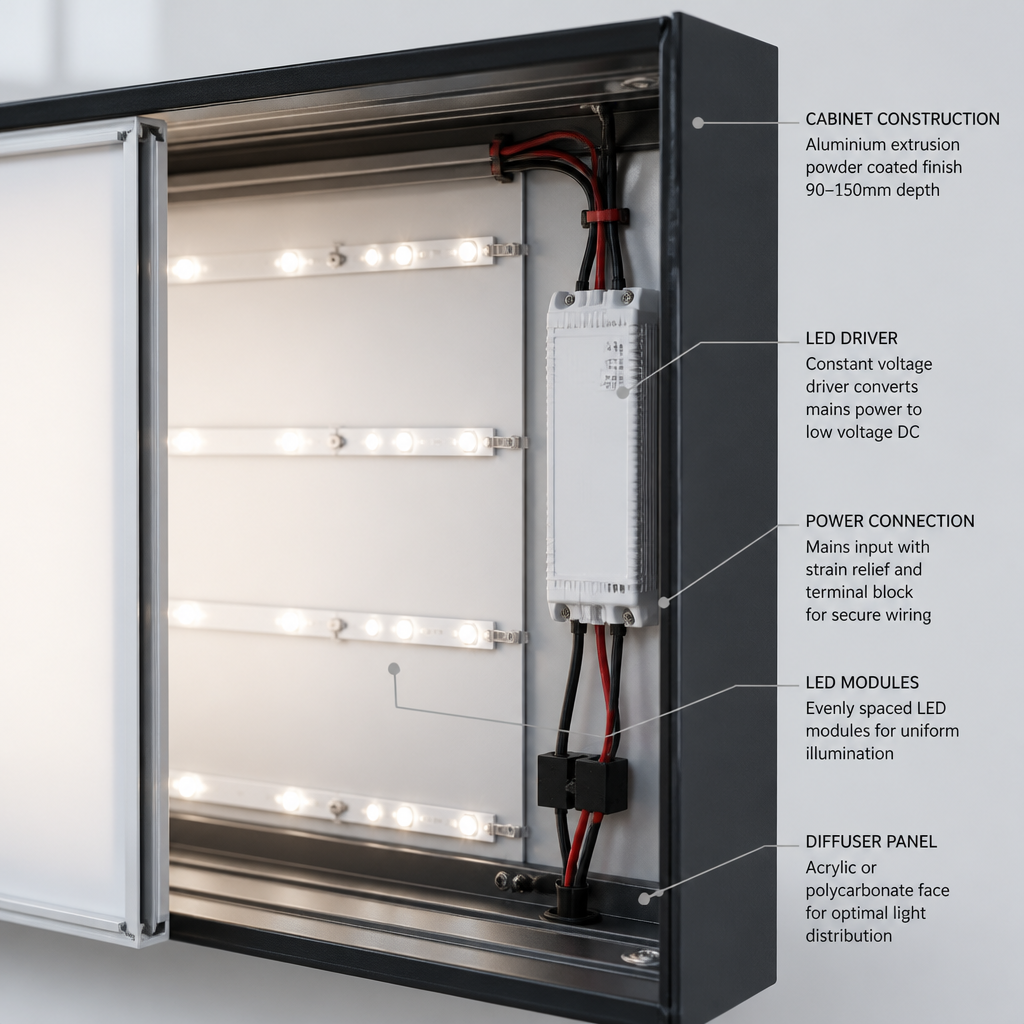
A fabricated light box sign is an internally illuminated sign cabinet consisting of a structural frame, one or more translucent faces, a lighting system, and a power supply. Unlike a flat-cut or routed sign, every component is engineered to work together: the frame holds depth for uniform light distribution, the face diffuses that light across the branded graphic, and the driver converts mains power to a stable DC voltage for the LED array.
The term "fabricated" distinguishes a custom-built cabinet from off-the-shelf snap-frame light boxes. Fabricated light box signage is made to a specified exterior dimension, chosen profile depth, and specific face material, which is why getting the specification right before manufacture is not optional. Once the aluminium extrusion is cut and welded, changing the depth costs you the entire cabinet.
In the South African commercial signage context, fabricated light boxes appear as fascia signs above retail shopfronts, as monument signs at building entrances, as menu boards in quick-service restaurants, as lobby nameplates in corporate buildings, and as internally illuminated pylon sign faces on forecourts and business parks across Gauteng.
Cabinet Construction and Depth Specifications
The cabinet is the structural backbone of any light box sign, and depth is its most consequential dimension. Too shallow and the LEDs create visible hot spots on the face; too deep and the cabinet becomes a structural problem on lightweight facades. In practice, the widely used profile sizes in the South African market start at 105 mm depth for smaller signs and step up through 120 mm and 125 mm for medium to large single-sided applications.
Frame Material and Finish
Aluminium extrusion is the correct frame material for any permanent light box installation. It is lightweight, dimensionally stable, and accepts powder coating in any RAL colour. Steel frames cost less upfront but corrode at welded joints within a few Highveld wet seasons, and the corrosion stains the face material from inside, which is impossible to fix without replacing the entire cabinet. Specify powder coating, not spray paint, for any external installation.
Anodised finishes in silver or black are also appropriate for corporate and hospitality installations where the frame itself is visible as a design element. Custom colour anodising is available but requires minimum quantity orders, so it is only practical on franchise rollouts where the same frame colour repeats across multiple sites.
Single-Sided vs. Double-Sided Cabinets
A single-sided light box has one illuminated face and a solid back panel. A double-sided cabinet has two illuminated faces, typically used on projecting blade signs or freestanding totems where visibility from both directions matters. Double-sided cabinets require a larger internal LED array and a correspondingly larger driver, so specify the orientation early. The depth on a double-sided cabinet is also slightly greater to accommodate two diffuser panels without the LED array touching either face.
Pro tip: For fascia signs wider than 1500 mm, specify an internal centre brace in the cabinet frame. Without it, the aluminium profile will bow under its own weight over time, creating a visible wave in the sign face that no amount of retensioning will fix permanently.
Face Material: Acrylic vs. Polycarbonate
The face material is what the public actually sees, and it is the component most directly affected by South Africa's climate. Gauteng sits on the Highveld at roughly 1,700 metres above sea level, which means intense UV radiation year-round and violent summer thunderstorms. That environment is genuinely harsh on sign faces.
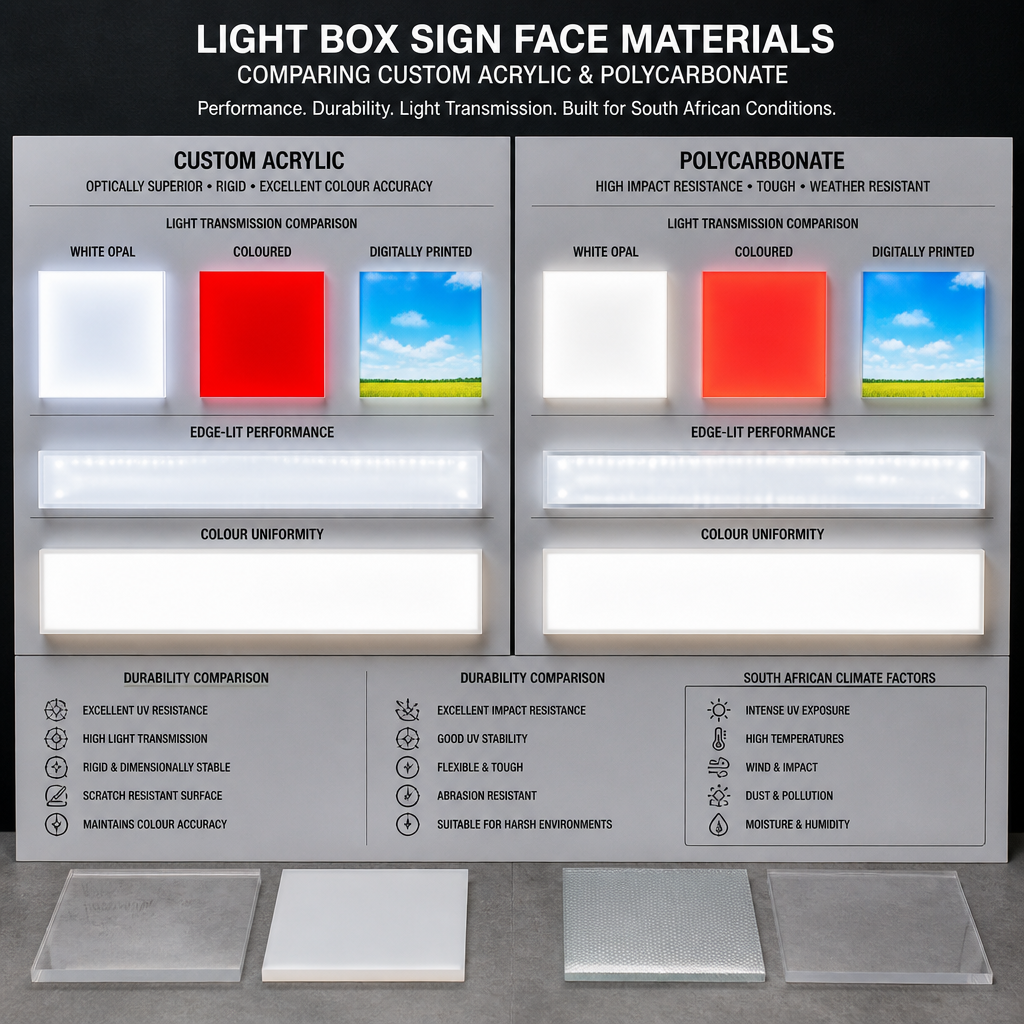
Cast acrylic (also sold as Perspex) offers excellent optical clarity and takes printed vinyl graphics well. It is the right choice for indoor light boxes in controlled environments: hotel lobbies, corporate reception areas, retail interiors. The issue outdoors is impact resistance. Standard acrylic is brittle and will crack under hail impact or if struck during installation. UV-stabilised grades perform better, but even UV-stabilised acrylic will show surface crazing on south-facing outdoor installations within three to five years under continuous LED backlighting heat.
When to Specify Polycarbonate
UV-stabilised polycarbonate is the correct outdoor face material for South African conditions. It is significantly more impact-resistant than acrylic, making it far better suited to exposed shopfronts, petrol station forecourts, and roadside pylon faces where flying debris is a real risk. It is also better suited to applications where signs may be handled repeatedly during seasonal graphic changes.
The trade-off is that polycarbonate is slightly less optically clear than cast acrylic and can be more expensive per sheet. For high-gloss brand applications where colour reproduction is critical, this difference in clarity is worth discussing with your signage fabricator before committing to the face specification. In most commercial settings, the clarity difference is imperceptible to the public from normal viewing distances.
The most common and avoidable specification error in South African commercial signage is specifying standard acrylic faces on outdoor light boxes in high-UV environments, then attributing the yellowing two years later to "poor-quality printing" rather than to the wrong material choice from the start.
Pro tip: Always ask your fabricator to confirm whether the polycarbonate or acrylic sheet specified is a UV-stabilised grade. Non-stabilised clear sheet is cheaper to buy but will yellow visibly within 12 to 18 months under continuous LED backlighting in Gauteng conditions. A single line on the spec sheet stating "UV-stabilised grade" protects your installation warranty.
LED Lighting Specifications for South African Conditions
The LED system inside the cabinet determines brightness, uniformity, energy consumption, and lifespan. This is the area where cheap fabrication is most visible, literally. An underpowered LED array produces a dim, uneven face that cannot compete with ambient daylight. An incorrectly driven LED strip overheats inside a sealed cabinet and fails within months.
Voltage and Driver Specification
The South African standard mains supply is 230V AC at 50 Hz. LED strip systems for light boxes run on DC 12V or DC 24V. This means every light box installation requires a driver (also called a transformer or power supply) to step mains voltage down to the correct DC level. The driver must be sized for the total wattage of the LED load, with a minimum 20% headroom above the calculated load to avoid the driver running at full thermal capacity, which shortens its lifespan significantly.
In practice, a 24V system is preferable for runs longer than 5 metres within a single cabinet because voltage drop across long LED strip runs is lower at 24V, which means more consistent brightness from one end of the sign to the other. For smaller cabinets under 1 metre, 12V systems work perfectly well and offer a wider range of compatible LED strip products locally.
Colour Temperature and CRI
Neutral white at 4000K to 4500K is the standard colour temperature for general commercial light box signage. It renders brand colours accurately without the yellow cast of warm white (3000K) or the clinical harshness of cool white (6500K). A Colour Rendering Index (CRI) above 80 is the minimum for any installation where printed vinyl graphics are part of the sign face. Below CRI 80, brand colours shift perceptibly under the backlight, which is a real problem for franchise operators managing strict colour standards.
For high-end corporate reception signage or hospitality environments where colour precision is specified in the brand guide, specify CRI 90 or above. The cost difference per strip metre is modest; the impact on finished sign quality is significant.
IP Ratings: Outdoor vs. Indoor Use
The Ingress Protection rating tells you how well the LED components are sealed against solid particles and water. This is not a cosmetic specification. In South Africa's outdoor environment, the wrong IP rating means water-damaged LED drivers and failed strips within one rainy season.
The two-digit IP code works as follows: the first digit covers protection against solid particles, the second against water. IP20 means protected against finger-sized solids and no water protection, making it suitable only for fully sealed indoor cabinets where there is zero moisture risk. IP65 means the component is dust-tight and protected against direct water jets from any direction, which is the practical minimum for any outdoor light box installation in South Africa. For forecourt or coastal applications, IP67 or IP68 provides submersion protection as an additional margin.
A common mistake is specifying IP65 for the LED strip but fitting an IP20 driver inside the same outdoor cabinet without adequate drain holes and ventilation. The driver fails from condensation long before the strip does. Specify the IP rating for the entire lighting system, not just the strip.
Pro tip: For outdoor installations in Gauteng, specify drain holes at the lowest point of the cabinet and a ventilation gap at the top. A sealed outdoor cabinet with no ventilation accumulates condensation during the temperature swing between a hot summer day and a cool Highveld evening. That moisture destroys drivers and corrodes LED strip connectors from the inside.
Comparison of Light Box Sign Types
Not all light box formats suit the same application. The three most common types used in South African commercial signage each have distinct structural and specification requirements.
| Sign Type | Best Application | Key Specification Considerations |
|---|---|---|
| Fascia / Flush-Mounted Light Box | Retail shopfronts, franchise outlets, hotel entrance signage | Cabinet depth 105-125 mm, single-sided, powder-coated aluminium frame, UV-stabilised polycarbonate face for outdoor, translucent vinyl graphic, IP65 LED system |
| Projecting / Blade Light Box | Side-street visibility, shopping centre corridors, restaurant and hospitality signage | Double-sided cabinet, structural steel bracket to building wall, minimum 150 mm cabinet depth, twin LED arrays, wind-load calculation required for projecting arm length |
| Pylon / Totem Light Box Face | Business park entrances, forecourts, roadside identification | Internally illuminated panel within a structural pylon frame, large-format polycarbonate face, high-output LED array for daytime visibility, separate IP-rated driver enclosure at base |
Corporate Identity and Franchise Compliance
For corporate clients and franchise operators, a light box sign is not just a product, it is a branded asset that must match specifications set by a head office or corporate identity (CI) manual. A sign that looks great in isolation but uses the wrong Pantone equivalent, wrong font size, or wrong background colour is a compliance failure, regardless of its fabrication quality.
Translucent Vinyl Colour Matching
The most technically demanding part of franchise light box compliance is colour matching on translucent vinyl films. A solid-colour vinyl that looks correct in daylight may shift dramatically when backlit with white LEDs. Reputable fabricators use translucent vinyl formulated for backlit applications, and they test a printed sample against the live LED array before committing to the full print run. Insist on a physical colour approval sample before full production on any franchise rollout.
The colour temperature of the LED array directly affects how the translucent vinyl reads. A 4000K neutral white is the standard reference point for most CI manuals developed in the past decade. If the CI manual specifies Pantone colours for illuminated signs, confirm with your fabricator that the print profile is calibrated for a 4000K backlight. Running a 6500K cool white behind a Pantone-matched print will shift reds toward orange and blues toward cyan.
Artwork Specification Requirements
Vector artwork in AI or PDF format is non-negotiable for light box sign production. Rasterised artwork, even at 300 DPI, will show pixelation when printed at the large formats typical of shopfront fascia signs and then backlit. The backlight amplifies any imperfection in the graphic because the entire face glows; defects that are invisible on a non-illuminated print become obvious when the LEDs are on.
For franchise rollouts with multiple sites, supply a single locked artwork file rather than allowing individual sites to supply their own variations. Even minor unauthorised changes accumulate across a network and erode brand consistency faster than any other single factor.
Installation and Structural Requirements
The specification does not end with the sign cabinet. Installation requirements determine whether a well-fabricated light box sign actually looks right and stays up safely. This is an area where cutting corners creates both aesthetic and liability problems.
For fascia signs mounted above shopfronts, the wall or shopfront structure must be assessed for load-bearing capacity before installation. A large aluminium cabinet with a full-colour polycarbonate face can weigh substantially more than it looks, particularly on double-sided projecting installations. In South Africa, local municipal regulations in Gauteng and other metros require that signage above a certain size be accompanied by a structural engineer's approval. Failure to obtain this approval creates both a compliance issue and an uninsured liability if the sign fails.
Electrical connections must be carried out by a registered electrician and the installation must comply with SANS 10142-1, which governs the wiring of electrical installations in South Africa. A Certificate of Compliance (CoC) should be issued for every mains-connected sign installation. Property managers, shopping centre landlords, and franchise property teams will increasingly request this documentation as standard.
Maintenance and Lifespan Expectations
A well-specified and properly installed light box sign requires relatively little maintenance, but "relatively little" is not the same as "none." Setting realistic lifespan expectations from the start of a project prevents both disappointment and budget surprises later.
Quality LED strips used in fabricated light box signage are rated for a lifespan in the range of 30,000 hours. At 12 hours of operation per day, that equates to roughly 6.8 years before the strips reach their rated lumen depreciation point. In practice, the first component to fail in a well-maintained outdoor cabinet is usually the driver, not the LED strip, because drivers accumulate thermal stress more quickly in sealed, warm environments. Specifying a quality driver from the outset and ensuring adequate cabinet ventilation are the two most effective maintenance-cost reduction measures.
The translucent vinyl face graphic has a shorter practical lifespan than the LED system in high-UV outdoor installations. Plan for graphic replacement every three to five years on outdoor South African installations as part of the total cost of ownership, not as an unexpected failure. This is particularly important for franchise operators: a faded or cracked face graphic on one outlet damages the brand perception of the entire network.
Cabinet cleaning on outdoor light boxes is a simple task: wipe the polycarbonate face with a mild soap solution and a soft cloth, never with solvent-based cleaners or abrasive materials, which scratch the face and accelerate UV degradation. Internal cleaning, including removal of insect debris from around the LED array, should be done annually on outdoor installations in areas with high insect activity, which is most of Gauteng in summer.
Frequently Asked Questions
What is the difference between a light box sign and an LED-backlit sign?
In everyday use, the terms are interchangeable for most commercial applications. Technically, all modern fabricated light box signs use LED backlighting. The term "LED-backlit sign" simply emphasises the light source, while "light box sign" refers to the entire cabinet assembly. Fluorescent tube light boxes still exist in older installations but are no longer fabricated for new projects in South Africa, as LED systems are more energy-efficient, produce less heat inside the cabinet, and last significantly longer.
How do I specify the correct LED brightness for a South African outdoor light box?
Outdoor light boxes in South Africa need to be visible in direct Highveld sunlight, which is considerably brighter than conditions in temperate climates. As a practical guideline, specify a high-output LED strip with an efficacy of at least 100 lm/W for outdoor fascia signs. Your fabricator should be able to confirm the total lumen output of the proposed LED array relative to the face area of the sign cabinet. Underpowered arrays look vivid at night but wash out completely during the day, which defeats the purpose of an illuminated sign.
Do light box signs in South Africa need municipal approval?
Yes, in most cases. Gauteng municipalities, including the City of Johannesburg and the City of Tshwane, have signage by-laws that regulate the size, position, and illumination of commercial signs. Signs above certain size thresholds require a formal application and approval before installation. Your signage provider should be familiar with the relevant local authority requirements for your specific location. Non-compliant signs can be ordered removed at the property owner's expense, so this is not a step to skip in the interest of saving time.
How long does fabrication of a custom light box sign take in Gauteng?
Lead times vary by complexity, but a straightforward single-sided aluminium light box with a printed face typically takes between two and four weeks from confirmed artwork approval to delivery and installation readiness. Large-format pylon faces or complex double-sided projecting signs with structural components may take four to six weeks. The most common cause of fabrication delays is late or incomplete artwork supply, not manufacturing capacity, so supplying confirmed, approved vector artwork promptly after order placement is the most effective way to protect your installation timeline.
What is the correct IP rating for an illuminated light box sign in a South African outdoor environment?
IP65 is the recommended minimum for all outdoor light box LED components in South Africa. This rating ensures dust-tight protection and resistance to water jets from any direction, covering the intense summer rainfall conditions typical of Gauteng. For installations in particularly exposed environments, such as forecourts, coastal regions, or areas prone to flooding, IP67 provides an additional margin of safety. Apply the IP rating consistently to both the LED strip and the driver, not just one component.
Can the graphic on a light box sign be changed without replacing the entire cabinet?
Yes, and this is one of the practical advantages of a well-designed fabricated light box. The standard design allows the face panel to be removed by an installation technician, the existing translucent vinyl graphic to be stripped and replaced with a new print, and the face to be refitted. This makes light boxes particularly suitable for retail environments where promotions change seasonally and for franchise operators who need to update CI across multiple sites simultaneously. The caveat is that low-quality cabinet designs with glued faces rather than removable panel systems are far more expensive to regraphic, so specify a removable face design from the outset if you anticipate future graphic changes.
We would love to hear your experience with light box signage projects in South Africa. Share your questions, specification challenges, or installation wins in the comments below.
We would love your feedback and any insights you would share with others. What perspective would you add?
References
- Custom light box signage specifications and profile options for South African commercial applications
- Lightbox sign types, IP ratings, and material specifications for Gauteng installations
- LED rigid strip selection guide covering voltage, IP rating, efficacy, and lifespan specifications
- Light box signage fabrication and material specifications from a Johannesburg sign manufacturer
- IP rating guidance for outdoor electrical installations in South African weather conditions