


Signage Compliance South Africa: Municipal By-Laws Guide
Getting your business signage removed by a municipality is not just embarrassing. It costs you money on fabrication, installation, and permit fees that you cannot recover, and in Johannesburg alone, enforcement revenue from non-compliant outdoor advertising jumped from roughly R5 million in 2024 to roughly R50 million in 2025 as cities ramped up their inspections. If you are a franchise owner, retail manager, or corporate property manager operating anywhere in South Africa, signage compliance is not a bureaucratic nicety. It is a direct cost of doing business, and the rules differ meaningfully from one municipality to the next. This guide breaks down the national framework, the Gauteng-specific picture, and the practical steps every business needs to follow before a single sign goes up.
Table of Contents
- Quick Takeaways
- The National Framework: SAMOAC and Constitutional Authority
- Signage By-Laws in Gauteng: Johannesburg and Tshwane
- Sign Types and Their Specific Restrictions
- Corporate Identity and Franchise Signage: A Special Challenge
- The Permit Application Process Step by Step
- Compliance Approaches: Which Route Works for Your Business
- What Happens When You Do Not Comply
- Frequently Asked Questions
- References
Quick Takeaways
| Key Insight | Explanation |
|---|---|
| Every municipality sets its own rules | South Africa has no single national signage permit. Each metropolitan and local municipality issues its own outdoor advertising by-law under the constitutional authority granted to local government. What is permitted in one city may be prohibited in the next. |
| SAMOAC is the common policy foundation | The South African Manual for Outdoor Advertising Control (SAMOAC), published by the national Department of Environmental Affairs and Tourism, is the guiding framework that most municipalities adopt when drafting their by-laws. Understanding SAMOAC helps you predict how any municipality will assess your application. |
| Corporate and franchise signage is not exempt | Brand standards do not override municipal by-laws. Franchise and corporate identity signage, regardless of whether it follows a national template, must still comply with every local rule on size, placement, illumination, and construction. |
| Tshwane promulgated a new by-law in June 2024 | The City of Tshwane's Outdoor Advertising By-law 2024 replaced the previous 2006 by-law. If your business is in Pretoria or any surrounding Tshwane municipal area, your older approvals may no longer be valid under the updated rules. |
| Signs on a property must relate to that property's business | Across most South African municipalities, outdoor signs may only advertise the business operating on the same property. Advertising unrelated products or third-party brands from your premises requires separate third-party sign approval, which is subject to stricter controls. |
| Some sign types never need a permit | Most by-laws define categories of exempt signs, such as small window signs on a ground-floor shopfront below a certain size threshold. Knowing what is exempt saves time and application fees, but the exemption criteria are specific and must be checked against your exact municipality's current by-law. |
| Non-compliance triggers removal orders, not just fines | Municipalities can order the removal of a non-compliant sign at the owner's cost, on top of issuing fines. You may lose both the sign and the money spent installing it, with no recourse unless you obtained prior written approval. |
The National Framework: SAMOAC and Constitutional Authority
South Africa's signage regulatory environment is built on a constitutional principle: section 156 of the Constitution grants municipalities the authority to make and administer by-laws for the effective administration of matters within their jurisdiction. Outdoor advertising is squarely within that local authority. This means there is no single national "signage permit" that covers the entire country, and any business operating across multiple provinces or towns must deal with each municipality separately.
The practical glue that holds the system together is SAMOAC, the South African Manual for Outdoor Advertising Control, published by the national Department of Environmental Affairs and Tourism. Most municipalities explicitly state in their by-laws that SAMOAC is the underlying policy framework. This means that even when the exact wording of a by-law differs between, say, Johannesburg and a smaller local municipality, the conceptual categories, the sign typology, and the underlying criteria for approval are broadly consistent. If you understand SAMOAC's logic, you can read any new by-law faster and predict how an application officer will assess your submission.
SAMOAC classifies areas into control zones, broadly ranging from maximum control zones (heritage areas, scenic routes, residential zones) through partial control zones to minimum control zones (commercial and industrial areas). The zone classification of your property determines which sign types are permitted, what sizes are allowed, and what illumination is acceptable. Getting this zone classification confirmed before you design your signage is the single most important early step.
A sign that meets every technical specification on paper can still be refused if it is placed in the wrong control zone. Zone classification must be confirmed before the design brief is written, not after the fabricator has already started production.
Pro tip: When approaching a new municipal area, request a copy of the municipality's current outdoor advertising by-law and its zoning map before engaging a designer. This is public information and can usually be obtained directly from the municipality's planning department. It takes a few days to acquire but saves weeks of rework later.
Signage By-Laws in Gauteng: Johannesburg and Tshwane
For businesses operating in Gauteng, which covers the majority of SignShopper's core service area, two metropolitan municipalities dominate the regulatory landscape: the City of Johannesburg and the City of Tshwane. Both operate under independently promulgated by-laws, and both have updated their frameworks in recent years.
City of Tshwane: The 2024 By-Law
The City of Tshwane promulgated a new Outdoor Advertising By-law on 26 June 2024, replacing the previous 2006 by-law in its entirety. This is not a minor amendment. Businesses in Pretoria and the surrounding Tshwane municipal area that operate under approvals issued under the 2006 framework need to assess whether their existing signs and structures still meet the new requirements.
The 2024 Tshwane by-law covers application processes, safety requirements, amenity and decency standards, sign construction and design specifications, offences and penalties, and the categories of signs permitted on private property versus in public areas. It also applies to signage visible from national and provincial highways within the municipal jurisdiction. The city has also stated that the revised by-law is intended to improve its ability to generate income through rental and application management, which is a clear signal that enforcement activity will increase, not decrease.
Under Tshwane's rules, no person may erect, distribute, maintain, or display a sign visible from any public space without obtaining consent from the relevant municipal authority. The scope is wide: it applies to all properties within the Tshwane municipal area regardless of whether the property is owned or managed by a private party or another sphere of government.
City of Johannesburg: Key Requirements
The City of Johannesburg's outdoor advertising by-law similarly requires that the owner of an advertising sign ensure it does not detract from the architecture of the building on which it is placed, does not obstruct previously erected signs, and does not create safety hazards. Johannesburg also distinguishes between on-premises signs (advertising the business at that address) and third-party signs (advertising something unrelated to the property). Third-party signs face significantly stricter controls and separate approval channels.
A common mistake among Johannesburg business owners is assuming that paying rental to a property owner gives them the right to erect a sign on that property. It does not. Any advertising must be separately approved by the city for by-law compliance, and this approval sits with the municipality, not the landlord. This distinction becomes especially relevant for franchise tenants who need to install corporate identity signage as a condition of their franchise agreement.

Sign Types and Their Specific Restrictions
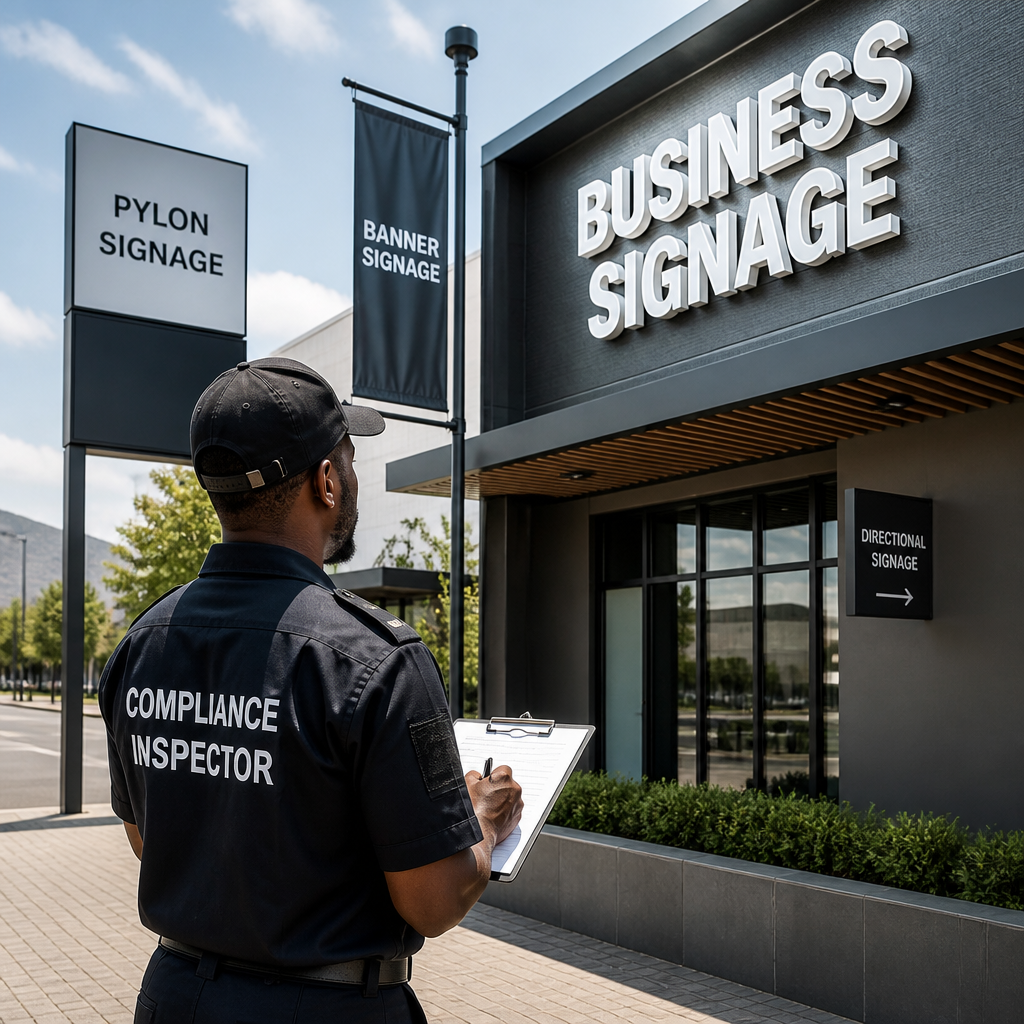
South African by-laws categorise signage into specific types, and each type carries its own rules. Understanding where your planned sign falls in this typology is essential before submitting any application. Getting the category wrong on your application form is one of the most common reasons for delays.
Pylon Signs and Freestanding Structures
A pylon sign is defined in most South African by-laws as a structure designed solely for advertising purposes, supported independently from any building, to which an advertising sign is attached or displayed. Pylon signs are among the most heavily regulated sign types because of their visual impact and structural requirements. Height limits, setback distances from road boundaries, and illumination rules all apply, and these specifications vary between municipalities. In partial and maximum control zones, pylon signs may be refused outright regardless of design quality.
Window Signs
Window signs are treated more permissively in most by-laws. A window sign displayed on the ground floor of a commercial building and below a certain size threshold is often classified as an exempt sign that does not require a formal permit. However, a permanent sign displayed inside a building within two metres of a window, visible from the street, is typically classified as a window sign for regulatory purposes and may still fall under by-law control even if it is technically inside the building.
Building-Mounted and Fascia Signs
Building-mounted signs, including fascia signs on shopfronts and channel lettering on building facades, must not exceed the extremities of the building's outside walls, and most by-laws prohibit them from projecting above the top of the building. The height from natural ground level at which such a sign may be placed is also regulated. Illuminated fascia signs and LED-backlit signage face additional requirements around brightness intensity to prevent driver distraction and light pollution in residential zones.
Prohibited Sign Locations
Several location categories are explicitly prohibited across most South African by-laws regardless of sign type or quality. Signs on towers, cooling towers, water towers, telecommunication masts, and pylons (the utility infrastructure type) are not permitted. Signs on or over bridges are prohibited except in very specific temporary event circumstances with written road authority approval. No sign may be placed within a power line servitude without the permission of the relevant authority. These prohibitions are non-negotiable and no amount of creative application will overcome them.
Pro tip: Before commissioning fabrication of any building-mounted sign, obtain a written confirmation from the municipality that your proposed sign falls within the permitted height above ground level and does not project beyond the building envelope. This written confirmation becomes your defence if an enforcement officer questions the installation later.
Corporate Identity and Franchise Signage: A Special Challenge
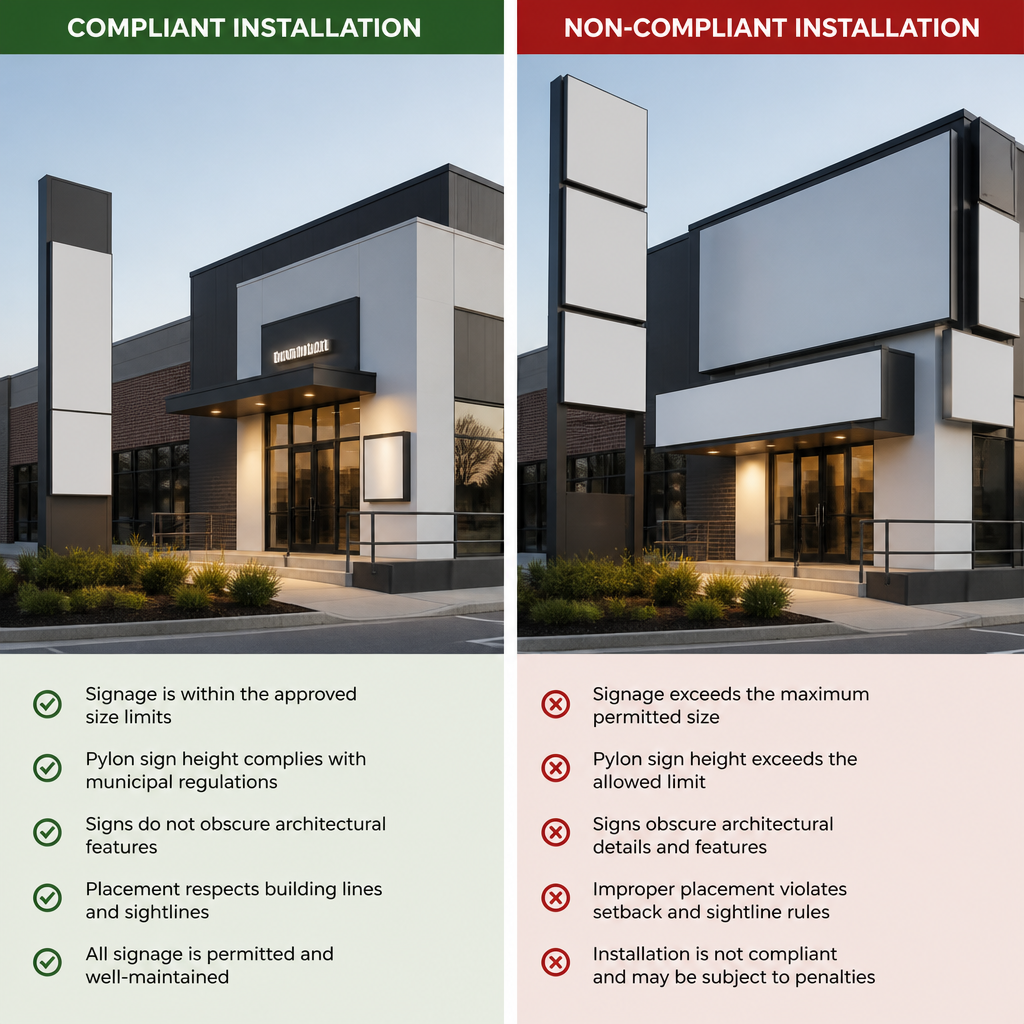
Franchises and national corporate groups face a specific tension that independent retailers do not. The franchise agreement or corporate identity manual typically specifies exact dimensions, colours, materials, and illumination standards for all signage. The municipality, independently, specifies what it will and will not approve. These two sets of requirements do not always align, and the municipality's rules will always take precedence.
South African by-laws are explicit on this point. Corporate signage, defined across multiple South African municipal by-laws as "trademark, brand-name, franchise and similar signage where only a specified range of signage is available to the proprietor of an enterprise," must comply with the provisions of the by-law just as any other sign must. Brand standards do not create an exemption. The fact that a franchisor specifies a particular LED pylon sign of a particular height does not mean the franchisee can install it at a location where that height exceeds the municipal limit.
In practice, this creates a situation where a franchise owner in Johannesburg may be permitted to install a sign that would be refused at the same chain's outlet in Tshwane or in a smaller Gauteng municipality, purely because of the difference in local by-laws. Working with a signage provider who understands both the brand standards and the local regulatory requirements is the only reliable way to navigate this tension without getting caught between the franchisor's demands and the municipality's enforcement officers.
The rules also require that signs on a property may only relate to the business operated on that property and the products processed, produced, or sold from that property. For a franchise tenant in a shopping centre, this typically means your signage must reference your own brand and offer, not other brands or services you do not directly provide on those premises.
The Permit Application Process Step by Step
The permit application process is broadly consistent across South African municipalities, though the specific forms, fees, and processing times differ. Understanding the general flow prevents the most common and costly mistakes.
Step 1: Confirm Your Zone Classification
Contact the municipality's planning or outdoor advertising department and confirm the control zone classification for your property address. Do this before anything else. The zone determines everything that follows: which sign types are available to you, the maximum dimensions, and whether illumination is permitted at all.
Step 2: Prepare Your Application Package
A complete application typically requires scaled drawings showing the sign's dimensions and positioning relative to the building and the road boundary, photographic montages showing the proposed sign in context, structural engineering certification for freestanding or large building-mounted signs, and details of the sign's construction materials and illumination type. Incomplete submissions are the primary reason for delays. Applications are often returned without assessment rather than assessed with missing information included.
Step 3: Pay the Application Fee and Submit
Every municipality charges an application fee. The fee is non-refundable regardless of whether approval is granted. Some municipalities, including the City of Tshwane, also charge ongoing monitoring or approval fees for third-party signs once approval is granted. Budget for both the initial application fee and any ongoing charges when calculating your signage project cost.
Step 4: Do Not Install Until Written Approval is in Hand
This is the point where the most costly mistakes happen. Verbal assurances from a planning official, confirmation that an application has been received, or even a long period of silence with no objection raised does not constitute approval. Installation before written approval is in hand exposes you to removal orders and fines, with no defence available. The fabrication and installation cost is lost.
Step 5: Keep Your Approval on File and Check Renewal Requirements
Some sign approvals are granted for a fixed period and require renewal. The Tshwane 2024 by-law provisions, for example, include conditions around further approval periods. Check whether your approval has an expiry date and set a calendar reminder at least three months before it lapses. Operating a sign after its approval has lapsed is treated the same as operating without approval.
Compliance Approaches: Which Route Works for Your Business
Businesses typically take one of three approaches to managing signage compliance. Each has real trade-offs that are worth understanding before committing to a method.
| Approach | What It Involves | Best Suited For |
|---|---|---|
| In-house management | Your own team handles zoning research, application preparation, submission, follow-up, and renewal tracking across all sites. Requires someone with dedicated time and a working knowledge of each municipality's current by-law. | Large corporates with a dedicated facilities or property management team operating in a small number of municipalities they know well. |
| Specialist signage provider with compliance expertise | Your signage fabricator and installer handles the regulatory side as part of the project scope, confirming zone classification, preparing application documents, and liaising with the municipality on your behalf. Design, compliance, fabrication, and installation are coordinated in one workflow. | Franchises and multi-site businesses that need consistent corporate identity standards applied across different municipalities without compliance failures. Reduces the risk of fabricating a sign that cannot be approved. |
| Retrospective compliance after installation | The sign is installed and the business then attempts to obtain approval after the fact, or simply operates without ever applying. This is common among businesses that are unaware of the requirement or that underestimate enforcement risk. | No business should choose this deliberately. Municipalities treat unauthorised signs as a compliance failure regardless of how long they have been in place, and enforcement has been increasing across Gauteng cities in 2025 and 2026. |
The specialist signage provider route offers the clearest risk management for most commercial clients, not because it outsources accountability, but because it integrates regulatory knowledge into the design and production process from the start. A sign that is designed with the municipal approval criteria in mind from day one is far more likely to be approved quickly and installed without incident than one that is designed to a brand manual and then adjusted to fit whatever the municipality will accept.
What Happens When You Do Not Comply
The consequences of non-compliance with South African business sign regulations are concrete and well-established. They are not limited to fines. Municipalities have the authority to require the removal of any non-compliant sign, and they can require that removal to be carried out at the sign owner's cost. In practice this means losing both the sign and the money spent on its design, fabrication, and installation.
Joburg's enforcement experience in 2025 provides a useful illustration of how seriously municipalities are now taking this: enforcement revenue from outdoor advertising by-law enforcement rose from roughly R5 million in the prior year to roughly R50 million. The increase reflects both increased enforcement activity and the scale of non-compliance that existed in the market. That enforcement pressure has not eased and is unlikely to ease given that municipalities have identified outdoor advertising compliance as a meaningful revenue stream.
Beyond fines and removal orders, non-compliant signage creates ongoing liability. An illuminated sign erected without structural certification or approval that subsequently fails and injures a member of the public creates a direct legal exposure for the business owner. The absence of municipal approval also typically voids any insurance coverage for the structure.
The path back from non-compliance varies by municipality. Some allow an owner of an unauthorised sign to either obtain approval retrospectively, cease erection, or remove the sign. Others apply an administrative penalty as a precondition of any retrospective approval process. Neither option is cheap, and neither recovers the cost of the original fabrication if the sign ultimately cannot be approved in its current form.
Pro tip: If you are taking over a premises where signage was already installed by a previous tenant, do not assume the existing signs are approved. Request copies of the approval documentation from the landlord or the municipality before you take responsibility for those structures. Inherited non-compliant signage becomes your legal exposure from the moment you occupy the property.
Frequently Asked Questions
Do I need a permit for every sign on my business premises?
Not necessarily. Most South African municipal by-laws include categories of exempt signs that do not require a formal application. Small window signs on the ground floor of a commercial building are commonly exempt if they fall below a specified size threshold. However, exemptions are specific and must be checked against the current by-law for your exact municipality. The safest approach is to verify the exemption criteria in writing with your municipality before assuming a permit is not needed. If the sign is illuminated, larger than a shopfront window, or freestanding, assume a permit is required until confirmed otherwise.
My franchise agreement specifies exact sign dimensions. What happens if those dimensions exceed the municipal limit?
The municipal by-law takes precedence. Your franchise agreement is a private contract, and no private contract can override a public law. You will need to discuss the conflict with your franchisor, present the municipal limitations in writing, and negotiate whether a compliant alternative sign design is acceptable under the franchise agreement. Most major franchise groups have a process for handling these situations, particularly in South Africa where by-law variation between municipalities is well known. A signage provider with experience in both franchise corporate identity and municipal compliance can help you document the specific constraints for each site.
How long does the permit application process take in Gauteng municipalities?
Processing times vary by municipality and by the complexity of the application. Simple on-premises building-mounted signs with complete application documentation generally move faster than freestanding or third-party sign applications. In practice, you should budget at least four to eight weeks for a standard application in a major Gauteng metro, and longer for signs in heritage, conservation, or special control zones. Do not start fabrication until you have written approval in hand. Shortcutting this timeline is how businesses end up with fabricated signs they cannot legally install.
What is a third-party sign and why does it face stricter rules?
A third-party sign is any sign that advertises a product, service, or brand unrelated to the business operating on the property where the sign is placed. Billboard structures carrying advertising for multiple brands, for example, typically fall into this category. South African municipalities apply stricter controls to third-party signs because they are primarily commercial advertising vehicles rather than business identification. Most by-laws restrict third-party signs to minimum control zones such as commercial and industrial areas, require separate and more detailed applications, and may charge ongoing monitoring fees in addition to the initial application fee.
Can I use LED-backlit or illuminated signs in all zones?
No. Illumination of signage is a controlled variable in most South African by-laws. Electronic signs, including LED-backlit and internally lit signs, may be restricted or entirely prohibited in maximum control zones such as residential areas, heritage precincts, and scenic routes. Even in commercial zones, by-laws typically specify requirements around intensity of illumination to prevent driver distraction and light pollution. Some by-laws also restrict electronic signs that are visible from specific road classifications. Before specifying any illuminated sign product, confirm whether illumination is permitted in your zone and whether there are intensity or animation restrictions that apply.
What should I do if my existing sign receives a removal notice from the municipality?
Do not ignore it and do not immediately dismantle the sign. Read the notice carefully and note the response deadline. Most removal notices give the sign owner an option to either obtain the necessary approval within a specified timeframe, cease the display, or remove the sign. Contact the municipality's outdoor advertising department promptly and establish whether retrospective approval is possible for your specific sign type and location. Simultaneously, gather all documentation you have related to the sign: any prior approvals, correspondence with your landlord, and installation records. If the sign cannot be approved in its current form, understanding exactly why gives you the information needed to design a compliant replacement without repeating the same mistake.
Have you dealt with a signage compliance issue at your business? Share your experience in the comments below so others in the South African business community can learn from what you encountered.
References
- City of Tshwane: New Outdoor Advertising By-law 2024 promulgation announcement and key requirements
- City of Johannesburg Outdoor Advertising By-law: General requirements for advertising signs
- South African outdoor advertising and signage by-law with SAMOAC framework and sign application procedures
- The Citizen: Johannesburg outdoor advertising non-compliance and enforcement revenue figures
- Open By-Laws South Africa: Outdoor Advertising By-law 2024 with prohibited sign categories and approval requirements