


ACM Signage South Africa: The Complete Guide
Ask any experienced signage contractor in Gauteng what material they specify most often for outdoor fascia boards, pylon cladding, and flat-face shop fronts, and the answer is almost always the same: ACM. ACM signage South Africa has become the practical default for commercial and franchise signage not because it is glamorous, but because it genuinely performs. It is lightweight enough to mount on a lightweight steel frame, rigid enough to stay flat in direct sun, and accepts print, vinyl, and routed lettering with equal ease. This guide covers everything a corporate buyer, franchise manager, or retail property owner needs to know before specifying aluminium composite material signs, from core types and thicknesses through to pylon inlay configurations and maintenance realities on South African sites.
Table of Contents
- What Is ACM and How Is It Made?
- ACM Grades and Core Types You Will Encounter in South Africa
- Where ACM Signage Is Used in Commercial and Franchise Environments
- Pylon Signage with ACM Inlay Explained
- ACM Compared to Alternative Signage Substrates
- Design and Specification Considerations Before You Order
- Installation Standards and Maintenance on South African Sites
- Choosing the Right ACM Signage Supplier in South Africa
- Frequently Asked Questions
- References
What Is ACM and How Is It Made?
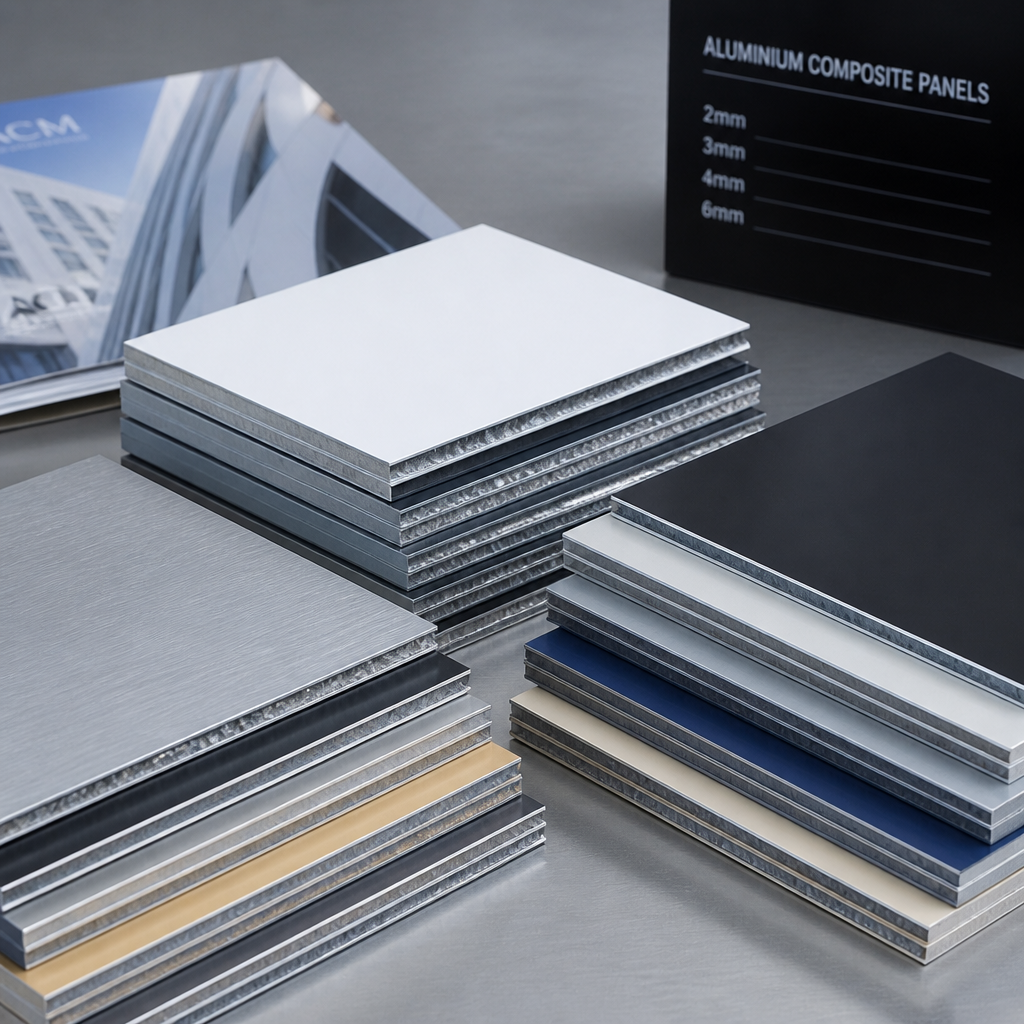
Aluminium composite material is a three-layer sandwich panel. Two pre-painted aluminium skins are bonded under pressure to a thermoplastic core, typically polyethylene, producing a sheet that behaves like rigid aluminium but weighs a fraction of what solid aluminium plate would. The result is a panel that is flat, workable, and dimensionally stable across a wide temperature range.
Standard sheet formats in the South African market commonly come in 3000 x 1500 mm and 2440 x 1220 mm configurations, though architectural-grade sheets can run up to 3200 x 1500 mm. The aluminium skins are typically between 0.12 mm and 0.5 mm thick, with the skin gauge being a direct indicator of overall panel quality and dent resistance. Signage-grade panels most often carry a 0.3 mm or 0.4 mm skin.
The outer surface arrives pre-painted in the factory, which means the colour runs uniformly across the panel face without the grain or porosity you get in timber or PVC foam board. That factory finish is what makes ACM such a reliable substrate for corporate identity applications where colour consistency is non-negotiable.
ACM Grades and Core Types You Will Encounter in South Africa
Not all ACM is interchangeable, and specifying the wrong core for a given application is one of the most common and expensive mistakes in commercial signage projects. South Africa's market supplies three meaningful grades.
PE Core (Polyethylene Core)
This is the standard signage-grade panel. A solid polyethylene sheet is bonded between the two aluminium skins, producing the flattest and most rigid panel at the lowest cost. PE core is the correct choice for flat-face signs, fascia boards, directional signs, pylon cladding panels, and any freestanding sign structure that is not attached to a building facade. It is combustible and should not be specified for building cladding on structures above certain height thresholds under the South African National Building Regulations.
FR Core (Fire-Retardant Core)
FR-core panels replace a proportion of the polyethylene with mineral fillers that resist flame spread. They are heavier and marginally more expensive than PE-core panels, but they are a more defensible specification when you are cladding an enclosed vestibule, a ground-floor retail interior, or any surface where an occupants-present fire scenario applies. FR panels are sometimes labelled B1 in supplier documentation.
A2 or Non-Combustible Core
A2-rated panels use a mineral-filled or aluminium honeycomb core that meets non-combustible fire classifications. These are the correct specification for external building facades, particularly on commercial buildings subject to South African National Building Regulations requirements, and on projects where a structural engineer or fire consultant has specified non-combustibility. For signage purposes, the additional cost of A2 core is rarely justified unless a building consent explicitly requires it.
The practical takeaway: for almost every freestanding sign, pylon, fascia, or flat-face sign application in South Africa, PE-core ACM at 3 mm or 4 mm thickness is the appropriate and cost-effective specification. Reserve FR and A2 for applications where the panel is attached to an occupied building facade.
The most expensive signage mistake is over-specifying material to feel safe. The second most expensive is under-specifying it. For freestanding commercial signage in South Africa, 4 mm PE-core ACM covers the vast majority of applications correctly.
Where ACM Signage Is Used in Commercial and Franchise Environments
ACM's combination of flatness, weather resistance, and printability means it appears across almost every category of commercial signage. Understanding which applications it genuinely excels at helps buyers avoid substituting it where a different material would perform better, and vice versa.
Fascia and Shopfront Signage
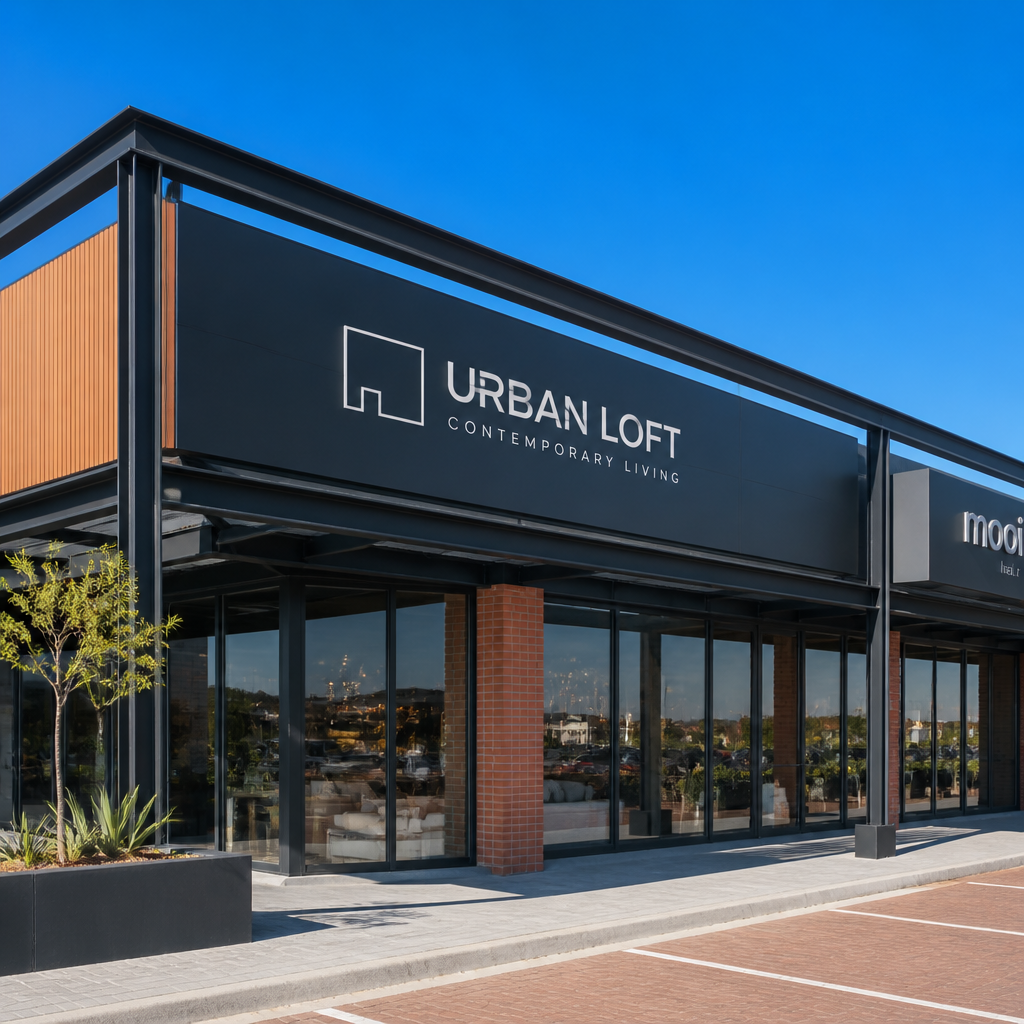
Fascia boards, which span the front face of a retail unit above the glazing line, are one of the highest-volume ACM applications in South Africa. The material cuts cleanly on a CNC router, holds flat against a lightweight angle-iron frame, and accepts either direct digital print or applied vinyl lettering. For franchise networks, where a consistent fascia colour across dozens of branches is mandatory, ACM's factory-coated surface delivers measurably better colour uniformity than site-painted alternatives.
Building Cladding and Column Wraps
ACM panels can be cut and folded to clad exterior walls, vestibules, column covers, beam wraps, canopies, and soffit areas. This is particularly relevant for petrol station forecourts, hotel entrances, and franchise restaurants where the building itself becomes part of the brand environment. The fold is achieved by routing a V-groove into the back of the panel and bending it cleanly to a right angle, producing a factory-quality corner without visible joins.
Pylon Signage Faces
Pylons are tall freestanding sign structures positioned at the edge of a property to command visibility from a road or highway. ACM is used as the infill panel within the pylon's steel frame. When combined with an acrylic inlay and rear LED illumination, it becomes a backlit pylon face. Without illumination, flat ACM faces are common for smaller site pylons in lower-traffic zones.
Directional and Wayfinding Signs
Car parks, logistics facilities, hospitals, and large retail parks all use ACM for interior and exterior wayfinding panels. The material's rigidity means panels remain straight on post-mounted installations without the bowing that affects lighter-gauge alternatives, and its surface takes screen printing and vinyl application cleanly for long-term legibility.
Exhibition Displays and Pop-Up Environments
Lighter-gauge ACM panels are used in exhibition stand construction and temporary retail environments where a rigid, printable substrate is needed but will not be permanently installed. The material is reusable if stored flat, making it practical for brands that rotate exhibition displays across multiple events per year.
Pylon Signage with ACM Inlay Explained
The term pylon with ACM inlay refers to a specific signage construction method that is widely used for franchises and retail parks across South Africa. Understanding the construction prevents specification errors that delay projects and inflate costs.
How the Construction Works
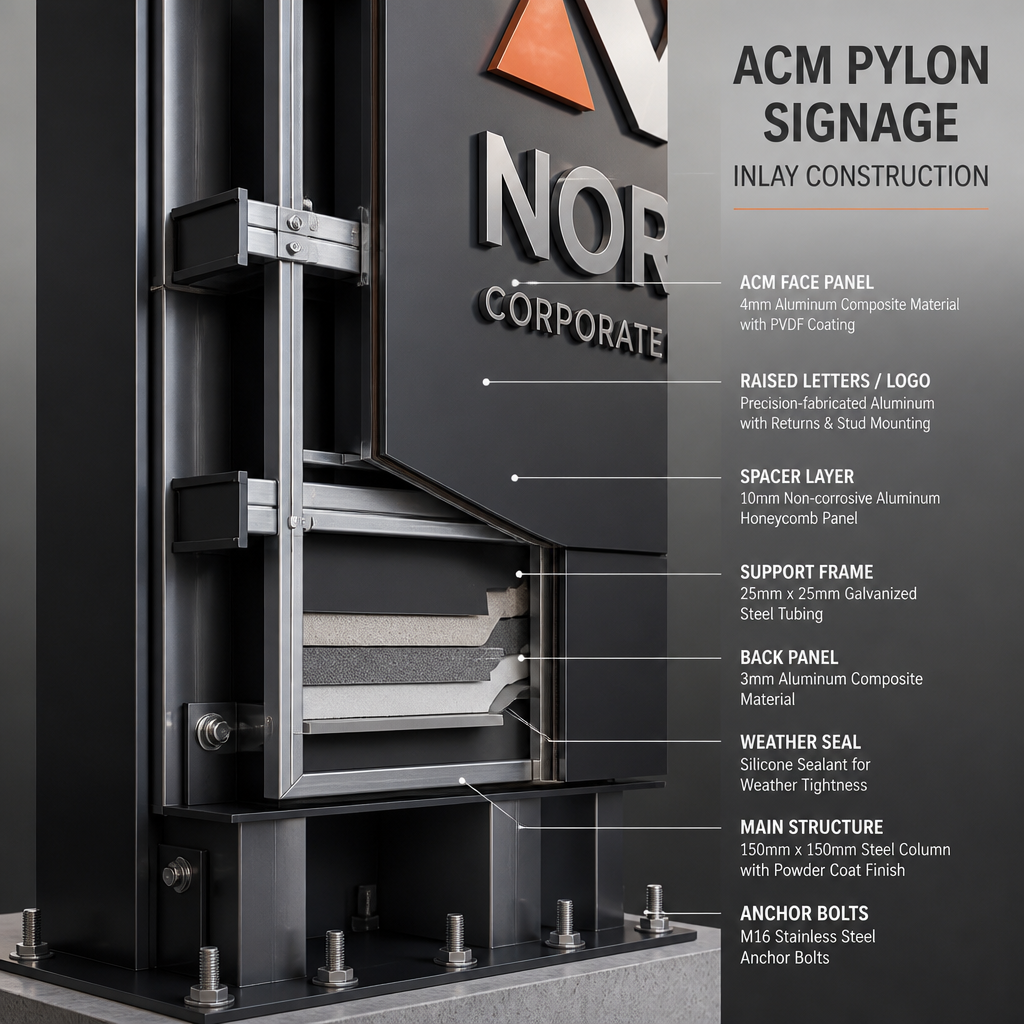
The pylon itself is a structural steel frame, typically square or rectangular hollow section steel, set in a concrete footing. The frame is clad on its faces with ACM panels, which provide the clean, flat, branded surface. Within the branded face, an opening is cut to accommodate an acrylic lightbox inlay. This inlay is typically fabricated from opal or white acrylic sheet, backlit with LED strip lighting, and carries the business name, logo, or unit number. The combination of an ACM outer face with an illuminated acrylic inlay produces the crisp, professional appearance seen outside shopping centres, fuel stations, and fast-food outlets throughout Gauteng and beyond.
Why This Configuration Is the Commercial Standard
The ACM outer panel gives the pylon face a rigid, weatherproof, UV-stable surface that holds the corporate identity colour precisely. The acrylic inlay provides the illuminated element without requiring the entire pylon face to be a lightbox, which significantly reduces electrical complexity and ongoing LED maintenance. For franchise networks with strict corporate identity standards, the configuration allows both the illuminated and non-illuminated elements to be specified exactly, ensuring consistency across every site.
Common Specification Errors to Avoid
The most frequent mistake is using signage-grade 3 mm ACM on a pylon face exposed to strong prevailing wind without adequate internal framing. Panels larger than roughly 1200 x 600 mm need intermediate support rails to prevent oil-canning, which is the visible waviness that develops in unsupported flat panels under thermal expansion and wind load. A competent fabricator will specify the support frame density based on panel size and site wind exposure, not leave it to chance.
Pro tip: Always confirm with your signage supplier whether the pylon quote includes the concrete footing, the structural steel frame, and the electrical connection to the LED driver, or only the fabricated face panels. These line items are frequently excluded from initial quotes and appear later as variations.
ACM Compared to Alternative Signage Substrates
ACM is not always the right material. Buyers who understand where it wins and where it loses make better decisions and avoid paying for a material's strengths they do not need.
| Substrate | Best-Fit Application | Key Limitation vs ACM |
|---|---|---|
| ACM (4 mm PE core) | Outdoor fascias, pylon faces, building cladding, wayfinding panels, franchise shopfronts | Combustible PE core not suitable for building facade cladding above regulated height thresholds |
| PVC Foam Board (Sintra/Forex) | Indoor point-of-sale displays, short-term event graphics, light-duty interior signs | Poor UV resistance outdoors; warps and yellows within 12-18 months in South African sun; significantly lower rigidity in larger formats |
| Solid Aluminium Sheet | Precision-machined plaques, name plates, high-end interior identification signs | Heavy, expensive, difficult to fabricate on-site; overkill for flat-face signage panels where ACM rigidity is sufficient |
In practice, PVC foam board is frequently substituted for ACM in indoor applications to reduce cost, and that substitution is reasonable. The substitution fails when the same board is used outdoors: South Africa's UV intensity will degrade an unprotected PVC board visibly within one to two seasons. ACM's factory-applied PVDF or polyester coating maintains its surface finish and colour far longer under direct sun exposure.
Design and Specification Considerations Before You Order
Getting ACM signage right means resolving several design and material variables before a fabrication order is placed. Resolving them late costs money and delays installation.
Thickness Selection
The signage market in South Africa predominantly uses 3 mm ACM for smaller flat panels and 4 mm for larger fascia boards, pylon faces, and cladding applications. The 3 mm panel is lighter and easier to handle on smaller jobs but offers less rigidity on spans wider than approximately 900 mm without intermediate support. Default to 4 mm for any panel that will be permanently installed outdoors on a span greater than 900 mm.
Surface Finish and Colour Matching
ACM is stocked in standard colours including white, silver, brushed silver, mill finish, black, and a range of solid colours. For franchise and corporate identity applications, standard stock colours rarely match a brand's Pantone or RAL specification precisely. There are two resolution paths: apply a vinyl film in the correct brand colour over a white or silver ACM panel, or source a custom-coated ACM panel in the specified colour. Vinyl application is faster and more cost-effective for most signage projects; custom-coated panels are the correct choice for large cladding areas where visible vinyl seams would compromise the finish.
Routing and CNC Fabrication
ACM is well-suited to CNC router fabrication. Clean V-groove routing allows panels to be folded to sharp corners without cracking, enabling box fascias, column wraps, and three-dimensional letterform backing panels. The polyethylene core cuts cleanly without the chipping or delamination that can occur when routing lesser composite materials. Any competent signage fabricator running a CNC router can work with ACM directly from standard sheet sizes.
Pro tip: When ordering ACM for a franchise rollout programme across multiple sites, specify a single batch of material from the same manufacturing run where possible. Colour drift between batches of the same nominally specified panel is a known issue in the market, and it becomes very visible when panels from different batches are installed side by side.
Print and Vinyl Compatibility
The smooth, factory-coated ACM surface accepts UV flatbed printing, solvent inkjet printing, and self-adhesive vinyl equally well, provided the surface is clean and free of release agents. Digital direct-to-substrate printing on ACM produces crisp, photographic-quality output and eliminates the risk of vinyl lift at edges over time. For panels that will remain in situ for more than three years, direct print with a UV-protective laminate over the top is the more durable specification compared to a printed vinyl overlay.
Installation Standards and Maintenance on South African Sites
ACM's reputation as a low-maintenance material is generally deserved, but only when installation is executed correctly. Poor installation creates most of the maintenance problems that get attributed to the material itself.
Fixing Methods
ACM panels are fixed using one of three methods depending on the application: mechanical fasteners through the panel face, concealed rivets from behind, or adhesive bonding using structural-grade panel adhesive. Face-fixed installations with visible screws or rivets are common on budget fascia projects but create visible fixing points that compromise the finish on corporate-quality signage. Concealed fixing systems, where the panel clips into a rail mounted to the substrate, produce a cleaner result and allow individual panels to be replaced without disturbing surrounding ones.
Thermal Expansion Allowances
ACM expands and contracts with temperature. South Africa's high summer temperatures in Gauteng and the Northern Cape can push panel surface temperatures well above ambient air temperature on south-facing surfaces. Fixing systems that do not allow for thermal movement will cause panels to buckle or fixing points to pull through over time. Any span wider than 600 mm should be fixed in a way that allows at least 2 mm of thermal movement at each fixing point.
Routine Maintenance
ACM requires minimal routine maintenance. Washing down with a mild detergent and a soft cloth once or twice a year removes accumulated grime without damaging the factory coating. Avoid abrasive cleaners or rotary polishing tools, which will scratch and dull the surface finish. For vinyl-clad ACM panels, inspect the vinyl edges annually and re-seal any lifted edges with a clear edge sealer before moisture penetration causes wider delamination. Replacing a single vinyl application is far cheaper than replacing the ACM substrate underneath.
Choosing the Right ACM Signage Supplier in South Africa
The ACM signage market in South Africa is crowded, and not all suppliers fabricate and install to the same standard. The differentiators worth examining are fabrication capability, material sourcing, and project management for multi-site rollouts.
In-House Fabrication vs Outsourced Manufacturing
A supplier who fabricates in-house on a CNC router maintains direct control over panel accuracy, corner quality, and finishing. A supplier who outsources fabrication to a third-party sheet-metal shop is an additional step removed from quality control, and the consequences usually show up in inconsistent corner radii, uneven V-grooves, and panels that are slightly out of square. For single-sign projects, this distinction matters less. For a franchise rollout across twenty or thirty sites, it matters considerably.
Corporate Identity Compliance
For franchise and corporate clients, signage must meet a brand manual's specifications precisely: exact Pantone colours, prescribed letter heights, defined logo clear zones, and approved material specifications. A supplier without documented experience in corporate identity compliance will routinely make judgement calls that deviate from the brand manual, producing signs that are "close enough" rather than correct. Insist on a sample or proof approval process before full production commences on any multi-site order.
Rental and Temporary Solutions
Some commercial situations, particularly pop-up retail, event branding, and construction hoarding, call for ACM signage that does not need to be permanently owned. A supplier who offers rental solutions for signage, including fabricated ACM panels, means capital expenditure is converted to an operational cost for the duration of the project. This is relevant for developers, event managers, and hospitality businesses who need quality-branded environments for a defined period without committing to permanent signage infrastructure.
SignShopper, based in Gauteng, fabricates and installs ACM signage across corporate, franchise, retail, and hospitality sectors, covering products from flat fascia panels and cladding through to pylon signage with ACM inlay configurations. For businesses requiring a single point of accountability from design through to installation and sign-off, a supplier with this scope eliminates the coordination risk that comes from using separate design, fabrication, and installation contractors.
For businesses exploring the full range of substrates and sign types before committing to ACM, the SignShopper signage types overview sets out the available product categories and their typical application contexts.
Frequently Asked Questions
What thickness of ACM should I specify for an outdoor fascia sign in South Africa?
For most outdoor fascia applications, 4 mm ACM is the correct specification. It provides sufficient rigidity to remain flat across spans up to approximately 1200 mm without intermediate support. The 3 mm option is adequate for smaller panels or interior applications, but it is prone to oil-canning on wider outdoor spans, particularly in Gauteng where high summer temperatures drive significant thermal expansion.
Can ACM signage be used as external building cladding in South Africa?
ACM with a PE (polyethylene) core is suitable for freestanding signage and low-level exterior cladding applications such as shopfront fascias and column wraps. For external building cladding on taller structures, South African National Building Regulations may require fire-retardant (FR or B1) or non-combustible (A2) core panels. If a fire consultant or architect is involved in your project, their specification takes precedence over general signage practice.
What is the difference between an ACM pylon and a standard pylon?
All modern pylons use ACM as the face panel material, so the distinction is usually between the face finish options rather than between fundamentally different structures. A pylon described as having an "ACM inlay" typically refers to a configuration where the main pylon face is solid ACM and a cut-out section is filled with an illuminated acrylic lightbox, producing both a branded flat face and an internally lit panel in a single structure. This is the configuration most commonly specified for retail parks, fuel forecourts, and franchise restaurant sites.
How long does ACM signage last outdoors in South African conditions?
A correctly specified and installed ACM sign with a factory PVDF-coated surface and properly applied vinyl or direct print finish will typically maintain its appearance for ten years or more in South African conditions. The most common failure modes are vinyl lift at edges due to moisture ingress, fading of non-UV-stable inks on printed overlays, and mechanical damage from impact or attempted vandalism. The ACM substrate itself rarely fails; it is the applied graphics or fixing system that determines effective service life.
Is ACM suitable for franchise signage rollouts across multiple sites?
ACM is arguably the most commonly specified material for South African franchise signage rollouts precisely because it delivers consistent colour, flatness, and surface quality across many different sites and installation crews. The material is predictable to fabricate, available from multiple suppliers in standard sheet sizes, and compatible with all common graphic application methods. The key risk in a rollout is batch-to-batch colour variation if panels are sourced from different production runs, so specify a single batch or insist on a colour match approval from each batch before installation proceeds.
What maintenance does ACM signage require?
Routine maintenance for ACM signage is straightforward: wash down with mild detergent and a soft cloth periodically to remove grime, and inspect vinyl overlays annually for edge lifting. Avoid abrasive cleaning products or mechanical polishing, which will scratch and dull the factory surface coating. For illuminated pylon faces with ACM surround panels, the LED modules within the acrylic inlay are the component most likely to require periodic attention, not the ACM panels themselves.
If you have specified ACM signage for a South African commercial project, share what worked well and what you would specify differently next time in the comments below.
We would love your feedback and any insights you would share with others. What perspective would you add?
References
- Why aluminium composite material is widely chosen for signage and display applications
- ACM panel specifications and applications from a South African polymer products supplier
- Overview of ACM sign features, construction, and commercial applications in South Africa
- ACM panel specification guide and common mistakes for the South African market
- Fire-rated ACP core types and their application under South African building requirements