


Estate Agent Signage South Africa: Boards That Sell Homes
Good estate agent signage in South Africa does two jobs at once. It has to catch the eye of a driver at a robot or a junction, and it has to give that driver a reason to keep reading and call. Most listings are won or lost in a few seconds on the road, long before a buyer opens a property portal. A board placed at the wrong turn, printed with the wrong hierarchy of information, or left up after its permit has expired costs money and sends enquiries elsewhere. This guide covers where boards earn their keep, which council rules can cost you a board or a fine, how to design for a moving car, and how to tell whether your signs are actually producing leads.
Table of Contents
- Quick Takeaways
- Why Placement Decides More Sales Than Design
- Matching Sign Types to Each Stage of a Listing
- Council Rules, Permits, and Board Counts
- Designing Boards That Read at Speed
- Banners, Hoardings, and Open-Day Dressing
- Agency Branding That Holds Across Every Listing
- Comparing Board Materials for Real Listings
- Measuring Whether Your Signs Bring Enquiries
- Frequently Asked Questions
- References
Quick Takeaways
| Key Insight | Explanation |
|---|---|
| Check permits before you print | In Cape Town, directional boards on City-owned land need a property marketing agent permit, and each numbered sticker must be displayed on a board for the year. Confirm the rules with the municipality for each area before the first board goes up. |
| Plan a small number of strong sites | Cape Town caps agents at six directional boards at a time under the permit. Fewer boards in better positions outperform a crowded row of signs that drivers cannot separate. |
| Respect the one-agency limit | Overstrand Municipality permits two for-sale signs per property, and not more than one may come from a particular agency. Stacking your competitors' boards is not an option, and your own count must stay inside the limit. |
| Lead with suburb and property type | Drivers read the top line first. Put the suburb and property type above the agency logo, and keep the phone number large enough to read from the lane next to the board. |
| Use one brand system on every sign | Matching colours, fonts, and logo placement across for-sale boards, open-day banners, and development hoardings make an agency recognisable within a single suburb. |
| Track every board location | Give each board site its own phone number or QR code. Without that, you cannot tell which corner produced the enquiry, and you will keep paying for boards that do nothing. |
Why Placement Decides More Sales Than Design
A board a driver can read is worth more than a beautiful board they never see. In practice, most board enquiries come from three kinds of location: the last turn before the property, the junction where a buyer first has to decide whether to keep going, and the stretch of road directly in front of the house. Placement that ignores these points wastes money even when the design is excellent.

Start with the route, not the map. Drive the approach from the nearest main road at the speed a buyer would drive it. Note where you slow down, where you cannot see the street name, and where a board would be the only thing telling you to turn. Those are your sites.
Corners, Robots, and Turn-Off Points
Traffic lights are the obvious place for a board, and they are also the most contested. Every agency wants the same pole, and councils often restrict what can be fixed to street furniture. A less crowded spot just past a robot, where a driver has time to read while stopped, often beats the pole itself.
A turn-off board needs to sit before the junction, not at it. A driver who has already committed to the turn has no time to read. Place the board far enough back that the arrow and suburb name register before the indicator goes on.
Pro tip: Photograph each board location from the driver's seat, once in the morning and once in the afternoon. Sun glare on glossy surfaces is a common reason a board that looked fine on install day stops working by midday.
Sightlines and Speed
Check the speed limit on the approach road. A board that works at 40 km/h often fails at 60 km/h because the reading window is much shorter than most people expect. Stand at the site, imagine the speed, and check whether you can read the top line in one glance.
Also check for obstructions. Parked trucks, trees that fill out in spring, and boards from other agencies can hide a sign within weeks. Revisit each site monthly. A board that was clear in January is often hidden by February growth, and nobody notices until the enquiries dry up.
Matching Sign Types to Each Stage of a Listing
Not every listing needs the same signage. A new listing, an open house, and a sold property each call for a different sign, and mixing them up is one of the most common and expensive mistakes we see. The right sign type depends on what the passing driver needs to do next.
For-Sale Boards
The for-sale board is the anchor. It sits on the property or at the nearest corner, and its only job is to confirm that the house is for sale and tell the reader who to call. Keep it clean. A board with the price, the bedroom count, the agent's name, and a website URL is asking the driver to read a brochure at 60 km/h.
In practice, the best for-sale boards carry three things: the property type and suburb, one phone number, and the agency logo. Anything else competes with those three items for attention.
Open-House Directionals
Open-house signs guide buyers from the main road to the property on a specific day. They need arrows, a date, and a start time, and they should come down the same day the viewing ends. Leftover open-house boards are a visual signal that a house has been on the market for a long time, which works against the listing.
Use a consistent arrow style and a fixed colour for all open-house directionals in a suburb. Buyers who see the same format at each turn trust the route, and they stop checking their phones at every junction.
Agency Branding Boards
Branding boards do not sell a specific house. They keep the agency visible in neighbourhoods where it wants to win future listings. These work best on the agency's own premises, at community events, and at sites where the agency has a sustained presence. They should carry the logo, a core service line, and a contact route, and they should be replaced when the branding changes rather than left to fade.
Council Rules, Permits, and Board Counts
Permits are the part of estate agent signage that catches agencies out most often. Each municipality sets its own outdoor advertising and street rules, and the rules can differ from one area to the next. Before you plan a route, find out which office governs the land you want to use, and read its current guidance.
The City of Cape Town publishes detailed rules for real estate signage, and they show how specific councils can be. Its Environmental Management Department moderates directional signage so that sidewalks are not cluttered, and all outdoor advertising must be approved before it is displayed.
Cape Town's Permit Stickers and Board Limits
If you sell, market, let, lease, or auction properties in Cape Town, you need a permit for any directional board placed on City-owned land. The permit includes six uniquely numbered stickers, and each sticker must be displayed on a directional board for the duration of the permit year. That limits you to six boards at a time.
The City also lists separate permit routes for principal property marketing agents, intern agents, and re-registration. If you manage a team, check that every agent placing boards holds the right permit for their status before the boards go out.
Private Seller Permits and Developer Boards
Private sellers receive three stickers, and each must be displayed on a board until the property sells. The permit is valid for three months, after which a new application is needed. Damaged stickers can be replaced for free if you bring the originals, but the stickers cannot be transferred to another person. Agencies should know these limits, because private sellers often ask them what they can and cannot put up.
For developers, the rules are tighter. A residential development may display one development board on the property, up to 3 m². A mixed-use development may have one board not exceeding 5 m². Directional boards are not permitted for developers under the same rules, so a development that depends on directional signs needs a different plan.
Checking Rules in Gauteng and Elsewhere
Gauteng municipalities run their own by-laws, so the rules for a board in one suburb may not match another. Start with the by-law office or outdoor advertising section of the council that governs the land where the board will stand. Ask specifically about directional boards, street poles, and the number of signs allowed per property.
The Overstrand Municipality has published a clear rule that is useful as a benchmark for any agency: two for-sale signs per property, and not more than one from any one estate agency. Whatever your municipality allows, build your sign count from the local rule, not from habit.
Designing Boards That Read at Speed
A board is read in a glance by someone who is doing something else. That single fact should drive every design decision, from font size to what you leave out. Designers often want to show everything the agency offers. Drivers want to know one thing: is this the house, or the agency, I should call?
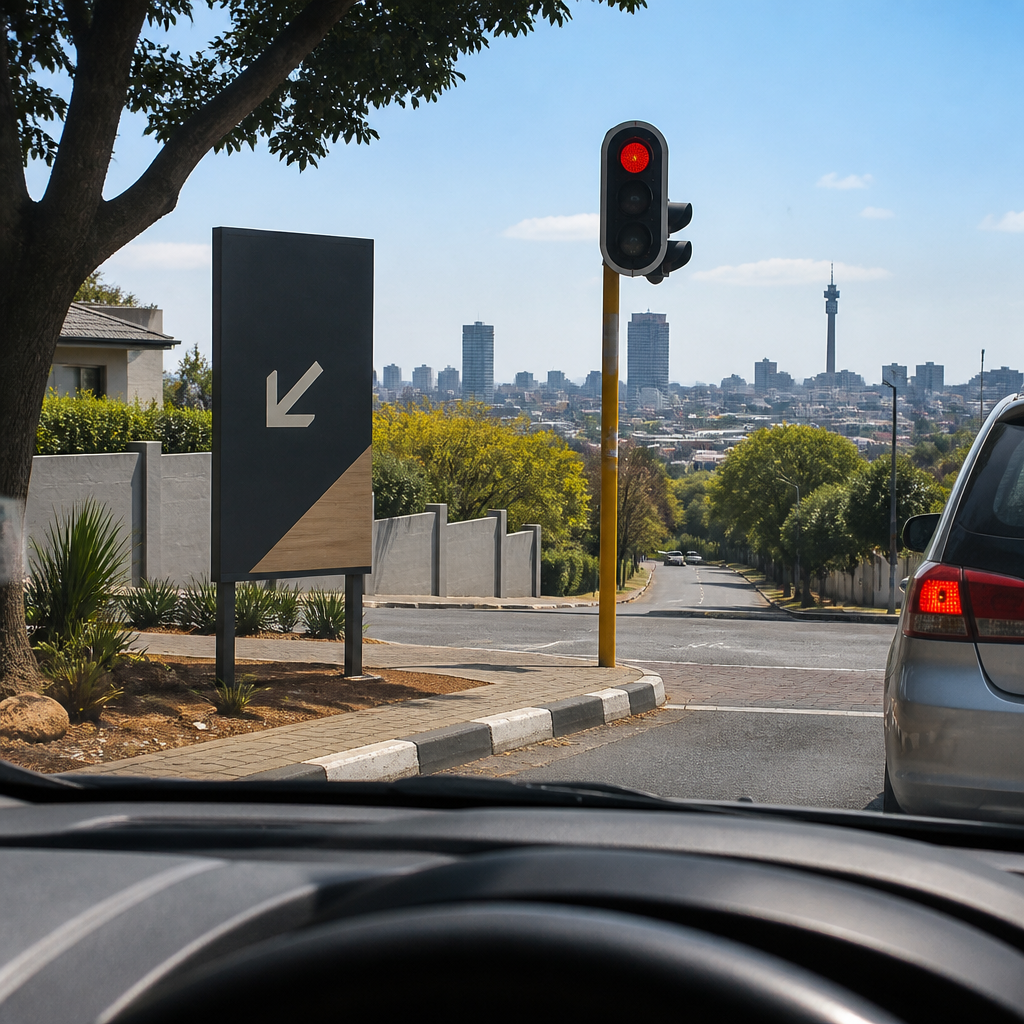
The fastest way to improve a weak board is to remove text. Cut the list of features, the sales tagline, and the second website. Then check the remaining text at the viewing distance from the lane. If the phone number is hard to read, make it bigger, not the logo.
Lead With the Suburb and Property Type
A line such as "Three-bedroom house, Ridgeview" tells a driver whether the sign is relevant before they read anything else. The agency logo belongs below that line, in a size that identifies the agency without competing with it. Buyers searching for a specific suburb or property type will stop for a board that names their target.
Contrast, Font Size, and Colour
Use high contrast between text and background. Dark lettering on a light panel, or white on a deep colour, reads better in harsh sun than mid-tone combinations. Choose a sans-serif typeface with generous letter spacing, and avoid script fonts for anything a driver needs to read at speed.
Pro tip: Print a proof at full size and tape it to a wall at roughly the distance a driver would view it from. Walk back until the phone number disappears, then move forward one step. That step is your reading distance, and the number must be legible from there.
What to Leave Off the Board
Leave off the detailed property specifications, the full list of agents, and any promotional offers that will be out of date within a fortnight. Those belong on the online listing, where a buyer can read at their own pace. A board is an invitation to call or visit, and it should stop there.
A sign that asks a driver to read is a sign that will be ignored. The best boards give one clear answer to one clear question.
Banners, Hoardings, and Open-Day Dressing
Banners and hoardings extend the agency's presence beyond the single for-sale board. They are most useful on open-day routes, at estate entrances, and on the front of developments where a builder or agency wants a sustained presence for months. They need a different set of decisions from a rigid board, because they flex, fade, and catch wind.
Banners That Survive a Weekend
Open-day banners usually hang for one or two days, but they are often left up longer. Choose a heavyweight vinyl with reinforced hems and eyelets at a regular spacing, so that wind does not tear the corners. Fix them at both ends and at the centre, and check the ties after the first gust.
A common mistake is hanging banners on fences or security gates that are not the owner's to use. Get written permission from the property owner or body corporate before you fix anything. A banner that gets the agency a complaint does more harm than good.
Hoarding and Development Sites
Hoardings on development sites are seen by many people for many months, so they should be treated as brand assets, not temporary dressing. Use a consistent layout across the full length, and repeat the agency's contact details at regular intervals so that someone who walks past the site on day ten still sees a route to call.
Because development boards are limited in size under many municipal rules, the hoarding often does more work than a single board. Confirm with the council that the hoarding itself is approved, and that its content matches the permitted purpose.
Agency Branding That Holds Across Every Listing
Recognition is built through repetition. A buyer who sees the same colours, typeface, and logo placement on a for-sale board, an open-day arrow, and a branding board starts to trust the agency before they meet an agent. Inconsistent signage makes an agency look smaller than it is, even when its listings are strong.
Agencies that run large portfolios often let each branch or agent print their own boards. That produces a patchwork of logos, colours, and fonts across a single suburb. Set a short brand guide with the approved logo versions, colour values, typeface, and minimum clear space, and make it the first document a new branch receives.
One Brand System, Many Boards
Your brand system should cover every sign type in the same way. The logo always sits in the same corner, the phone number always uses the same typeface and size, and the colours never shift from one product to the next. When every board follows the same rules, a driver can tell at a glance that they are looking at the same agency.
Keep one master file for each sign format, and store it with the approved vendor. Versions drift quickly when agents edit their own artwork, and a corrected logo is hard to fix once a hundred boards are in the ground.
Franchise Brand Standards
Franchise principals face a particular challenge. Each franchisee wants local phone numbers and local agent faces, but the head office wants a single visual identity. The workable compromise is a fixed template with defined fields for the suburb, the agent's name, and the contact number. Everything else stays locked, so the franchise looks like one network even when each office runs its own listings.
Comparing Board Materials for Real Listings
Material choice affects cost, weight, lifespan, and how a board looks after a season in the sun. Most agencies end up using two or three materials for different jobs. The table below compares the three that come up most often for for-sale boards, open-day signage, and banners.
| Material | Best Use | Main Trade-Off |
|---|---|---|
| Corrugated plastic boards | Standard for-sale boards on stakes or fences, and short-term listings | Light and inexpensive to replace, but the surface can fade and warp within a few seasons of sun exposure. |
| Aluminium composite panels | Long-running boards, development signs, and sites where the board stays up for months | Rigid, flat, and durable, but heavier and more costly to fix and reposition than corrugated plastic. |
| Vinyl banners | Open-day routes, estate entrances, and temporary hoardings | Flexible and easy to hang, but it catches wind and needs reinforced edges and secure fixing points. |
Use corrugated plastic for the bulk of your short-term listings, because it is cheap to replace when a property sells or a board is damaged. Move to aluminium composite for sites that will stay on the market for a long time or for developments where the board is a permanent fixture. Keep vinyl for the routes that are only needed for a weekend, and always confirm that the banner fixings are safe before the first viewing.
Measuring Whether Your Signs Bring Enquiries
Most agencies know how many boards they have, but very few know which boards produce calls. That gap is where budgets disappear. A measurement system does not need to be complicated, but it does need to be consistent, and it needs to be set up before the boards go out rather than after the first disappointing month.
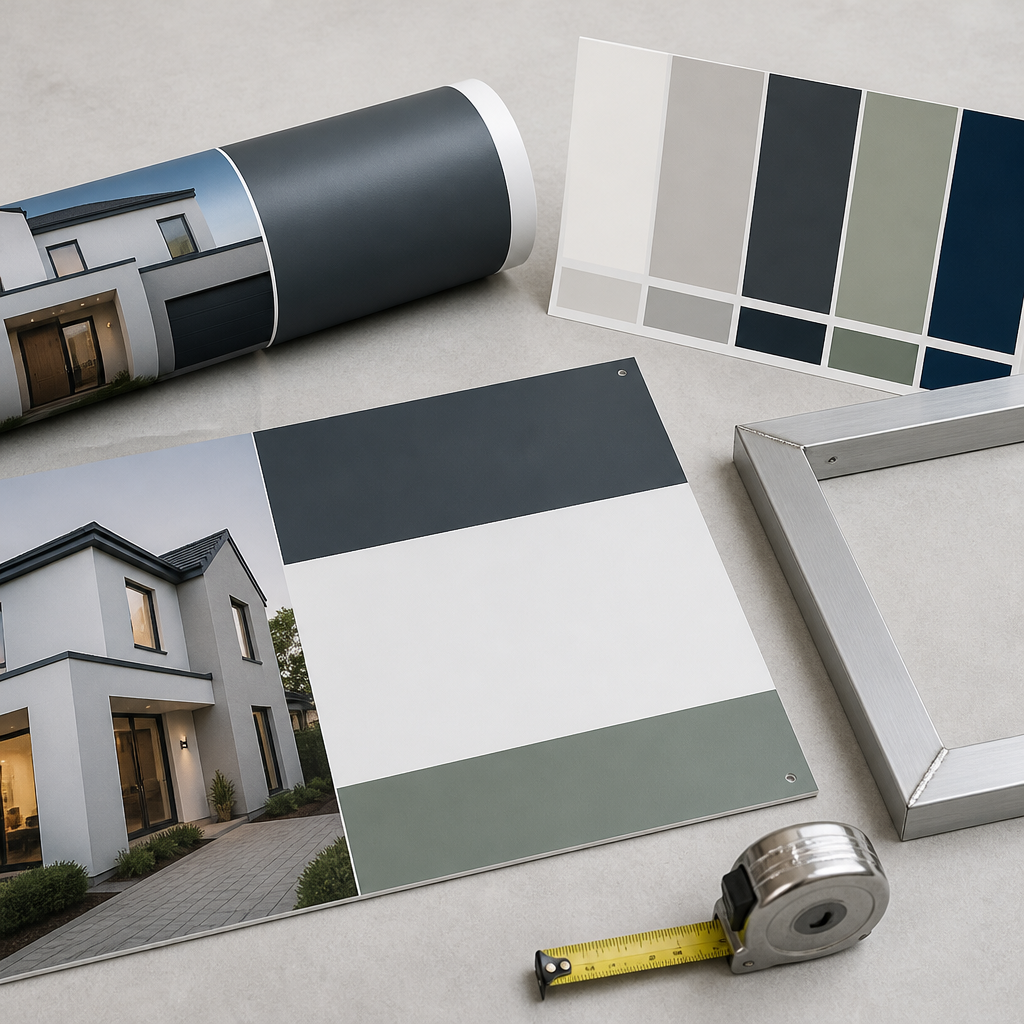
The simplest approach is to assign every board site a code. Use that code in the QR link, the phone number, or the URL printed on the board, and log each enquiry against the code when it arrives. After a few months, the pattern becomes obvious, and you can move the weak boards to better sites.
Board-Specific Phone Numbers and QR Codes
A separate call-tracking number for each high-traffic board site is the cleanest method. The number forwards to the same office line, so the agent experience does not change, but the data shows which site generated the call. A QR code linked to a site-specific landing page works in the same way, although it only captures buyers who scan the code.
Be careful with QR codes on boards. Drivers will not scan a code while driving, so the code is for the buyer who stops, returns, or sees the board from a parked car. Treat it as a secondary route, not a substitute for a readable phone number.
Logging Enquiries by Location
Ask every caller how they found the listing. Record the answer against the site code, the suburb, and the property reference. Over time, the log will show which corners produce viewings and which produce only curious calls. Review it monthly, and replace or remove boards that have produced nothing for a full listing cycle.
Frequently Asked Questions
How many for-sale boards can an estate agent put up for one property?
The answer depends on the municipality. Overstrand Municipality, for example, permits two for-sale signs per property, and not more than one from a particular estate agency. Check the local by-law before you plan your count, because some councils set different limits or require permits for directional boards.
Do I need a permit for an estate agent board in Cape Town?
If you place directional boards on City-owned land, yes. The City of Cape Town requires a property marketing agent permit, and each board must carry a numbered sticker for the permit year. Private sellers need their own permit and receive three stickers, valid for three months.
What size should a for-sale board be?
There is no single correct size, because the right size depends on the speed of the road and the distance from which the board must be read. For fast roads, choose a larger board with fewer words. For slower streets, a smaller board can carry a little more detail. Always test the board at its actual site before you commit to a print run.
Which colours work best for real estate signage in South Africa?
High contrast matters more than any particular colour. Strong combinations of dark text on a light background, or light text on a deep background, read well in bright sun. Choose colours that match your agency's brand guide, and check the contrast on a printed proof rather than on a screen.
How long should a for-sale board stay up?
Keep the board up for as long as the property is actively on the market, and take it down promptly once the property is sold, let, or withdrawn. Boards left up after a sale create a poor impression and can breach local rules. Set a reminder in your listing system so the removal is not forgotten.
Can I use the same sign design for different agencies in a franchise network?
Use one template with locked brand elements and defined fields for the local contact details and agent name. This keeps the network visually consistent while allowing each office to show its own phone number and team. Avoid letting individual offices change the logo, colours, or typeface, because small changes add up to a fragmented brand.
Which board placements or permit rules have worked best for your team in your area? Share your experience in the comments, and tell us where your boards have produced the best enquiries.