


Street Pole Advertising South Africa: Still Worth It?
Street pole advertising in South Africa has a reputation as the cheap, scrappy option, the thing a café owner tries once and forgets. We still see it work well for local businesses, but only when the campaign is built around a specific road, a specific audience, and a clear reason for someone to remember the name. Business owners in Gauteng often ask whether a banner on a lamp post still does anything when everyone is looking at their phones. Our short answer is yes, with conditions. Here is how we decide when to recommend it and when we tell clients to spend the money elsewhere.
Table of Contents
- Quick Takeaways
- Why Street Poles Still Work for Local Businesses
- Costs and Permits: Where First-Time Buyers Get Caught
- Where Street Pole Campaigns Actually Work
- Lamp Post Banners in Gauteng: Practical Realities
- How Street Poles Compare With Other Outdoor Options
- When Street Pole Advertising Is Not Worth It
- Measuring Street Pole Results Without Fake Precision
- Frequently Asked Questions
- References
Quick Takeaways
| Key Insight | Explanation |
|---|---|
| Street poles build repeat local recall | Pole banners suit neighbourhood service businesses that want people to recognise the name on the route they drive every week, not a one-off launch. |
| Choose the road before you design the banner | Pick a route your customers already use to reach you, such as the road to a shopping centre or a school run, and design for the speed of that traffic. |
| Keep the copy to a few words | Drivers have a second or two to read. A business name, one offer and a phone number beat a list of services every time. |
| Budget for permits and removal from day one | Municipal approval, installation, weather damage and removal are the costs first-time buyers most often leave out of their quote. |
| Tie every route to a trackable offer | Street poles do not produce click data, so give each route its own promotion name, phone line or short web address. |
| Skip the format for considered purchases | Legal, medical and high-value services rarely convert from a passing glance, so put that budget into search and direct contact instead. |
Why Street Poles Still Work for Local Businesses
Street pole advertising means printed banners or panels fixed to lamp posts and light poles along a road. Trade coverage of out-of-home media describes it as strategically placed, hyper-local, and surprisingly high-impact, and that matches what we see when a campaign is placed well. We agree, but only when the poles sit on a route your customers already travel.
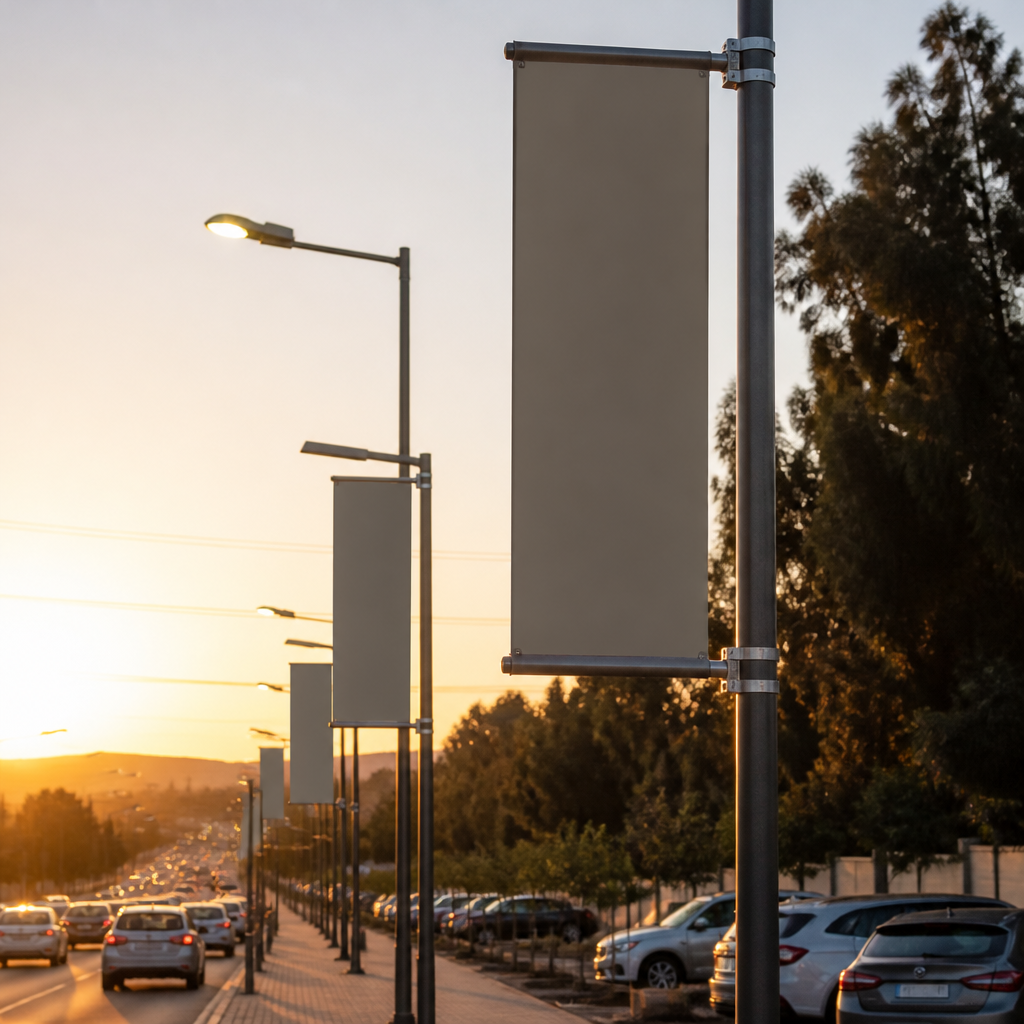
The real value is repetition. A commuter who passes the same pole every weekday sees your name dozens of times in a month, and that builds recognition a single billboard rarely delivers to a local audience. For a dental practice, a gym or a tyre centre, that familiarity is often worth more than one big splash.
Repetition on a fixed route
Most local advertising fails because it tries to do too much in one hit. A pole banner works the opposite way. It hands a single message to the same people again and again, which is why we push clients to choose a route they drive every week rather than a busy main road chosen from a map.
In practice, that means asking where your customers already travel. A school run corridor, the road to a shopping centre, or the stretch between a taxi rank and a residential estate will usually beat a busier road where nobody has a reason to stop.
Who this format suits
Street poles suit service businesses with a local catchment: clinics, gyms, restaurants, auto workshops, schools, property agents and franchise outlets that depend on customers within a few kilometres. They are a poor fit for national brands that need broad reach, and for products with a long sales cycle.
Franchise owners often get strong results because the poles reinforce a local presence that national head office campaigns cannot deliver. The catch is that every design must still sit inside the brand standards the franchisor sets, which we come back to later in this article.
Costs and Permits: Where First-Time Buyers Get Caught
What actually drives production cost
Price is set by material, print size, mounting hardware and the number of poles, so quotes vary widely. Ask every supplier to itemise production, installation, removal and the cost of replacing a damaged panel. A low headline price that excludes installation is not a low price.
Quotes also differ on the substrate. A flexible printed banner with reinforced hems costs less to produce than a rigid panel, but it moves in the wind and needs tighter fixing and more frequent checks.
Pro tip: Ask for a per-pole cost and a per-month cost on the same quote sheet. Comparing a run of forty poles against a run of twelve is meaningless without those two numbers side by side.
Municipal approval and permits
Outdoor advertising sits under municipal by-laws, and the national guidance sets the wider framework. The revised South African Manual for Outdoor Advertising Control (SAMOAC) stresses the importance of local character, so councils look at how a sign sits within the streetscape, not only whether it is technically allowed.
Approval requirements vary by municipality, so do not assume a permit from one area carries over to another. Before ordering artwork, confirm with the municipality which poles, which road reserves and which sizes are allowed, and get written approval where it is required.
Maintenance and weather damage
A lamp post banner that looks sharp on installation day can look tired within six months. Sun fades inks, wind tears eyelets and summer storms drive dust and grit into the surface.
Budget for at least one inspection visit per campaign and a replacement plan, because a torn or faded banner sends the wrong signal about a business. Removal at the end of a campaign is also a cost, and it is the one most often forgotten.
Where Street Pole Campaigns Actually Work
Matching the road to the customer
Start with your customer's journey, not the map. Ask where people are when they realise they need you, whether that is on the way home from work, on the way to school or on the way to a shopping centre. Then match the road to that moment.
A busy arterial road with fast-moving traffic may look impressive in a proposal, but drivers there have a second or two to read. A slower feeder road where cars queue at a traffic light usually gives you far more usable reading time.
Reading traffic speed and foot traffic
Lettering and copy have to match speed. For traffic moving at urban speeds, keep the headline to a few words, use one large offer, and put the phone number or web address in the largest type after the business name.
For pedestrians the rule changes. Walkers read more, so you can carry a short service list, but the poles should sit near bus stops, crossings or shop entrances where people already pause.
Density over single poles
One banner on one pole is rarely enough. A run of poles on the same stretch creates the repetition that makes the format work, and it makes the campaign look like a genuine local presence rather than a stray notice. In our experience, a neighbourhood business gets a sensible start with a cluster of poles on a single route, and the right count depends on how often people actually pass.
Lamp Post Banners in Gauteng: Practical Realities
Wind, storms and mounting
Summer afternoons in Gauteng can bring sudden storms, and a banner that behaves well in still air can flap, tear or work loose in a strong gust. Specify reinforced hems, eyelets at close spacing, and mounting straps suited to the pole diameter. Ask your installer how they will check the straps after the first storm.
Also confirm who owns each pole. Municipalities, utilities and private landlords all have different rules about attaching hardware, and a pole you assumed was free to use may not be.
Artwork that survives the road
Design for distance first. Print your artwork at actual size and walk fifteen metres away from it. If you cannot read the offer, neither can a driver.
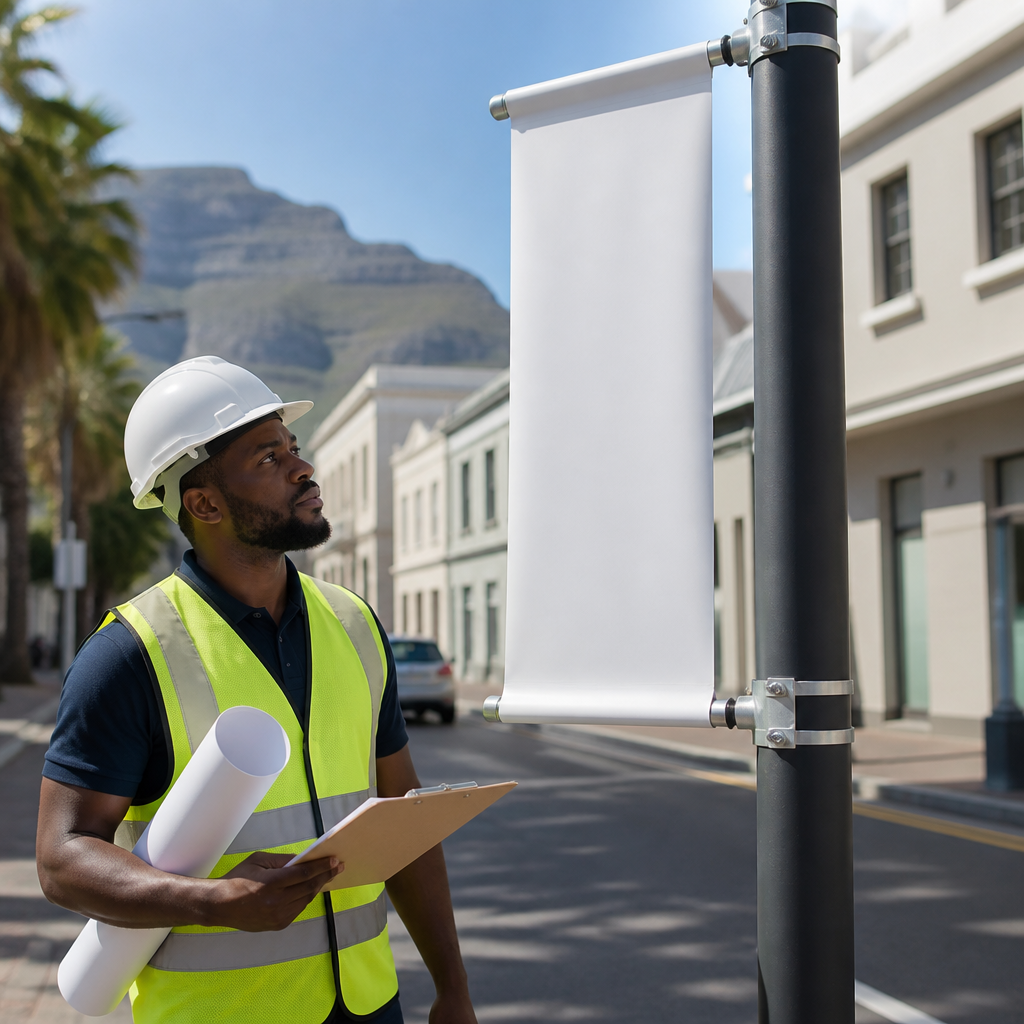
Use high-contrast colours, avoid thin script and make the logo large enough to recognise at a glance. Sun fades certain inks quickly, so ask the printer for UV-resistant output and confirm the warranty in writing.
Replacement and rotation schedule
Plan the campaign in phases. A four-week run with a fresh design every two weeks keeps the poles relevant and gives you a way to test which message gets the phone ringing.
Keep a log of which poles were damaged, which were removed by others and which needed a new panel. That log becomes your evidence in the next budget conversation.
How Street Poles Compare With Other Outdoor Options
Side-by-side comparison
The table below sets street pole banners against two formats we see most often in the same budget conversations. The honest answer is that none of them wins on every measure.
| Format | Best Use | Main Drawback |
|---|---|---|
| Street pole banners | Repeat local awareness along a fixed route | Limited copy space and visible weather wear over time |
| Roadside billboards | Broad reach for brands that need wide awareness | Higher cost and longer lead times for approvals and production |
| Storefront signage (channel letters or LED-backlit signs) | Direct visibility at the door for people already nearby | Only reaches people who are close enough to see the shop |
Using formats together
The strongest local campaigns we run pair a street pole run with storefront signage. The poles build awareness on the route, and the shopfront converts people who are already nearby. Neither format does the other's job well on its own.
If your budget allows only one, choose based on where your customers are at the moment they decide. If they decide while driving, poles make sense. If they decide after they arrive in the area, invest in the shopfront.
When Street Pole Advertising Is Not Worth It
Our clear position is that street pole advertising is not relevant for every local business, and we turn down some enquiries for that reason. A format that works brilliantly for a gym can waste money for a law firm.
Products that need careful evaluation
If a purchase needs research, such as legal services, a private clinic offering elective procedures or a high-value vehicle dealership, a passing glance rarely leads to a call. Spend that money on search visibility, reviews and direct contact with people who have already shown interest.
Franchise brand standards
Franchise owners need to be careful. A pole design that departs from the franchisor's corporate identity manual creates a compliance problem the moment it goes up. We check every artwork against the brand guide before production, because a wrong colour or an outdated logo is harder to remove than it is to print.
Also check whether head office has already approved a local outdoor programme. Running one without sign-off can damage the franchise relationship, which is a far larger expense than the campaign itself.
The wrong road for your audience
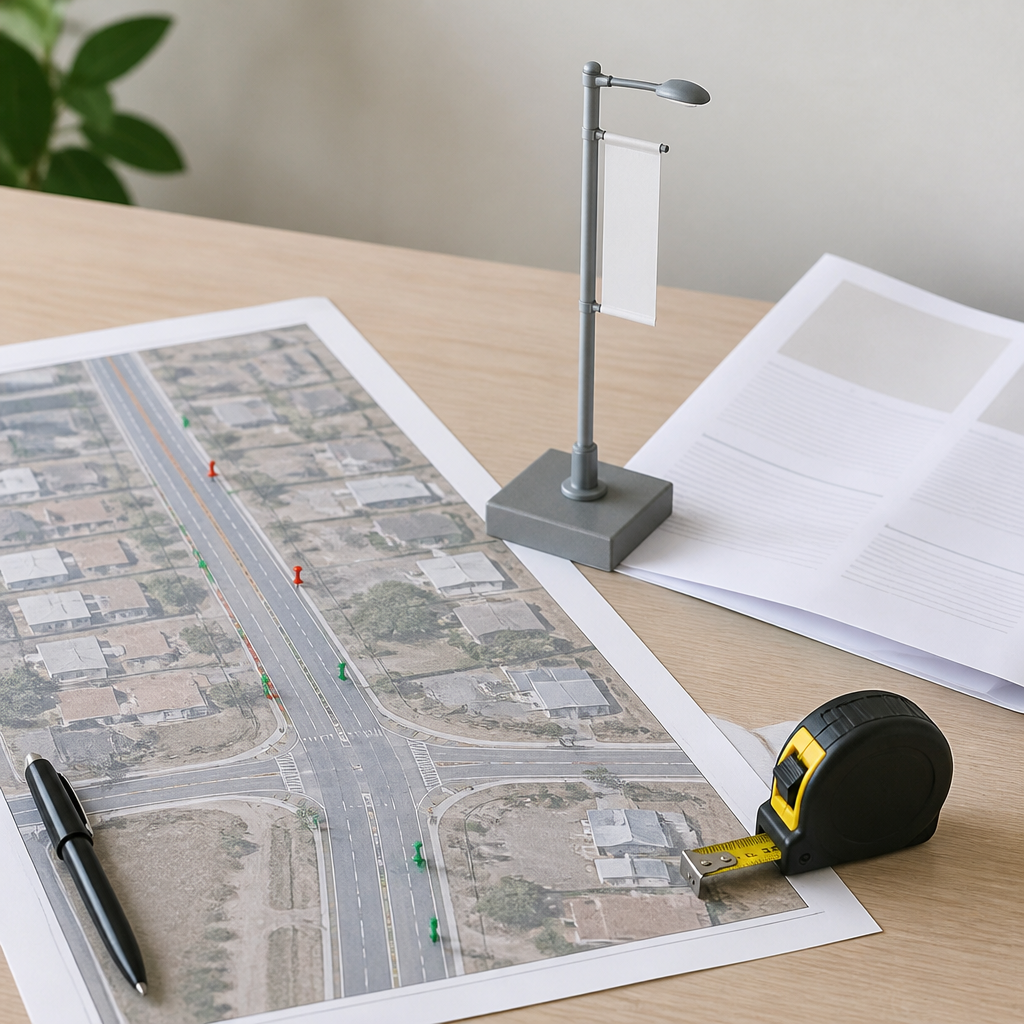
A busy road may still be the wrong road if your customers do not drive it. A bridal boutique placed on a commuter corridor will spend most of its budget on people who will never need a wedding dress that month. Map your customer postcodes or home areas before you choose a route, even if the mapping is rough.
Measuring Street Pole Results Without Fake Precision
Unique codes and offers
Street poles do not give you clicks, so you have to build measurement into the campaign. Give each route its own promotion name, a dedicated phone line or a short web address that redirects to a tracked landing page.
Ask staff to log how callers heard about you, and add a route question to your booking form. The data is rough, but it beats guessing.
Pro tip: Run one pole route with a unique discount code and a second route with no code, then compare enquiries over the same weeks. The gap between the two routes tells you more than any impression estimate a supplier gives you.
Footfall and enquiry logs
For shops and clinics, a simple daily tally of walk-ins and calls before and after a campaign gives you a baseline. Seasonal swings are real, so compare the same weeks year on year where you can.
Setting a realistic benchmark
Judge street poles against the job they were hired to do: local recall and steady enquiries, not a viral moment. A campaign that brings a steady stream of enquiries for a fixed monthly cost is doing its job, even if no single pole ever feels like a success.
A pole banner does not sell the product. It keeps your name in the place people think of when they are ready to buy.
Frequently Asked Questions
Is street pole advertising still effective in South Africa?
Yes, for local service businesses with repeat customers on a defined route. It is weak for national awareness and for products that need careful research before a purchase.
How much does a lamp post banner campaign cost?
The cost depends on the number of poles, the print specification, installation, permits and removal. Ask for an itemised quote so you can compare like with like.
Do I need municipal approval for pole banners?
In most cases, yes, and requirements vary by municipality and by who owns the pole. Confirm the rules in writing before you order artwork.
How long should a street pole campaign run?
A four-week run is a sensible starting point, with the design refreshed partway through so you can compare messages. Longer runs make sense only if the enquiry log shows steady results.
Can franchise owners run street pole advertising without head office approval?
Not safely. Get written sign-off from the franchisor, and check every design against the brand guide, because an unapproved design can create compliance problems that outlast the campaign.
How do I know whether a street pole campaign worked?
Use a unique offer or phone line for each route, log every enquiry with its source, and compare results against a period with no campaign. Judge the result against the number of new enquiries it produced, not against impressions.
Tell us about your experience with street pole campaigns, whether they brought in enquiries or fell flat, and what you would change next time.
We would love your feedback and any insights you would share with others. What perspective would you add?
References
- Revised South African manual on outdoor advertising control and local character
- Why street pole ads are earning their place in the out-of-home media mix
- Community post on wall and street pole advertising for South African small businesses
- Comparison of digital and traditional retail signage on cost, flexibility and impact