


How Signage Impacts Commercial Property Value in SA
Many landlords in Gauteng treat signage as a cost that comes after the lease is signed. In practice, the sign on the building often shapes how buyers, valuers and tenants read a property before anyone walks through the door. Commercial property signage in South Africa affects footfall, rental appeal and, over time, how a building is perceived on the open market. This guide looks at where that influence is real, where it is overstated, and which decisions actually move the needle for owners and franchise operators.
Table of Contents
- Quick Takeaways
- How Signage Affects Perceived Property Value
- Why Location Still Sets the Ceiling
- Municipal Approval and By-Law Limits
- Landlord Signage Strategy for Gauteng Properties
- Comparing Signage Approaches for Commercial Owners
- Corporate Identity and Brand Standards
- Maintenance, Measurement and Record Keeping
- Frequently Asked Questions
- References
Quick Takeaways
| Key Insight | Explanation |
|---|---|
| Signage affects value mainly through visibility and tenant appeal | A sign that reads from the nearest main road shortens the time a vacancy takes to attract viewings. |
| Location sets the ceiling | Good signage improves how a site performs, but it rarely turns a weak node into a strong one. |
| Check municipal approval before you order | Cape Town and Tshwane both run approval or permit systems for many signs, and an unapproved sign becomes a problem during a sale. |
| Replace faded or non-compliant signs quickly | Dated lettering signals a tired building to buyers and tenants long before they read the lease. |
| Standardise signage across the portfolio | Consistent fascias and mounting positions make a precinct look actively managed. |
| Write signage terms into every lease | Drawings, dimensions, fixings and removal duties prevent disputes when a tenant leaves. |
| Track enquiries before and after a change | Log viewings and time to let so that the next signage decision rests on your own numbers. |
How Signage Affects Perceived Property Value
Valuers price buildings on income, location, lease terms and condition, and signage rarely appears as a line item. That does not mean it has no effect. A building with clear, maintained signage gives prospective tenants and buyers a reason to stop, and that attention feeds directly into how quickly a unit lets and how confidently a buyer reads the asset.

Frontage and first impression
In practice, the first thing a tenant sees from the road is the building's signage, not its floor plan. A fascia that is legible at driving speed, lit in the evening and aligned with the rest of the frontage tells a viewer that the owner pays attention. A cracked panel, a half-lit name or a sign that has lost its letters tells the opposite story, and that story reaches the people deciding whether to view the space.
A sign is often the only part of a building that sells the building before anyone has spoken to it.
Tenant appeal and letting speed
For a vacant unit, the question is how long it sits on the market. Good signage shortens the time between a listing and a viewing because passing traffic and nearby businesses can see that the space exists and what kind of business might suit it. A letting board that is faded, out of date or still showing a previous tenant's name does the reverse, and it can make the property look abandoned.
Pro tip: Before you list a vacancy, photograph the frontage from the road at the times when traffic is heaviest. If the sign is hard to read in that photo, a prospective tenant driving past will not read it either.
Signage also works as a proxy for management quality. A precinct where every tenant follows a consistent approach looks properly run, and buyers tend to assume the rent roll is managed the same way. That assumption is not always correct, but the market makes it, and it is worth taking seriously when you decide what to spend on the frontage.
Why Location Still Sets the Ceiling
Signage can make a good site work harder, but it cannot turn a weak location into a strong one. Valuers and buyers look first at where a building sits, how it connects to the wider road network and who lives and works nearby. Signage sits on top of that foundation, and it only pays off when the location already gives people a reason to pass.
Proximity to amenities and infrastructure
Proximity to shopping, transport, parking and access roads is the first filter most commercial occupiers apply. A sign on a building that is hard to reach or screened from traffic gives a tenant little to work with. In practice, the best return on signage comes where the frontage already faces a main route, has clear turning access and sits near a complementary mix of businesses.
Economic growth and demand
Demand in an area changes what a sign is worth. In a node where new offices, schools or residential developments are coming online, a clear sign helps a landlord capture interest from occupiers who are still deciding where to relocate. In a shrinking node, even a striking sign rarely changes the rent roll, because the people who might have responded have already chosen somewhere else.
Market perception of the node
Perception matters as much as the facts. Buyers often judge a precinct by its general look, and a row of tired boards or unmanaged signage can drag down the reputation of the whole street. A landlord who invests in coordinated, well-maintained signage is partly protecting the perception of the node, which is far harder to rebuild once it slips.
Pro tip: Ask a local agent which buildings on your street get noticed first when a unit is listed. The answer usually points to signage that is already working, and it gives you a benchmark for your own frontage.
Municipal Approval and By-Law Limits
A sign that is not approved can cost you more than the sign itself. Municipalities in South Africa regulate outdoor advertising and on-premises signage through by-laws, and an unapproved sign can be ordered down, fined or removed. That turns a frontage asset into a dispute during a sale or refinance, so check the rules before you order rather than after the sign is up.
Permits before display
The City of Cape Town states that all outdoor advertising and signage must be approved before it can be displayed, and that some signs need a permit. Tshwane's guide for the display of advertising signs applies similar controls, although the detail differs between metros, towns and by-law areas. A common mistake is to assume that a sign allowed at one property is automatically allowed at another within the same group.
Some by-laws give small, un-illuminated on-premises signs a light-touch position. A Free State municipal by-law, for example, covers on-premises business signs that are un-illuminated, do not project over a public road and do not exceed 0,2 m² in total area. Anything larger, lit or projecting usually needs a formal application, so size and illumination are the first two questions to answer.
Letting boards and temporary signs
Letting boards are where many landlords run into trouble. Tshwane's guide notes that a real estate agent sign may not be displayed on commercial or industrial use for longer than twelve months. A vacancy that stays empty beyond that point needs a fresh look at what the rules allow, rather than the same board left in place out of habit.
Treat temporary signage as a compliance item with a start date, an end date and a named owner. A board that outlives its permission is a liability, and it signals neglect to the same people the signage was meant to attract.
Landlord Signage Strategy for Gauteng Properties
A landlord signage strategy works when it is written into the lease, not negotiated tenant by tenant after the frontage has already been damaged. Gauteng has a wide mix of older office parks, retail centres and mixed-use developments, and each needs slightly different rules. The goal is simple: protect the building's appearance, keep the rules enforceable, and make sure every tenant's sign helps the asset rather than competing with it.

Setting signage rules in the lease
The lease should cover who designs the sign, who approves it, who pays for installation and removal, and who is responsible for permits. It should also set minimum standards for illumination, materials and mounting position. Without those terms, a tenant who wants a bright sign at the top of the building can often get one, and the next owner inherits the cost of fixing it.
Coordinating with franchise and corporate tenants
Franchise and corporate tenants usually arrive with brand guidelines the landlord did not write. The best outcome is a shared standard: the tenant's brand goes on the fascia in a size and colour the building can carry, and the landlord controls positions, sizes and removal. Where a tenant pushes for more visibility, a secondary sign in an approved location is often easier to agree than an oversized main fascia.
Pro tip: Attach a signage schedule to every new lease, with drawings, dimensions and approved fixings. It takes an afternoon to draft and saves months of argument when one tenant leaves and the next arrives.
Comparing Signage Approaches for Commercial Owners
Owners usually choose between a small set of signage formats, and each carries a different cost, maintenance profile and effect on perceived value. The table below compares three approaches that appear most often on commercial buildings. It is a practical view of fit, not a ranking.
Where each option earns its cost
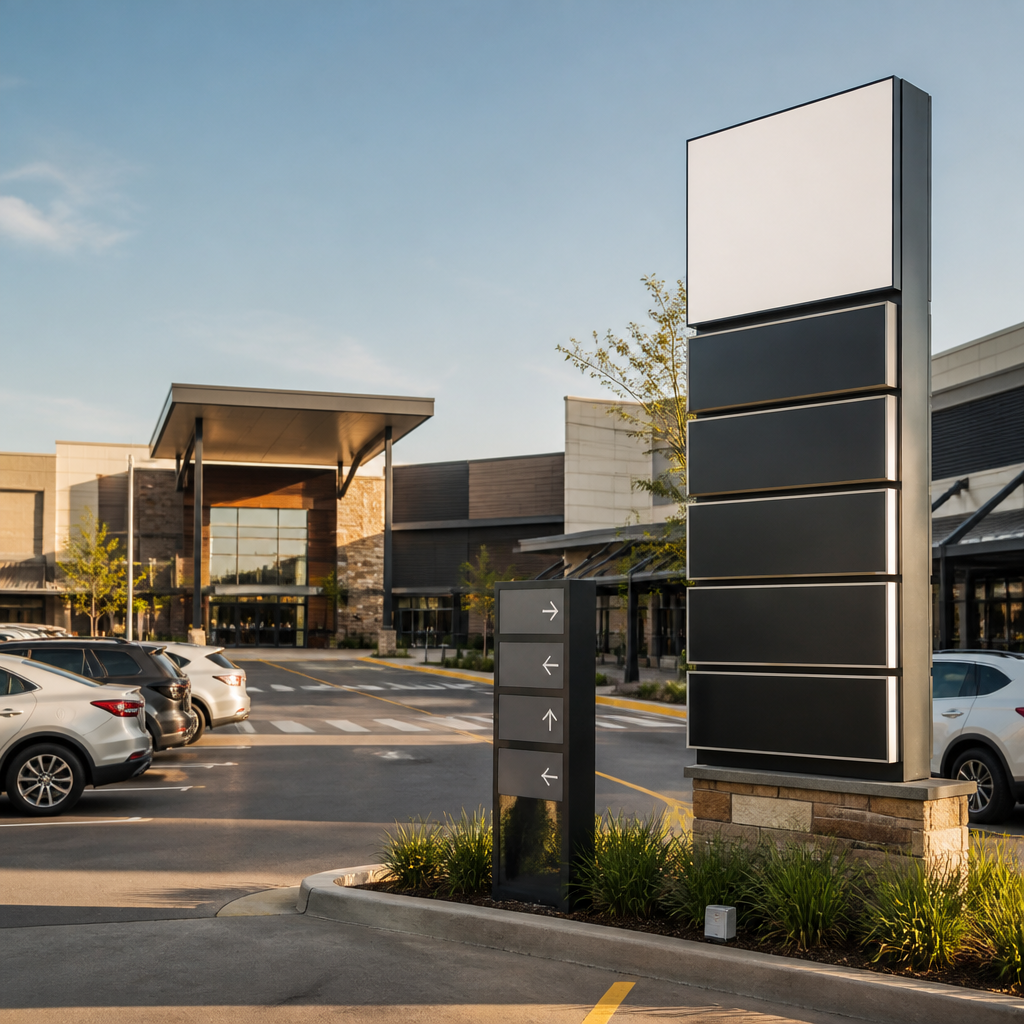
Channel lettering and backlit fascia signs suit multi-tenant buildings with corporate occupiers, because they look deliberate from the road and age well when maintained. Pylon signage makes sense where a site sits back from the road or competes with other frontages, since it lifts the name above the traffic. Vinyl or banner boards are the cheapest way to market a vacancy, but they are also the easiest to let deteriorate.
| Approach | Best suited to | Effect on perceived value |
|---|---|---|
| Channel lettering and backlit fascia | Multi-tenant offices and retail frontages | Strong and lasting when maintained, reads as managed |
| Pylon or monument signage | Sites set back from the road or on busy arterials | Improves findability, with value depending on the site's traffic |
| Vinyl or banner boards for vacancies | Short-term letting and temporary campaigns | Helpful while new, damaging once faded or expired |
Mistakes that erode the benefit
The most common mistake is buying a premium format for a site that cannot support it. A backlit fascia on a building with poor sightlines produces a good photograph and very few enquiries. The second mistake is leaving temporary boards up long after they stop doing their job, which quietly turns a marketing tool into evidence of a building that is struggling to let.
Whatever format you choose, decide it against the site's traffic, the tenant profile and the maintenance budget you will actually keep. A cheaper sign that gets replaced on schedule usually beats an expensive one left to fade.
Corporate Identity and Brand Standards
Corporate identity is where signage moves from decoration into a visible record of how a property is run. A building that carries consistent colours, fonts, mounting positions and sign sizes looks like it has an owner who sets standards. That impression matters to corporate tenants checking whether a building fits their own brand, and it matters to buyers who want a portfolio that will hold its appearance over time.
Why brand consistency reads as value
When a precinct carries one clear visual system, visitors can tell where one business starts and another ends. Inconsistent signage makes a building look like a collection of separate decisions made by people who never spoke to each other. A valuer may not put a number on that difference, but a corporate occupier notices it during a site visit.
Consistency is one of the few signage qualities that improves with age, because every year of disciplined maintenance makes a building look more intentional.
Enforcing standards across franchise tenants
Franchise systems often come with strict brand manuals, which helps the landlord when approvals are requested. The difficulty is that some franchisees bring their own sign package, and some regional offices approve sizes the building cannot carry. A simple rule works well: the landlord approves the location and structure, the franchise brand approves the artwork, and both sign off before fabrication starts.
Pro tip: Keep a master register of every approved sign on the property, with the drawing reference, approval date and permit number. When a tenant changes, the register shows exactly what can be removed and what must stay.
Maintenance, Measurement and Record Keeping
A sign only protects property value while it is working. Once lettering fades, illumination fails or a panel starts to lift, the building loses the benefit the sign was meant to deliver. Maintenance is therefore part of the value case, not a separate operational task, and it belongs in the same budget line as roofing or painting.
Maintenance schedules that protect the asset
A practical schedule includes a monthly visual check from the road, a quarterly check of lighting and fixings, and an annual inspection that compares every sign against its approved drawing. Night checks matter, because a sign that is lit on Monday may stay dark for a week before anyone reports it. Record what was fixed and when, so the history is ready when a buyer asks.
Tracking whether signage is paying off
Measure before and after any change. Note enquiries, viewings and time to let for vacant units, then compare them with the period before the new sign went up. Your own numbers are more useful than any general claim about signage, and they will show whether the next upgrade is worth the cost.
Keep these records in the same file as the lease, the permits and the maintenance invoices. When the property is valued or sold, that file answers most questions about the frontage before the buyer asks them.
Frequently Asked Questions
Does signage actually increase the market value of a commercial property?
Signage rarely appears as a separate line in a valuation, but it influences the factors that do, including letting speed, tenant quality and how well the building holds its appearance. The effect is real but indirect, and it is strongest where the sign is well placed, lit and maintained.
Do I need municipal approval for a sign on my own building?
In most cases, yes. The City of Cape Town requires outdoor advertising and signage to be approved before it is displayed, and Tshwane runs similar controls. Some small, un-illuminated on-premises signs may be exempt under local by-laws, so check the specific rules for your municipality before ordering.
How long can a letting board stay up on a vacant unit?
Tshwane's guide states that a real estate agent sign may not be displayed on commercial or industrial use for longer than twelve months. Other municipalities set their own limits, so confirm the rule for your area and set a removal or review date when the board goes up.
What should a landlord include in a signage clause in the lease?
Include who designs and approves signs, who pays for installation and removal, who holds the permits, and the minimum standards for size, illumination and mounting. Attach drawings so the agreed position is clear when a tenant leaves.
Is a backlit sign always better than a standard fascia sign?
No. Backlighting helps most where the building is visible after dark and the tenant trades into the evening. On a site with limited night traffic or strict approval limits, a well-made non-illuminated fascia can do the same job for less.
Have you seen a signage change shift enquiries or letting times on a property you manage, and what did you learn from it?