


Construction Hoarding Signage South Africa: Brand Your Site
Most building sites in Gauteng sit behind plain fencing for months, and most of that fencing says nothing at all. That is a missed opportunity. A hoarding along a busy road can be seen by thousands of drivers and pedestrians every day, and good construction hoarding signage South Africa developers can rely on carries a project identity, a tenant brand, and clear safety messages in one system. Done properly, the same boards keep the public safe and keep you on the right side of inspectors. Here is how we approach it at SignShopper, from the first safety notice to the last panel change.
Table of Contents
- Quick Takeaways
- Why Hoarding Is Your Largest Static Billboard
- Mandatory Safety Signage Comes First
- Designing Brand Panels That Survive Gauteng Weather
- Keeping Corporate Identity Intact on a Live Site
- Choosing a Hoarding Graphics System
- Municipal Approvals, Size Limits, and Permits
- Rental Hoarding Graphics and Phased Changeovers
- Frequently Asked Questions
- References
Quick Takeaways
| Key Insight | Explanation |
|---|---|
| Treat hoarding as an advertising asset and a legal duty at once | Plan safety notices and brand panels as one layout from day one, not as two separate jobs. |
| Legibility beats size | People reading from a pavement or a moving car take in a few words. Keep headlines short and high contrast. |
| Check the municipal by-law before you order | Size caps, illumination rules, and approval requirements vary by municipality, so confirm them before anything is printed. |
| Design for wind and summer storms | Gauteng thunderstorms punish loose panels. Specify fixings and substrate for each elevation, not for the whole site. |
| Lock corporate identity specs into the brief | Colour values, logo clear space, and approved taglines should be signed off in writing before a panel goes to print. |
| Plan graphic changeovers by construction phase | Swap messages when the leasing number, opening date, or handover date changes, instead of leaving outdated boards up. |
| Match the model to the project length | Short builds often suit rented panels. Multi-year developments or groups with many sites may justify owned systems. |
Why Hoarding Is Your Largest Static Billboard
Who Actually Sees a Site Hoarding
A site hoarding is seen by people who would never open a brochure. Commuters on a daily route, delivery drivers, shop owners across the road, and residents walking past all see the same stretch of fencing for the full length of the build, which can run for several months or more than two years on a mid-sized development.
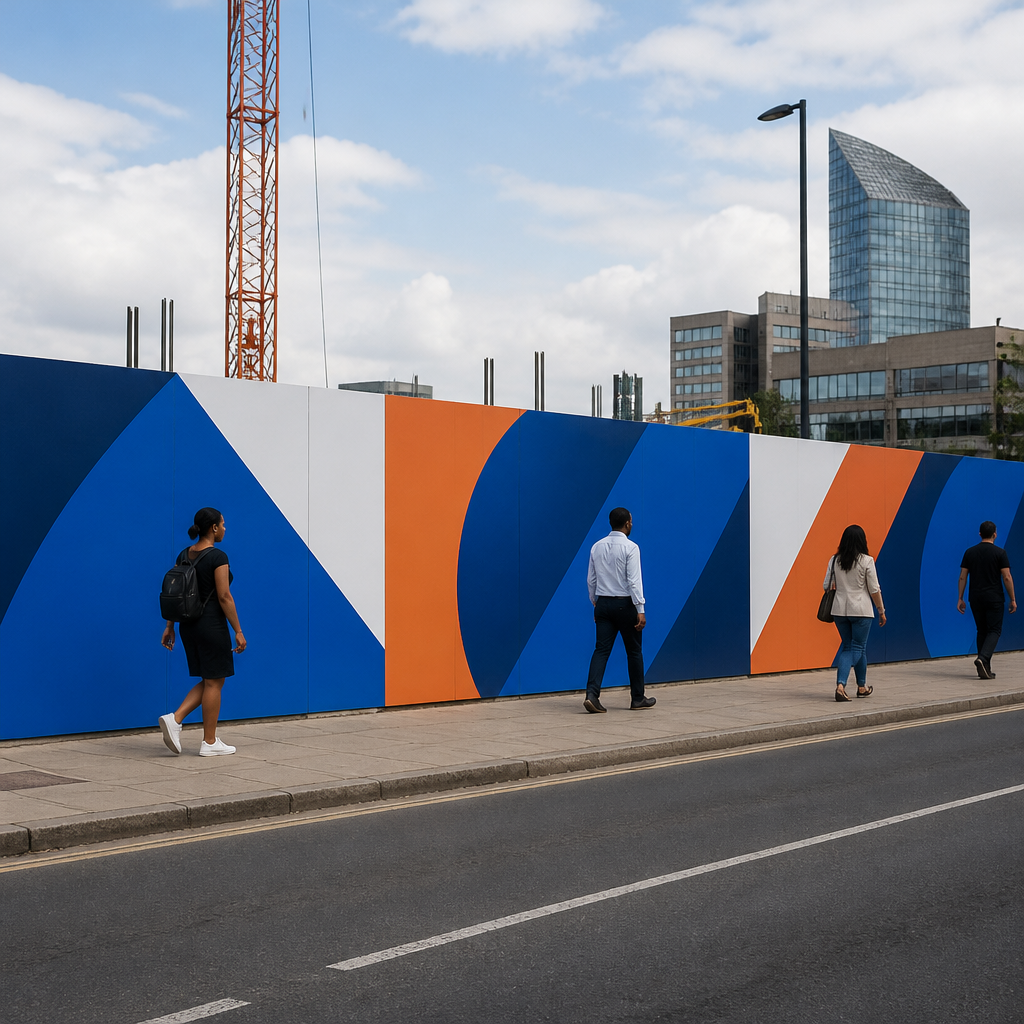
On high-traffic roads in Johannesburg and Pretoria, a hoarding can outlast the launch campaign that was meant to promote the same project. The catch is that most people read a hoarding at walking or driving speed, which gives them a few seconds at most. A panel that tries to say everything ends up saying nothing. Give each panel one job: the project name, the developer's logo, a leasing number, or an opening date.
What a Good Brand Panel Does in Five Seconds
Good panels follow a simple hierarchy. The logo or project name comes first, one line of supporting text comes second, and a contact or website comes third. Colour contrast matters more than detail, because a dark logo on a pale background stays readable at ten metres, while a fine line illustration disappears into the grey of the fence.
Use a consistent grid across the full run of panels. A hoarding that reads as one continuous message, with repeated colour bands and a fixed logo position, looks deliberate. A hoarding built from unrelated posters looks like a site that has given up on presentation.
A hoarding is the only sign on a project that is guaranteed to be seen every single day. Treat it with the same discipline you would give a shopfront.
Mandatory Safety Signage Comes First
Before any brand artwork goes on a hoarding, the safety layer has to be in place. The UK guidance we reviewed treats hoarding signage as one system covering safety, security, compliance, and community information, and that framing works well in South Africa too. Local sites operate under the Occupational Health and Safety Act and its construction regulations, so the exact notices required on your site should come from your health and safety agent, not from a generic template.
Principal Contractor and Emergency Contact Details
The contractor's name, a working phone number, and an after-hours emergency contact should appear at every entrance and at regular intervals along the perimeter. The UK guide lists these as core elements, and the logic carries over. A neighbour who sees a cracked wall or a hazard on the pavement needs to know who to call without walking into the site office.
Restricted zone notices belong at each access point, not only at the main gate. Pedestrians often enter through a gap in a fence line that was never meant to be a gate, so every point of access needs its own message.
Warnings That Must Be Legible from the Pavement
Legibility is where most sites fail. A warning printed on A4 paper and fixed three metres up a panel is invisible to anyone standing on the pavement. Size warning text for the real viewing distance, and confirm the mounting height relative to pavement level before the artwork is approved.
Pro tip: Stand on the pavement at the exact spot where a pedestrian would first see each warning, then walk backwards until the text becomes hard to read. Measure that distance and design the minimum text size on your artwork to work at it.
Fragile roof edges, asbestos or other hazardous material notices where relevant, and overhead work warnings should be placed where they can be read before a person reaches the danger. Put each warning on the hoarding nearest its hazard, not on a generic panel at the front. Keep these messages in plain, high-contrast text, and never let a brand colour overpower them. A red warning band on a red brand panel is a common mistake that makes both messages harder to read.
Designing Brand Panels That Survive Gauteng Weather
Gauteng's weather is hard on hoarding. Summer brings afternoon thunderstorms with strong gusts, and the dry months bring dust and sun exposure that fades inks. A panel that looks sharp on installation day can look tired within a season, and loose graphics on a fence line become a safety issue as well as an eyesore.
Print Substrate and Panel Sizing
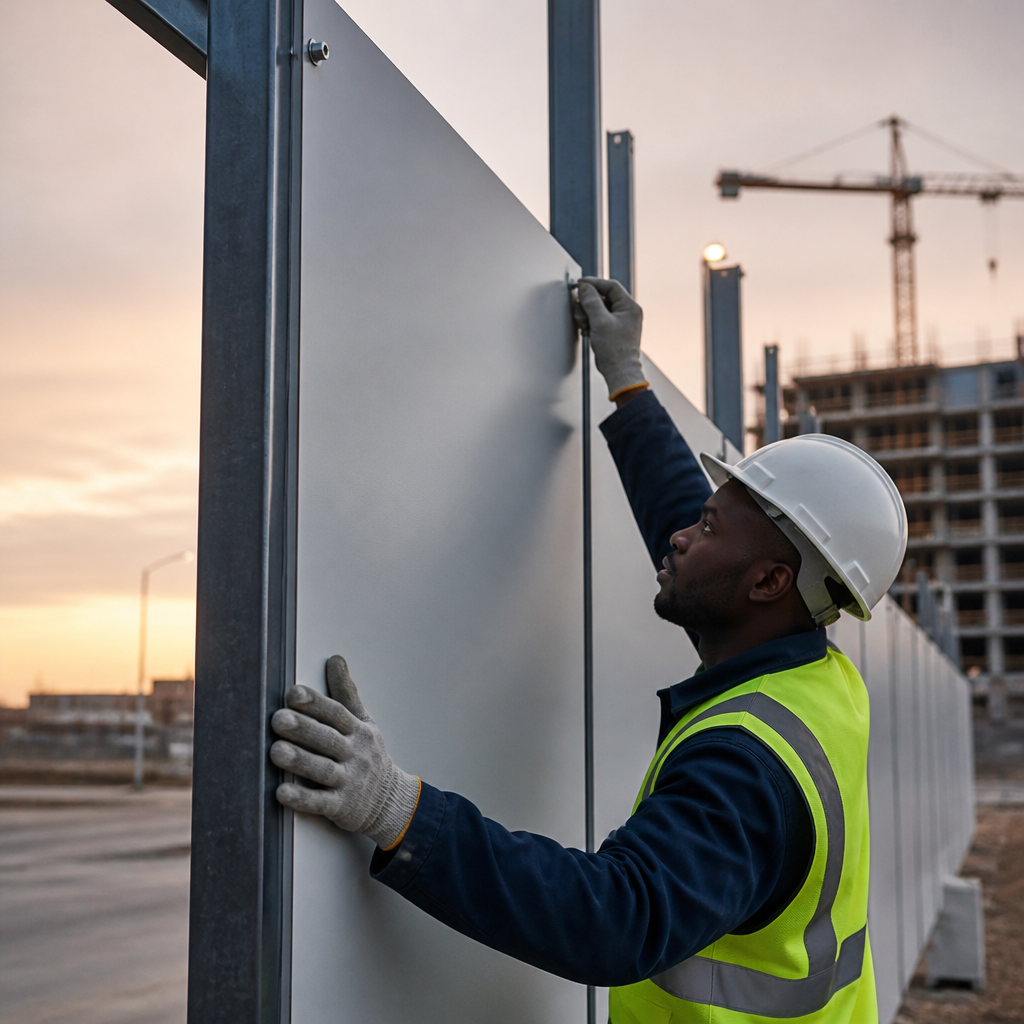
Mesh banners are light, let wind pass through, and suit long perimeter runs. Solid printed panels carry richer colour and sharper detail, but they catch wind and need a stronger frame. Choose the substrate based on the wind exposure of each elevation, not on the cheapest quote for the whole site.
Panel size should match the fence module. Artwork that breaks across two modules at a joint looks misaligned every time a panel is replaced. We design to the module grid first and build the graphic around it.
Wind Load and Fixings
Large format panels on a fence that was never designed to carry them are a common failure point. Ask the hoarding contractor for the fixing schedule and the maximum panel area per post, and make sure the printer and the frame builder have agreed on those numbers before production starts. A sign that lifts off a fence in a storm becomes a hazard on a public road.
Inspect fixings after the first major storm of each season. Check for torn eyelets, bent brackets, and panels that have started to tear at the corners. Replacing one torn section early costs far less than repairing a sheet that has flapped for a month.
Pro tip: Order one spare panel per elevation at the start of the job. When a storm tears a section or a delivery truck clips a board, a matching spare saves you from a visibly mismatched run of colour.
Keeping Corporate Identity Intact on a Live Site
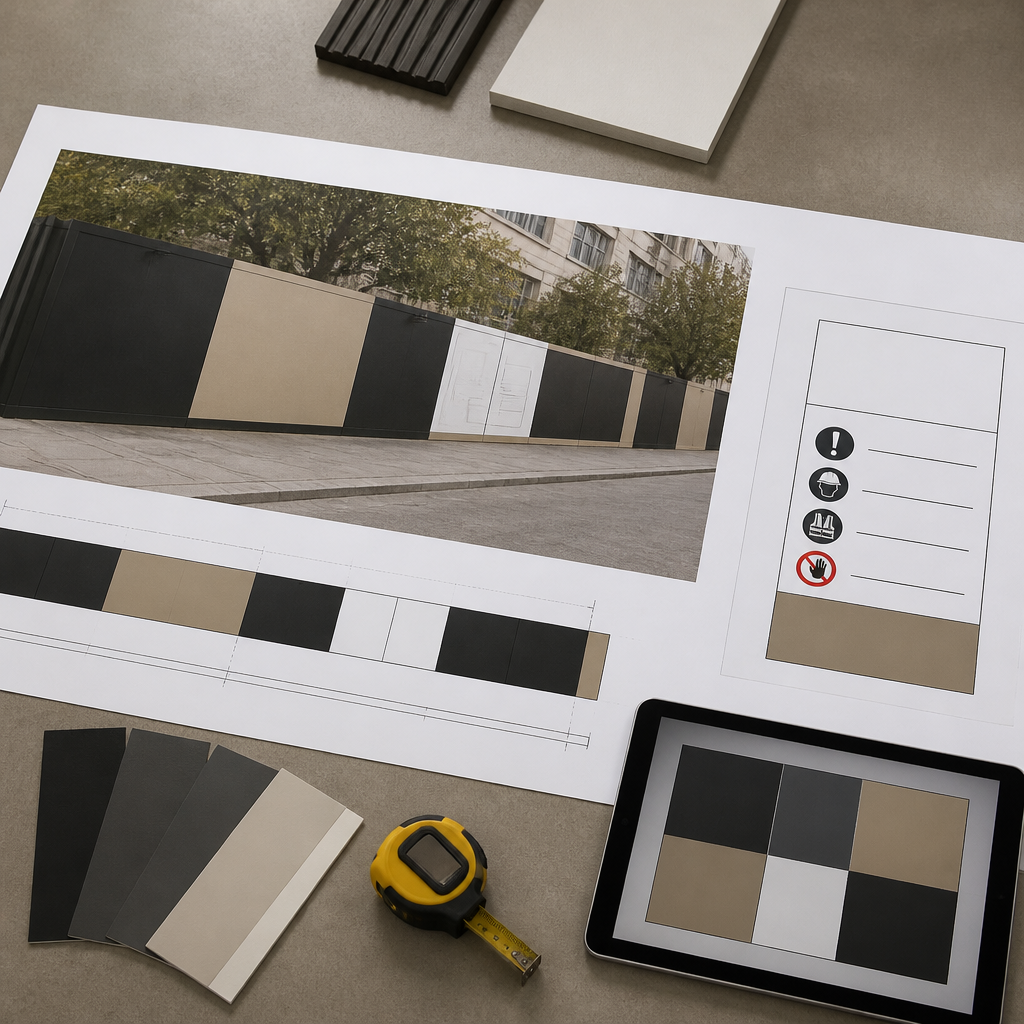
Corporate clients and franchise groups have strict brand rules, and a hoarding is where those rules are tested most visibly. Colour values, logo clear space, minimum sizes, and approved fonts all have to survive the move from a brand manual to a twenty-metre run of fence. Errors here show from every angle and are hard to explain away.
The fix is to treat the hoarding as a brand application, not a construction afterthought. Give the brand team actual panel dimensions and full-scale sample renders, and ask for written sign-off before a single panel goes to print. Colour shifts between a screen proof and printed vinyl, so request a physical colour swatch from a test print.
Brand Guideline Sign-Off Before Print
Build a one-page checklist covering the logo version, colour codes, approved taglines, the legal entity name, and any regulated wording. Name the people who can approve changes. Most delays on corporate projects happen when a brand reviewer sees the mock-up for the first time after production has already begun.
Franchise Rollouts Across Multiple Sites
Franchise groups often run the same hoarding design across several sites in different towns. The risk is drift. One site uses an older logo file, another changes the tagline, and a third drops the franchise number. Keep a master file under version control and issue site-specific artwork from it, so every hoarding in the portfolio matches the current standard.
The first time a hoarding is photographed and shared online, it is judged as a brand statement, not as a construction fence. Design it to that standard from day one.
Choosing a Hoarding Graphics System
There is no single best hoarding graphics system for every site. The right choice depends on how long the project runs, how exposed the elevation is, and how often the message must change. Three approaches cover most of the decisions we see.
Where Each Option Earns Its Place
Printed mesh or vinyl banners suit long perimeter runs, short timelines, and sites with moderate wind exposure. They are quick to produce and easy to swap, but they show wear sooner and need regular fixing checks. Rigid panels are better for frontage hoarding on busy roads, where a clean, flat face matters and the project will run for many months.
Backlit or illuminated hoarding sections are a niche choice. They make sense on high-traffic evening routes or beside a hotel or retail frontage that needs night visibility. They cost more to power and maintain, so use them on the elevations that earn the attention rather than across the full perimeter.
| Approach | Best For | Main Trade-off |
|---|---|---|
| Printed mesh or vinyl banners | Long perimeter runs and short to mid-length builds | Shows wear faster and needs regular fixing checks |
| Rigid printed panels | Busy road frontages and multi-month projects | Heavier, needs a stronger frame and careful wind planning |
| Backlit or LED hoarding sections | Evening high-traffic routes and hospitality frontages | Higher power, maintenance, and installation cost |
Our Default Recommendation
For most corporate and franchise projects, we start with rigid panels on the main road elevation, mesh banners on side and rear runs, and a lit section only where night visibility adds real value. This split puts the strongest brand presence where people actually look and controls cost across the rest of the perimeter. Review the mix at each phase change.
Municipal Approvals, Size Limits, and Permits
A hoarding that is brilliant on paper can still be stopped by the municipality. Sign and advertising rules are set locally, and they can cover size, placement, illumination, and how long temporary signs may stay up. Confirm the rules for your specific municipality before you commit to a design.
One example from the South African legal library is a signs and advertising hoardings by-law that limits flat wall signs to 20 square metres in total area, subject to the exceptions in that by-law. That figure applies to flat signs on a building wall, so it does not automatically set the limit for a hoarding panel. It does show that size caps are real, and a design that ignores them can delay your project.
What the By-Law Typically Covers
Read the definitions section first, because a hoarding may be treated as a temporary structure, a sign, or both, depending on the wording. Then check size limits, illumination rules, and whether an approval or permit is required before installation. Ask for the document in writing and keep a copy in the site file.
Working With Your Municipality Early
Submit the design before the print run, not after the hoarding is up. A short pre-application conversation with the relevant municipal department often exposes a problem that would otherwise cost a full reprint. The rules for a site in one Johannesburg suburb can differ from those in Pretoria or Ekurhuleni, so never assume a design approved on one project will carry over to the next.
Rental Hoarding Graphics and Phased Changeovers
Not every developer wants to buy a hoarding system. For shorter fit-outs, refurbishments, and event-linked sites, renting panels keeps capital in the construction budget where it belongs. The same logic applies to temporary event hoarding, where the message changes around an opening or a launch.
When Renting Makes More Sense
Renting suits projects that run for a few months, sites where the message will change several times, and developers who want a consistent look without investing in a full system. Owned systems pay off on multi-year developments and on groups that run hoarding across many sites. Compare total cost over the actual project length, including installation, removal, storage, and any repair after damage.
Scheduling Graphic Changes Around Construction Phases
Hoarding messages should change as the site moves from groundworks to structure to finishes. Swap the leasing number once the show unit opens, then switch to the handover date. Build these changeovers into the project programme so a graphic does not stay up for six months after its message is out of date.
Pro tip: Put the changeover dates on the project programme and assign one person to own the artwork calendar. A hoarding that still advertises a sold-out phase damages credibility, and a simple schedule prevents it.
Frequently Asked Questions
Does construction hoarding signage have to meet legal requirements in South Africa?
Yes. Site safety notices and perimeter controls fall under South African occupational health and safety rules, and municipal by-laws control the size and placement of signs. Your health and safety agent should confirm the mandatory notices for your site, and your municipality should confirm the sign rules.
Can I put my brand on a hoarding without approval?
Not always. Branded panels may need municipal approval depending on size, illumination, and location. Check the local by-law before printing, and submit the design early if the site sits on a main road.
How long should a site hoarding graphic last?
Printed mesh and vinyl usually need checking after each storm season and can show wear within months of exposure. Rigid panels hold up better on exposed elevations. Schedule regular inspections so torn or faded sections are replaced before the site looks neglected.
What is the most common mistake in construction hoarding branding?
Designing for the screen instead of the pavement. Text that looks clear at arm's length becomes unreadable from a moving car or across the road. Measure real viewing distances, then size the headline and contact details to match.
Is renting hoarding graphics cheaper than buying?
For most builds that finish within a year, renting is the better financial choice, especially when the message changes often. Owned systems make more sense on multi-year projects or across many sites. Compare total costs over the full programme, including installation and removal.
What approval, weather, or brand sign-off problem has caught you out on a live site, and how did you solve it?