


Petrol Station Signage in South Africa: Built for Speed
A driver decides whether to pull into a petrol station in the few seconds between spotting the canopy and reaching the pump lane. If your petrol station signage cannot be read at that pace, the brand, the fuel price and the shop offer all go unseen. Forecourt branding is not decoration. It is the first thing a driver processes, and in a market where rebrands, mergers and new owners keep changing who sits under the canopy, getting it right has direct sales consequences. This guide covers what works at speed, from sight lines and lighting to rebrand planning and permits, written from the position of a signage provider that delivers these projects across Gauteng.
Table of Contents
- Quick Takeaways
- Reading at Driving Speed
- Gauteng's Fuel Market and What It Means for Signage
- Rebrands and Sign Changeovers
- Canopy Lighting and Night Visibility
- Choosing Between Pylons, Canopy Fascias and Price Boards
- Permits, Approvals and Installation Timing
- Rental Options for Promotions and Events
- Frequently Asked Questions
- References
Quick Takeaways
| Key Insight | Explanation |
|---|---|
| Read distance is the design brief | Design the brand mark to be legible from the approach lane, not from the forecourt. Test the sign from the road, not from a desk. |
| Fuel prices are read first | Keep price digits high contrast, consistently placed and at the same height on every board so drivers find them without scanning. |
| Gauteng carries serious volume | Kalibrate's 2024 analysis puts Gauteng, KwaZulu-Natal and Cape Town at 67% of national fuel consumption, so Gauteng sites compete for drivers in a dense market. |
| Rebrands create repeat sign work | Caltex sites moving to Astron show that changeovers happen in waves. Specify modular faces that swap without rebuilding the structure. |
| Night colour must be tested at night | LED colour temperature changes how brand colours look under canopy lights. Approve a lit sample on site, not a printed proof. |
| Permits come before fabrication | Large illuminated and pylon signs commonly need municipal approval. Waiting for approval after fabrication costs weeks and sometimes the sign itself. |
Reading at Driving Speed
A forecourt sign is read in a different way from a shop fascia. The driver is moving, often well above walking pace on the approach, and is scanning for a fuel brand, a price and a turn-in point in a few seconds. The sign has to deliver all three before the driver has committed to a lane.
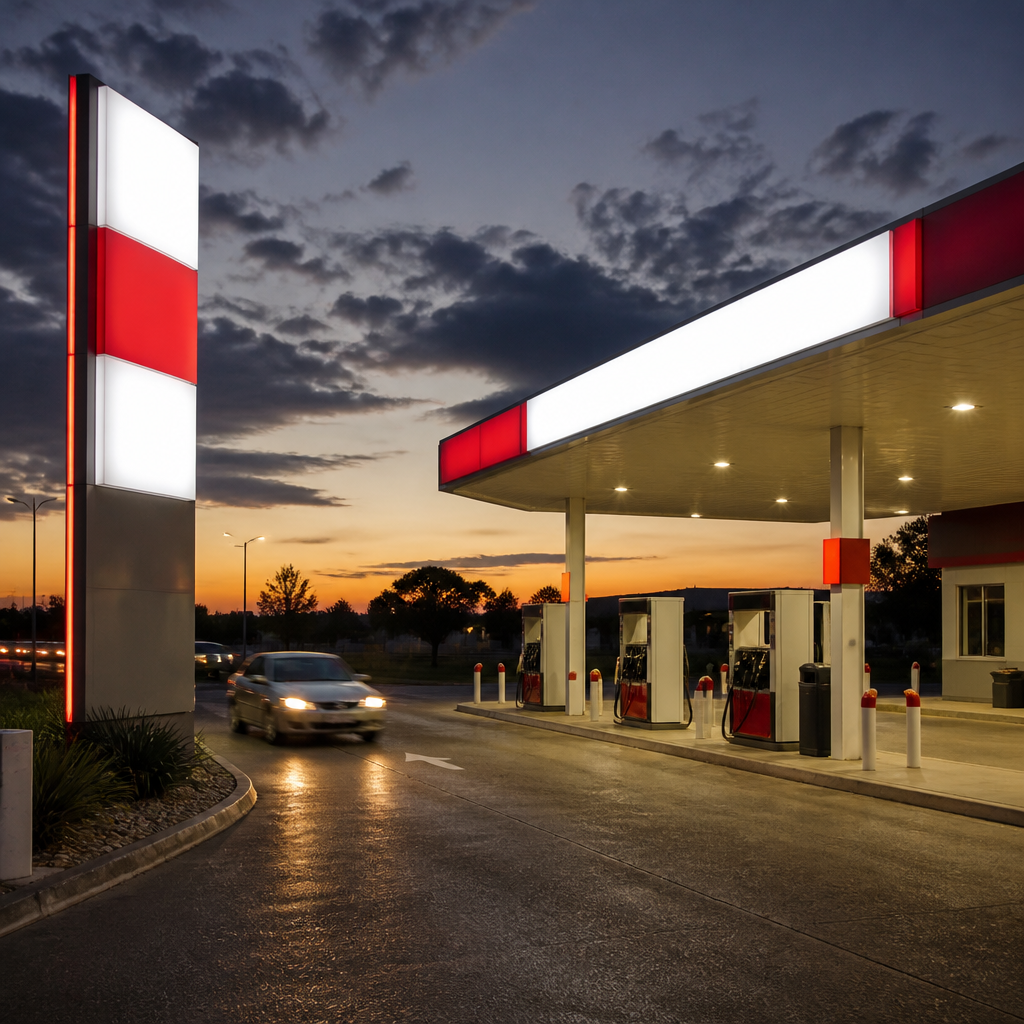
In practice, we use a simple test. Stand at the point where a driver first picks up the site, then check whether the brand mark and fuel price can be read without slowing down. If the answer depends on the driver looking twice, the sign has failed.
Sight lines and approach angles
Most forecourts are approached from more than one direction, and a sign that faces the pump island is often invisible from the main road. Pylon signs solve the approach problem because they sit above the traffic line and inside the driver's eye line. Position matters more than size. A smaller face placed where a driver looks is more effective than a large one set back behind a fence line.
Brand mark before the words
A driver recognises a colour and a shape before a word. Research on fuel station brand positioning has found that drivers link some brands more closely with the tangible features of a station than others, which means the physical site is part of the brand story. A University of KwaZulu-Natal study covered the six major petrol brands in South Africa: BP, Caltex, Shell, Engen, Total and Sasol. Keep your brand colours exact, because a non-standard tint makes drivers hesitate. They are no longer sure they are at the right station.
On a forecourt, a sign is a driving decision made before the car has stopped.
Pro tip: Drive the approach at the speed your customers drive it, and photograph the site from the lane, not from the shop window. A phone camera held at windscreen height shows you what the driver actually sees.
Gauteng's Fuel Market and What It Means for Signage
Kalibrate's analysis of the South African retail fuel market, published in September 2024, gives a useful picture of where sign spend will concentrate. Across the country, approximately 30bn litres of fuel is consumed per year, and Gauteng, KwaZulu-Natal and Cape Town together consume 20bn litres, or 67% of the total. For a Gauteng operator, that concentration means your site sits in one of the most contested fuel markets in the country.
Where the volume sits
Volume is not the same as profit, but high-throughput sites are where drivers see your branding most often. A sign that works for a commuter who fills up every second morning has to be readable in the same conditions as one for a fleet driver who stops once a week. Your design has to work for both the daily regular who knows the site and the stranger who has never seen it.
Oil major moves that shape demand
Kalibrate notes that Glencore acquired Chevron's Caltex-branded network in South Africa in 2018, and that nearly 50% of that network now shows Astron Energy colours. Engen and Vivo Energy completed a merger, and Shell announced in May 2024 its intent to exit shareholding in its South African retail operations. BP followed with a stated long-term strategy to invest in South Africa. Each move produces sign work, whether it is a full changeover, a partial refresh or a new owner's first branding package.
The lesson for site owners is that brand changes are not one-off events. Expect ownership changes to ripple through a region over several years, and plan your sign assets so that a change in colour or logo is a face swap rather than a structural rebuild.
Rebrands and Sign Changeovers
A rebrand is the moment when a forecourt is most likely to get its signage wrong. The old identity is still visible, the new one is partly installed, and drivers are unsure which brand they are buying from. Good changeover planning closes that gap quickly.
Phasing a changeover across sites
Where an operator runs many sites, do the work in waves that match fabrication lead times and each site's trading calendar. Start with the highest-traffic sites so the most drivers see the new identity first. Keep a standard list of face sizes so you order each component once. A common mistake is ordering by site rather than by component, which multiplies setup and delivery costs.
Digital price boards and fast content swaps
Digital price boards cut the cost of changing prices and promotions, but they also change the rebrand job. Chris Day, managing director at Moving Tactics, has said that digital signage can change and customise content at any given time, which replaces the paper and ink waste of printed swaps. On a forecourt, the practical gain is that a price change no longer needs a crew on a ladder.
Removing the old identity cleanly
Remove old faces before the new ones are fitted, and label removed components for storage or disposal. Leftover branding on a changeover site confuses drivers and can create a compliance problem with the brand owner. Ask the brand owner for written confirmation of which old elements must come down first.
Pro tip: Ask for the brand guideline pack before you quote. Colour specifications for illuminated faces often differ from print specifications, and you want that settled before fabrication starts.
Canopy Lighting and Night Visibility
The canopy is where most petrol station signage either works or fails after dark. Many forecourts trade for long hours, and drivers arriving at night judge the site by its illumination. A bright canopy with a dim fascia sign looks unfinished.
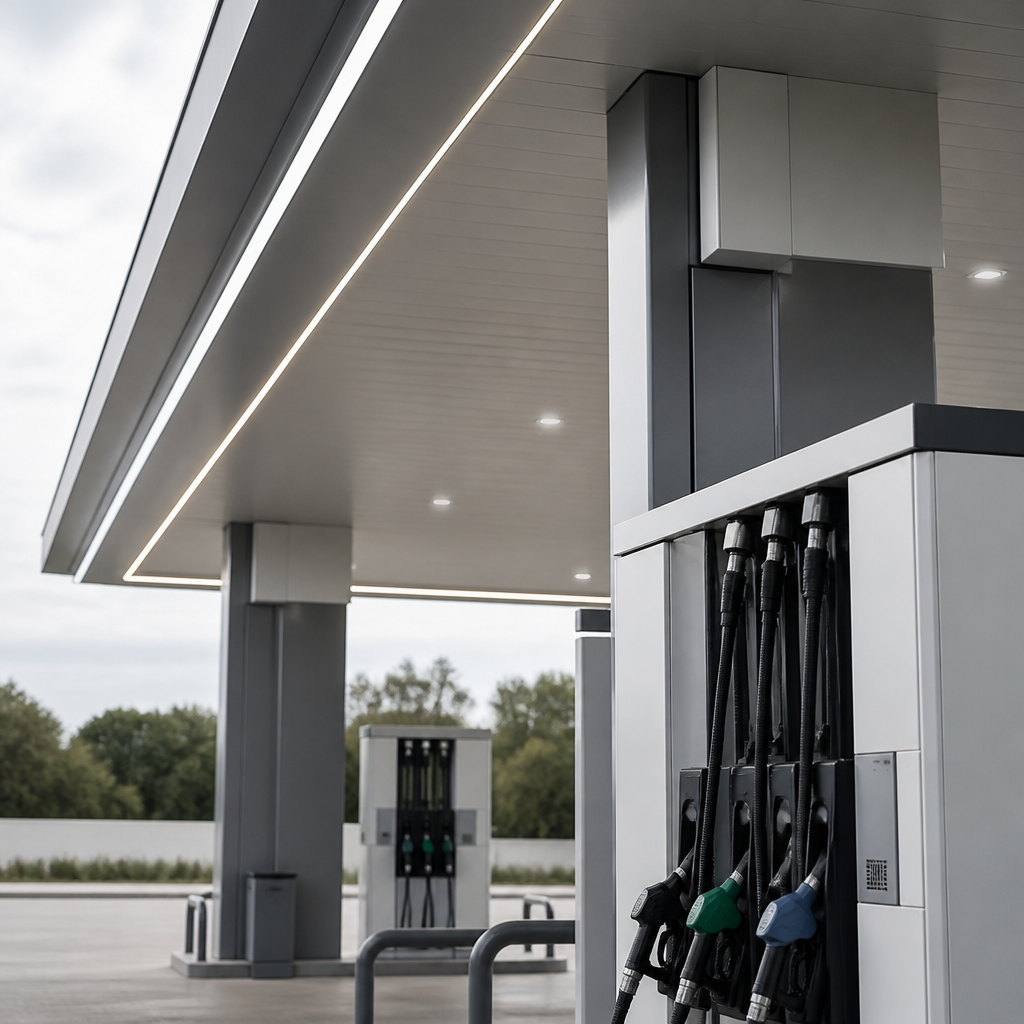
Our rule is that every illuminated face should be bright enough to read next to the canopy lights, not just in a workshop test. Brand colours shift under different LED temperatures. A red that looks right on a spec sheet can look orange under cool white canopy lighting.
LED temperature and colour matching
Specify LED colour temperature in the quote and check samples under the actual canopy lighting before production. Ask the fabricator to show a sample at night. Printed proofs rarely reflect how a backlit face will look once it is mounted.
Backlit faces versus channel letters at height
Channel lettering with LED modules gives a crisp edge at height and suits a fascia where the brand name is the message. Backlit boxes give a larger, more uniform colour field that reads well from the road, so they suit sites where the colour block carries the identity. Neon still has a place in shop-front and promotional work, but it costs more to maintain and drifts in colour over time. For a forecourt that runs every night, LED is usually the practical choice.
Pro tip: Schedule a night inspection three months after installation. Dimming, dead modules and colour drift are cheaper to fix early, and a single dark letter on a fascia is often the first sign of neglect.
Choosing Between Pylons, Canopy Fascias and Price Boards
Most forecourts need three sign types working together: a tall identifier, canopy branding and price information. Trying to make one sign do all three is the most common design error we see. Each element has a different viewing distance and a different job.
| Approach | Best use | Main risk |
|---|---|---|
| Pylon sign | Long approach roads and sites visible from multiple directions | Too much content on one face makes it unreadable at speed |
| Canopy fascia branding | Brand recognition at the pump island and on the forecourt | Poor night contrast if the canopy lighting is not matched to the fascia |
| Digital or LED price board | Fast price and promotion changes with consistent digits | Inconsistent placement across boards teaches drivers to search for prices |
The table is a starting point, not a shopping list. Begin with what the driver needs at the approach distance, then work backwards to size and height.
Pylon height and content limits
A pylon is the sign drivers see from farthest away, so it should carry the brand mark and, where permitted, the fuel prices. Keep the content simple. More than four or five elements turns a sign into a noticeboard. Drivers cannot read a noticeboard at 60 kilometres an hour.
Price information that stays legible
Fuel prices must be legible at the approach distance and kept accurate. Use high-contrast digits with consistent placement on every board so drivers learn where to look. A common mistake is mixing price fonts across pylons and price boards on the same site, which makes the prices look like they belong to different stations.
When a canopy fascia is enough
On smaller forecourts with a short approach, a well-lit canopy fascia can carry the brand, and a separate pylon may be unnecessary. Be honest about the sight lines before you commit to a pylon budget. A pylon that nobody can see from the road is a cost with no return.
Permits, Approvals and Installation Timing
Signage on a petrol station is subject to approval processes that many operators underestimate. Large illuminated signs, pylons and signs close to roads commonly need municipal approval, and the requirements differ between municipalities. Confirm them before fabrication, because a sign that is built and then refused costs far more than a permit delay.
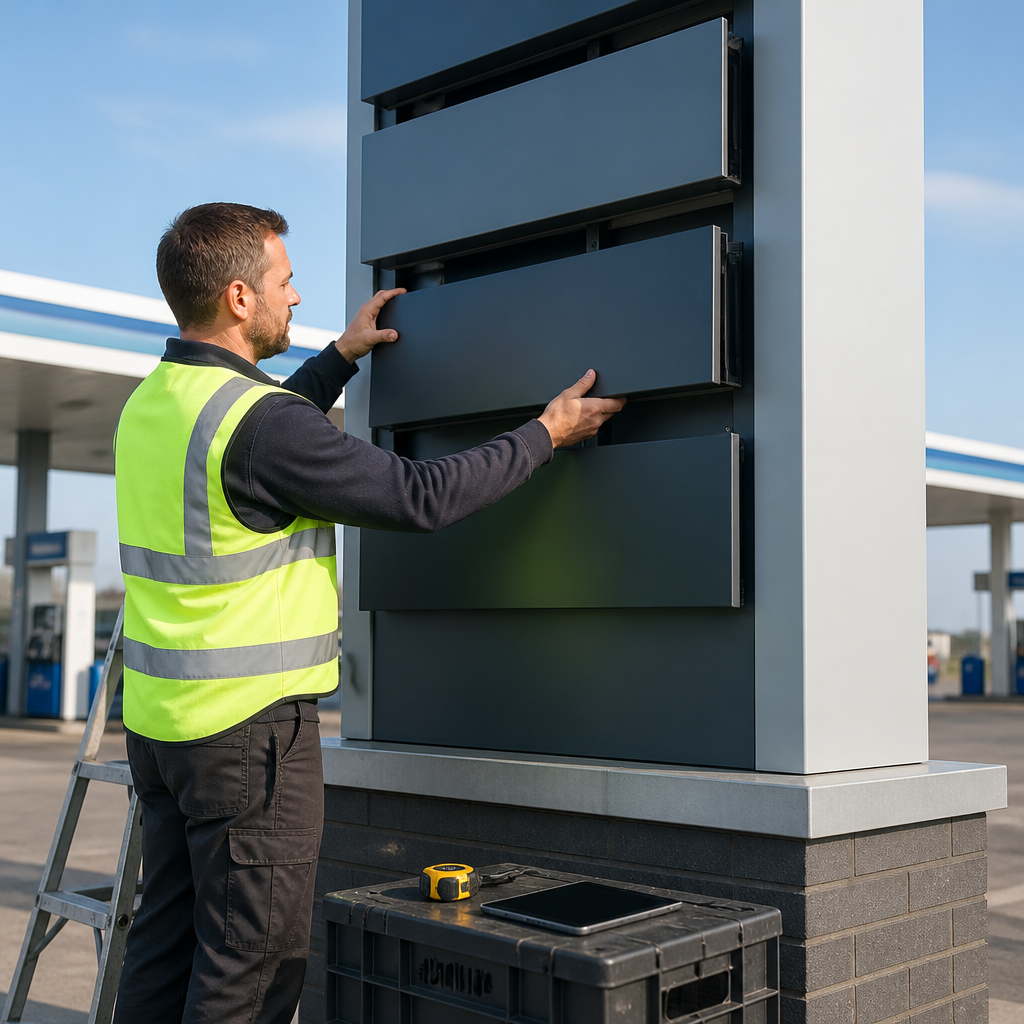
We do not give legal advice on permits, but we build the approval timeline into every project from the first site survey. That habit has saved more programmes than any design refinement.
Getting approvals in the right order
Submit drawings that show sizes, heights, illumination and location, then wait for approval before ordering aluminium and LED components. Where the brand owner must approve colour and layout, get that sign-off in the same step rather than after the sign is built.
Installation windows that avoid trading disruption
Schedule installations for quieter trading periods and coordinate with the site operator so fuel deliveries and crane access do not clash. Weather and holiday trading peaks are the usual causes of slipped programmes. Build a buffer of at least two weeks into the plan.
Structural checks and records
Pylon and fascia installations need structural checks for wind loading and fixings. Ask the engineer or fabricator for certification and keep it on file with the site's compliance records.
Pro tip: Keep one document per sign with its dimensions, power requirement, permit reference and installation date. When a sign needs repair years later, that record saves days of searching.
Rental Options for Promotions and Events
Not every forecourt needs permanent signage for a promotion. Fuel price campaigns, car wash launches, convenience store openings and sponsored community events often run for a few weeks. Buying permanent faces for them wastes capital and adds a permit you do not need.
Rental signage gives you visibility for the campaign period without the capital cost or the long-term approval process. The key is to treat rental stock with the same brand discipline as permanent work.
Temporary faces that still meet brand standards
Rental banners, freestanding display stands and portable LED units can carry promotional messaging, but they must follow the brand guide. Mismatched colours on a temporary sign do as much damage as on a permanent one, and drivers do not give a temporary sign the benefit of the doubt.
Planning rental stock around trading calendars
Book rental stock early for long weekends, school holidays and fuel price events. Stock that is unavailable on the day a campaign launches is a lost campaign, and the cost of that gap is higher than the rental fee.
Frequently Asked Questions
Do petrol station signs need municipal approval in South Africa?
Large illuminated signs, pylons and signs near roads commonly need approval, and the rules vary by municipality. Confirm the requirements for your specific site before fabrication starts.
What should a pylon sign show on a forecourt?
A pylon should carry the brand mark and, where permitted, the fuel prices. Keep the content to a few elements so it can be read from the approach road.
Is LED or neon better for forecourt signage?
For a site that trades every night, LED is usually the more practical choice because it holds colour consistency and needs less maintenance. Neon still suits some shop-front and promotional applications.
How long does a forecourt rebrand take?
The timeline depends on the number of sites, fabrication lead times and approval periods. Plan the rebrand in waves, start with high-traffic sites, and build approval time into the schedule from the start.
Can rental signage work for fuel promotions?
Yes, rental banners, display stands and portable LED units suit short campaigns such as price promotions or store openings. They must still follow the brand guidelines, and stock should be booked ahead of trading peaks.
We would like to hear from fuel station managers and franchise owners: which sign problem has cost your site the most drivers, and how did you fix it?
References
- Kalibrate analysis of the South African retail fuel market in 2024
- Five digital signage trends for South African retail and quick-service brands
- Research on brand positioning of fuel stations in the high-tier fuel category
- University of KwaZulu-Natal study on the six major petrol brands in South Africa