


Neon Signs with Backing Board South Africa Guide
Walk into almost any new restaurant, boutique gym, or upscale hotel in Gauteng and you will spot one: a glowing custom LED neon sign mounted on a crisp Perspex or timber backing board, commanding attention from across the room. Neon signs with backing board have quietly moved from novelty to near-standard fitment in South African commercial interiors, and for good reason. They deliver brand personality, ambient mood lighting, and social-media-ready visual impact in a single installation. Yet many business owners still choose their backing board type based on aesthetics alone, overlooking the installation, durability, and corporate-identity implications that separate a professional result from an expensive mistake. This guide covers all of it.
Table of Contents
- Quick Takeaways
- What Is a Neon Sign with a Backing Board?
- Backing Board Types: Acrylic, Wood, and MDF Compared
- LED Neon Flex Signs vs. Traditional Neon: Why the Switch Matters
- Interior Signage Applications Across Gauteng Industries
- Corporate Identity and Franchise Compliance
- Installation, Maintenance, and Lifespan Realities
- Backing Board Comparison at a Glance
- Frequently Asked Questions
- References
Quick Takeaways
| Key Insight | Explanation |
|---|---|
| LED neon flex is the practical standard | Modern LED neon flex signs built on Perspex or acrylic backing offer the classic neon glow without fragile glass tubes or hazardous gas, making them far safer and more practical for commercial interiors. |
| The backing board choice is not cosmetic | Acrylic, timber, MDF, and OSB backings each carry different weight, moisture resistance, and installation requirements. Choosing the wrong one for the wall surface or environment causes premature failure. |
| LED neon flex lasts up to 50,000 hours | Quality LED neon flex can run between 30,000 and 50,000 hours, compared to 8,000 to 15,000 hours for traditional glass neon, making the cost-per-year argument overwhelmingly in favour of LED. |
| Pre-drilled boards drastically cut installation time | A backing board supplied with pre-drilled mounting holes means a clean, fast wall installation without drilling into the neon flex itself, reducing the risk of on-site damage to the sign. |
| Acrylic backing suits events and relocations | For franchise pop-ups, trade shows, or rental installations, a full rectangular acrylic board allows the sign to be moved and re-installed repeatedly without structural compromise. |
| Corporate identity compliance is non-negotiable | Franchise and multi-site corporate clients must specify backing board dimensions, colour, and finish in their brand standards document so every location presents a consistent visual identity. |
| Rental solutions reduce capital expenditure | For events, pop-up activations, or short-term campaigns, renting a neon sign with backing board eliminates the upfront cost while still delivering full brand impact on the night. |
What Is a Neon Sign with a Backing Board?
A neon sign with a backing board is exactly what the name describes: an LED neon flex or traditional neon element mounted onto a solid panel that serves as both a structural frame and a design surface. The backing board holds the sign rigid, provides the mounting interface for the wall, and contributes its own visual character to the finished piece. Clear acrylic lets the wall behind show through for a floating effect. A coloured or painted board becomes part of the graphic composition itself.
In South Africa, the most common construction uses LED neon flex bent into custom lettering or shapes, then fixed to a Perspex or acrylic backing board. Each unit typically includes pre-drilled holes so it can be fixed directly to a wall surface using standoff locators, screws, or hanging hardware. The result is a self-contained sign that is both structurally sound and visually complete without requiring a separate mounting frame or built-in cabinet.
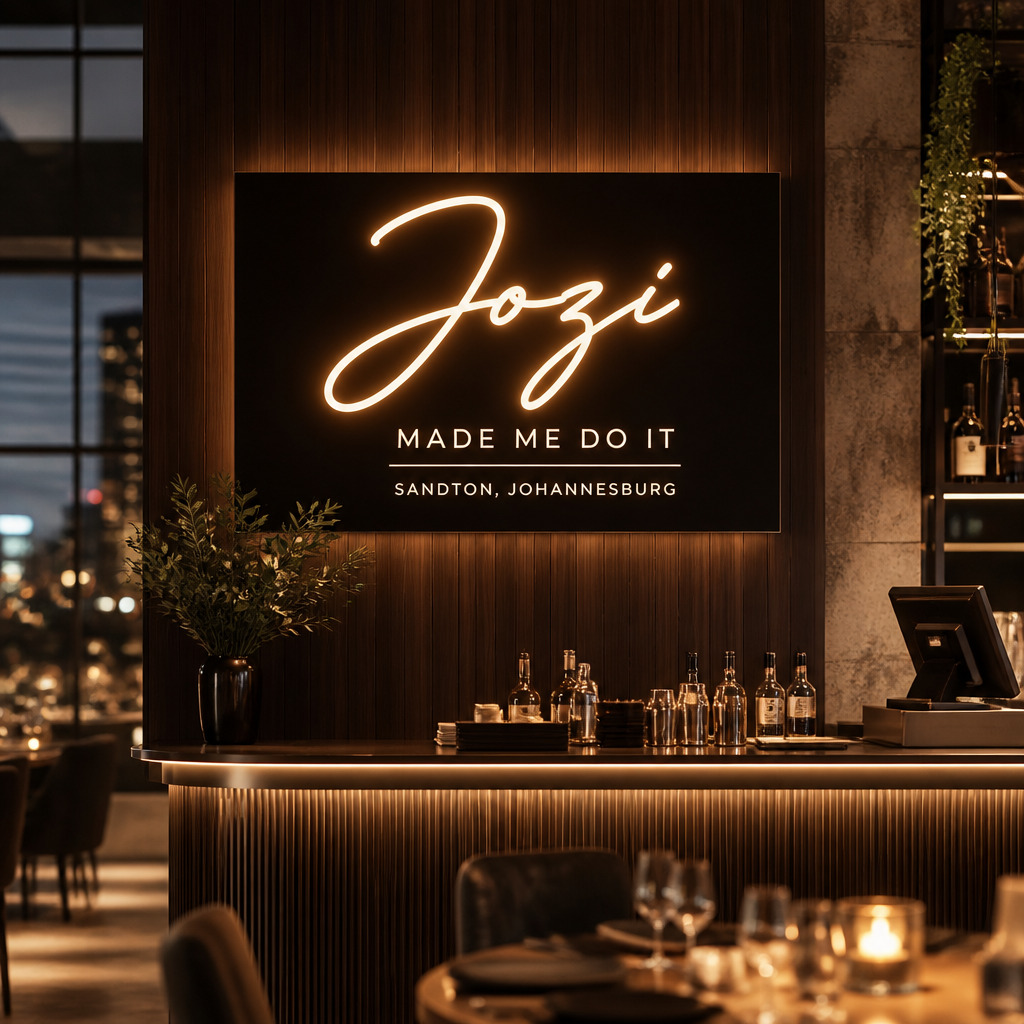
What makes these signs commercially relevant, rather than just decorative, is their versatility. A hospitality business can specify a warm amber glow on a reclaimed timber board to reinforce a craft aesthetic. A corporate office can opt for a cool white on a matte black acrylic board that aligns with its brand colour palette. The combination of neon element and backing material is what makes each installation site-specific and brand-specific at the same time.
The backing board is not just structural support. It is the frame through which the light is interpreted. Get the board wrong and even the best neon flex looks like an afterthought.
Backing Board Types: Acrylic, Wood, and MDF Compared
Not all backing boards are created equal, and the wrong choice for the environment or application will undermine both the look and the longevity of the sign. Here is what each material actually delivers in a South African commercial context.
Acrylic and Perspex Backing Boards
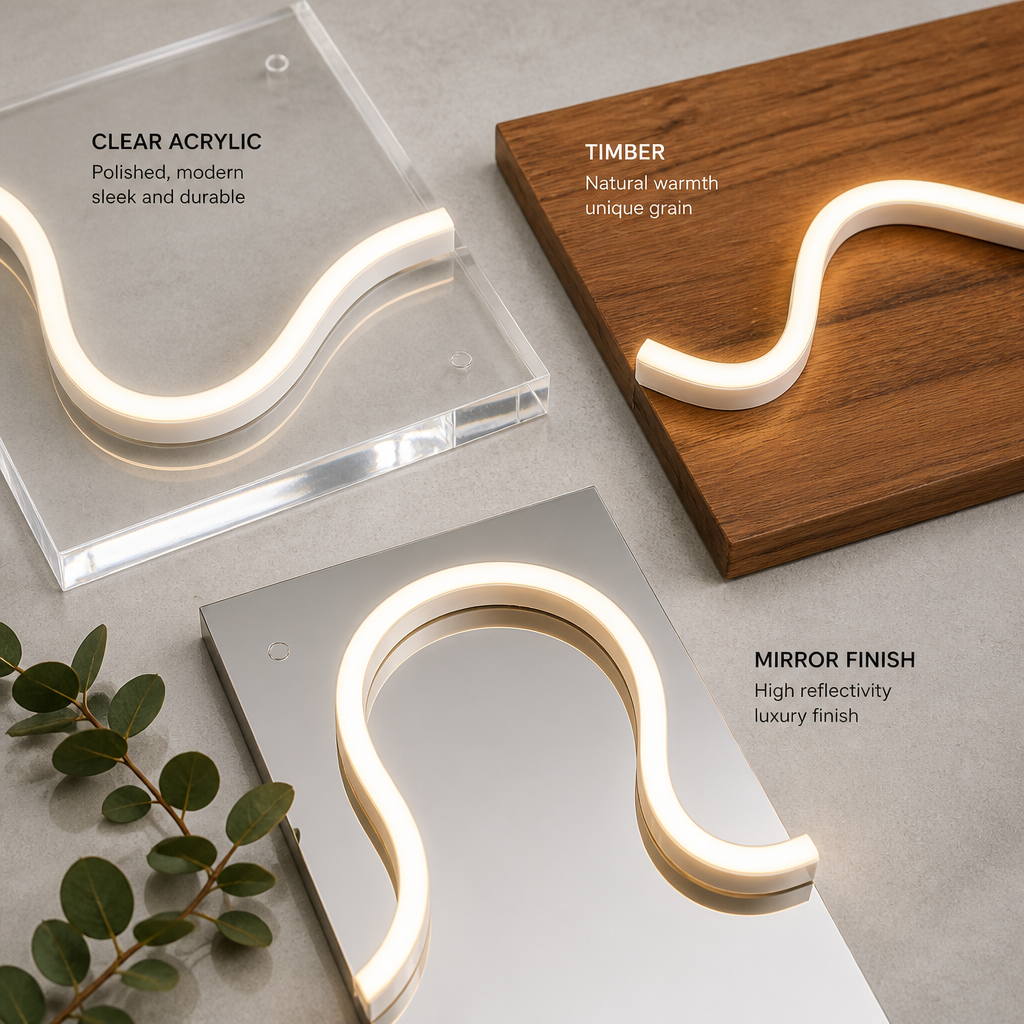
Clear or coloured acrylic (commonly sold under the Perspex brand in South Africa) is the default choice for most neon signs with backing board in retail and hospitality settings. Acrylic is lightweight, shatter-resistant, and effective at transmitting light around the edges, giving the board a subtle illuminated border that enhances the overall glow. It can be cut to the exact shape of the lettering (contoured cut) or supplied as a clean rectangle or square (full board). The contoured cut minimises visible board area and works particularly well for script and cursive font designs. The full rectangular board is the right call when the sign will be moved frequently, hung from ceiling rigging, or used in event rental applications where structural robustness matters more than minimalism.
Acrylic is also resistant to UV light and weathering, which makes it the only backing board type suitable for both indoor and sheltered outdoor installations. For interior signage in Gauteng, where venues range from air-conditioned shopping centre retailers to open-plan industrial restaurant spaces with high humidity from kitchen extraction, acrylic consistently outperforms timber-based boards in longevity.
Pro tip: For script or handwritten fonts, always request a contoured acrylic cut that traces the shape of the lettering. A rectangular board behind a flowing script sign creates a visual mismatch that reduces the premium feel of the installation.
Timber, Reclaimed Wood, and OSB Backing Boards
Wooden panels bring a natural, tactile quality that acrylic cannot replicate. Reclaimed wood, OSB board, and painted MDF are popular choices for craft breweries, farm-style restaurants, boutique fitness studios, and retail stores targeting a heritage or artisanal brand positioning. Like acrylic boards, timber backing boards can be fixed directly to walls, hung from chains, or suspended on steel cable, and the sign simply plugs into a standard power socket once mounted.
The trade-off is moisture sensitivity. MDF in particular will swell and warp if installed in a kitchen-adjacent or outdoor area without proper sealing. In practice, timber backing boards belong in dry, climate-controlled interiors and should always be specified with a sealed or lacquered finish when used in venues where humidity fluctuates. A common mistake is ordering a reclaimed wood backing board for a rooftop bar installation without accounting for evening condensation and wind-driven moisture. The result is a warped board within one wet season.
Coloured and Mirror Acrylic Variants
Black, white, gold mirror, and rose gold mirror acrylic boards have gained significant traction in South African beauty salons, event backdrops, and hotel lobbies. These boards become an active design element rather than a neutral background. A warm white neon sign on a matte black acrylic board reads as a premium, considered installation. The same sign on a standard white wall looks competent but unremarkable. If the goal is brand distinction rather than just visibility, the board colour and finish deserve as much specification attention as the neon flex colour itself.
LED Neon Flex Signs vs. Traditional Neon: Why the Switch Matters
Traditional glass neon signs use sealed glass tubes filled with neon or argon gas, energised at high voltage to produce their characteristic glow. They are fragile, heavy, expensive to repair, and produce heat. LED neon flex signs replicate that glow using flexible LED strips encased in a silicone or PVC jacket, cut to shape and mounted on a backing board. The visual difference at normal viewing distance is negligible. The practical differences are significant.
LED neon flex runs on a far lower voltage than traditional glass neon, making it meaningfully more energy-efficient. Traditional glass neon typically lasts between 8,000 and 15,000 hours before degradation becomes visible. LED neon flex can last between 30,000 and 50,000 hours with proper use, which at a standard commercial operating schedule of 12 hours per day translates to over a decade of reliable service before replacement is necessary. For a business owner calculating the total cost of a signage investment, that lifespan difference is the single most important number in the comparison.
From a safety perspective, LED neon flex is the only sensible choice for indoor commercial use. There are no glass components to shatter, no gas to leak, and no high-voltage transformer to fail unexpectedly. It also operates at a lower surface temperature, which matters in food service environments or anywhere the sign is within reach of staff or customers.
Pro tip: When sourcing LED neon flex signs for a South African climate, ask specifically about the silicone jacket quality. A sealed silicone construction resists dust build-up and insect ingress, both of which are real factors in Gauteng's summer months and can shorten the operational life of cheaper imported units significantly.
Interior Signage Applications Across Gauteng Industries
The appeal of neon signs with backing boards spans almost every commercial interior category, but the brief for each industry is quite different. Understanding what works where prevents a technically correct sign from being commercially ineffective.
Restaurants and Food and Beverage
The restaurant sector has driven the bulk of neon sign adoption in South African interiors over the past several years. A well-placed neon sign in a dining room serves three simultaneous functions: it contributes to the ambient lighting scheme, it communicates brand personality (playful, premium, artisanal), and it creates a natural focal point that customers photograph and share. The most effective placements are above the bar, behind the cashier counter, or on a feature wall visible from the entrance. Avoid mounting neon signs directly above food preparation surfaces where grease and heat are present.
Retail and Boutique Stores
In retail, neon signs function as product-adjacent branding rather than primary navigation signage. A brand tagline or mood phrase on a backing board near the fitting rooms or product display area reinforces the customer experience without competing with the merchandise. Clear acrylic backing boards are preferred in retail settings because they do not introduce a second visual layer that competes with wall finishes or product colour palettes.
Fitness Centres and Wellness Studios
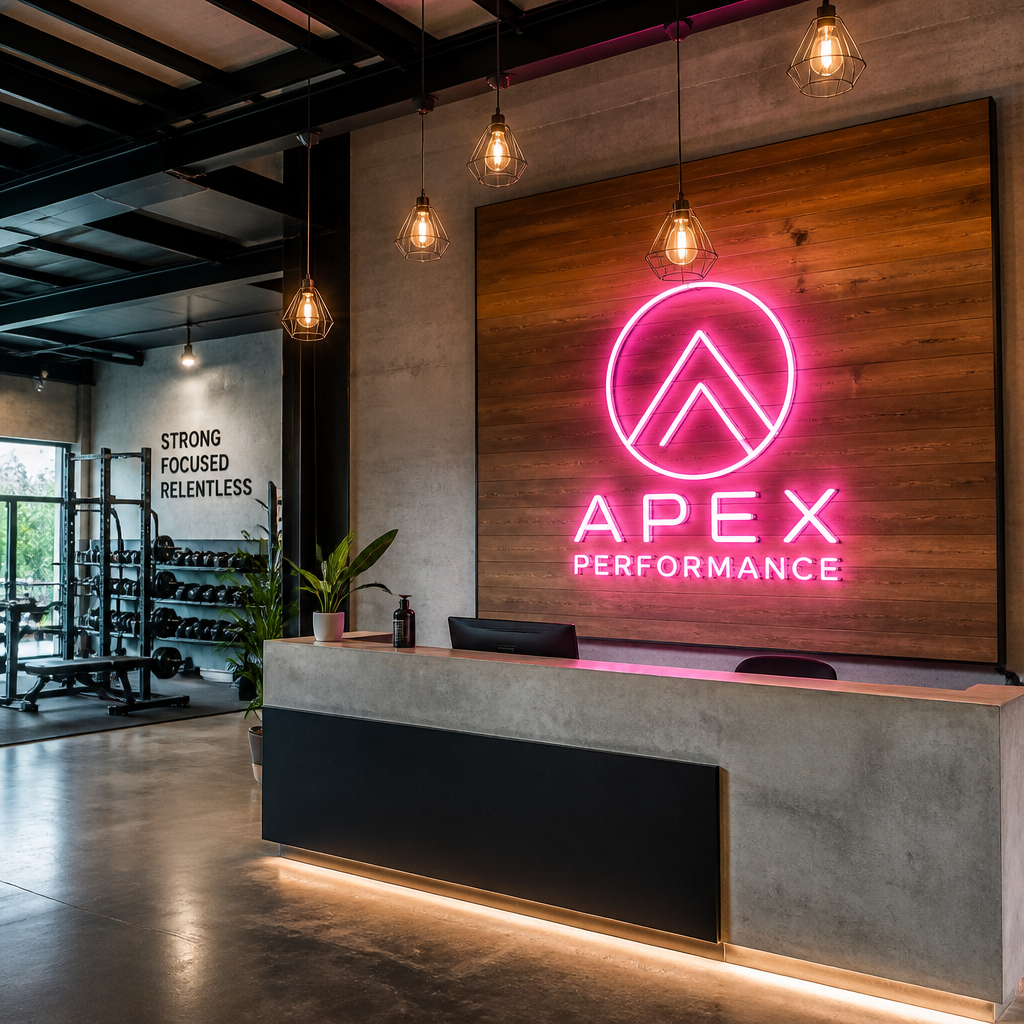
Gyms, yoga studios, and wellness brands use neon signs with backing boards to deliver motivational cues or brand slogans at high-traffic points such as the entrance, the weights floor, or the reception desk. The energy-efficiency of LED neon flex is particularly relevant here because these venues often run signage for 14 to 16 hours per day. A sign rated for 50,000 hours at those operating hours will still be performing well after eight years of daily use.
Hotels and Corporate Hospitality
Hotel lobbies, conference facilities, and co-working spaces use neon backing board signs most effectively when the design connects directly to a corporate or property brand identity. A hotel brand name in its proprietary typeface, rendered in LED neon flex on a mirror acrylic board, is a markedly different proposition from a generic inspirational phrase. Corporate hospitality clients should always provide their brand standards guide before sign production begins so the typeface, neon colour, and board finish can be matched exactly to approved specifications.
Corporate Identity and Franchise Compliance
For franchise networks and multi-site corporate clients, the backing board specification is not a stylistic preference. It is a brand standard that must be documented and enforced consistently across every location. Differences in board size, finish, or neon colour between franchise sites undermine the visual consistency that franchise fees are partly paying for.
In practice, the brand standards document for any franchise that uses neon signs should specify the following: the exact backing board material and finish, the board dimensions relative to the sign element, the neon flex colour in a verifiable reference system (not just "warm white"), the mounting method, and the standoff depth if applicable. A signage provider working at scale across multiple franchise sites must be able to manufacture to these specifications consistently, not approximate them from site to site.
SignShopper's work with franchise and corporate clients across Gauteng and beyond is built on exactly this discipline. The specification process begins with the client's existing corporate identity documentation and works outward to the physical sign, rather than the other way around. That sequence matters because a sign that looks right in isolation but deviates from brand standards creates compliance problems that are expensive to correct after installation.
Pro tip: If your franchise does not yet have a signage specification section in its brand standards document, commissioning that specification as a standalone deliverable before any signs are produced is the most cost-effective decision you can make. Retrofitting specifications after a dozen sites have been signed off in different ways is far more expensive than getting it right from the start.
Installation, Maintenance, and Lifespan Realities
A neon sign with a backing board is one of the more straightforward installations in commercial signage, provided the wall substrate is assessed correctly before any fixing begins. Concrete and brick walls require rawl bolts or appropriate anchors. Drywalling or partition walls need to be fixed into the stud frame or reinforced with a backing plate behind the plasterboard, because the combined weight of the backing board and neon flex element must be supported reliably over years of use, not just on the day of installation.
Pre-drilled backing boards, where the mounting holes are positioned and sized during manufacture, are the correct approach for any professional installation. Attempting to drill mounting holes on-site into an acrylic board after the neon flex has been attached risks cracking the acrylic or disturbing the LED connections. A properly manufactured sign arrives with its mounting positions already determined, and the installer's job is to transfer those positions accurately to the wall.
Maintenance requirements for LED neon flex on a backing board are minimal by design. The silicone-jacketed flex does not accumulate moisture internally and can be wiped clean with a damp cloth. The backing board, whether acrylic or timber, should be inspected annually for any signs of UV yellowing (in older acrylic grades) or moisture ingress (in timber boards in humid environments). The power supply unit, typically housed behind the board or in the wall cavity, is the component most likely to require replacement over the sign's lifespan and should remain accessible for servicing without requiring the entire sign to be dismounted.
For businesses using neon signs in rental or event contexts, the backing board choice significantly affects transport durability. A full rectangular acrylic board protects the neon flex better during repeated packing and transit than a contoured cut board where the sign edges are more exposed. If the sign will be moved more than a handful of times across its life, specify accordingly at the order stage.
Backing Board Comparison at a Glance
| Feature | Acrylic / Perspex Backing Board | Timber / MDF / OSB Backing Board | Mirror or Coloured Acrylic Backing Board |
|---|---|---|---|
| Best suited for | Retail, hospitality, events, franchise rollouts | Craft restaurants, boutique retail, wellness studios | Salons, hotel lobbies, event backdrops, premium branding |
| Moisture resistance | High, suitable for indoor and sheltered outdoor use | Low to medium, requires sealing for humid environments | High, same as standard acrylic |
| Visual effect | Neutral to invisible, lets wall show through on clear | Warm, textural, artisanal, adds rustic character | Dramatic, doubles as a reflective design surface |
| Installation ease | Very easy with pre-drilled holes and standoffs | Moderate, heavier and requires appropriate wall fixings | Very easy, same hardware as standard acrylic |
| Suitability for repeated relocation | Excellent, especially full rectangular board | Poor to moderate, susceptible to damage in transit | Good, but mirror surfaces scratch if unprotected |
| Corporate identity flexibility | High, available in custom colours and finishes | Medium, limited to natural tones and painted finishes | High, available in a wide range of mirror and gloss finishes |
| Typical commercial application in South Africa | Franchise stores, shopping centre retail, offices | Craft venues, farm-style restaurants, co-working spaces | Luxury hospitality, beauty industry, event photography walls |
Frequently Asked Questions
What is the difference between a contoured and a full backing board for neon signs?
A contoured backing board is cut to follow the shape of the neon lettering or design, so very little board is visible around the sign. A full backing board is a complete rectangle or square that the neon element is mounted onto. Contoured boards suit script and cursive designs where minimising board visibility creates a cleaner result. Full boards are better for signs that will be moved frequently or hung from rigging, because the complete perimeter provides more structural protection during transport and installation.
How long do LED neon flex signs on backing boards typically last in a South African commercial environment?
Quality LED neon flex is rated for between 30,000 and 50,000 hours of operation. At a standard commercial schedule of 12 hours per day, that equates to between 7 and 11 years of service before brightness degrades noticeably. The backing board itself, particularly if acrylic, will typically outlast the LED flex element and can be reused if the flex is ever replaced or the design is updated.
Can neon signs with backing boards be used outdoors in Gauteng?
Acrylic and Perspex backing boards are UV-resistant and suitable for sheltered outdoor applications such as covered patios, entrance canopies, and outdoor dining areas that have overhead cover. Timber or MDF backing boards are not recommended for outdoor use unless they are thoroughly sealed and the installation is fully protected from rain and direct sun. The LED neon flex itself should be IP-rated (indicating water and dust resistance) if any outdoor exposure is expected, even in a sheltered position.
How are neon signs with backing boards installed on different wall surfaces?
Most professionally produced backing boards arrive with pre-drilled mounting holes. On concrete or brick walls, rawl bolt anchors hold the sign securely. On drywalled partitions, fixings must go into the stud frame behind the plasterboard, or a reinforcing plate must be added behind the wall at the mounting points. Standoff locators, which hold the board a short distance from the wall surface, create a shadow gap that enhances the floating effect and shows the glow of the sign around its perimeter. The power cable is typically routed through the wall cavity for a clean finish.
What should a franchise business specify when ordering neon signs with backing boards across multiple sites?
A franchise ordering neon signs across multiple sites should specify the backing board material, finish, and exact dimensions; the neon flex colour in a verifiable reference (not just a generic colour name); the typeface and letter sizing; the mounting method and standoff depth; and the cable management approach. Providing a written signage specification to your supplier before any production begins prevents variation between sites and ensures every location presents the brand consistently. A supplier with experience in franchise rollouts will ask for these specifications upfront rather than making assumptions.
Are rental neon signs with backing boards available for events in Gauteng?
Yes. Rental solutions for neon signs with backing boards are available for events, pop-up activations, trade shows, and short-term brand campaigns. Rental eliminates the capital expenditure of purchasing a sign for a one-time use while still delivering full visual impact on the night. For rental applications, full rectangular acrylic backing boards are typically specified because they protect the LED neon flex better during repeated transport, setup, and breakdown than contoured boards do.
Is it possible to update or change a neon sign design without replacing the entire backing board?
In many cases, yes. If the new design fits within the dimensions of the existing backing board and the mounting positions are compatible, a new neon flex element can be fitted to the original board. This is particularly relevant for businesses that update slogans or brand messaging periodically without changing the overall sign format. Discuss this possibility with your signage provider at the initial order stage so the board is manufactured with future flexibility in mind, rather than being custom-sized so tightly that it only works for the original design.
Have you recently installed a neon sign with a backing board in your business, or are you trying to decide on the right backing material for your space? Share your experience or question in the comments below.
References
- How LED neon flex signs are handcrafted on Perspex backing in South Africa
- Guide to neon sign backing board options including acrylic, reclaimed wood, and OSB panels
- What an acrylic backboard is and how it supports neon sign installation
- LED neon flex sign benefits including lifespan, energy efficiency, and safety
- Comparing traditional glass neon and LED neon flex on cost, durability, and energy use