


Lobby Signage South Africa: Make the Right First Impression
Most visitors decide how they feel about your company before anyone at reception says hello. In a Gauteng office block, a hotel entrance or a franchise store with steady walk-in traffic, the first sign a person reads sets the tone for the whole visit. Lobby signage South Africa businesses install is often treated as a finishing touch, bought last after the furniture and carpet. That order is backwards. Your reception signs do the work of a receptionist who never leaves the desk, and they either support your corporate identity or quietly undermine it.
Table of Contents
- Quick Takeaways
- What the First Five Seconds Actually Ask of a Sign
- Choosing Sign Types for Reception Walls
- Corporate Identity Standards in Practice
- Lighting, Materials and Durability
- Digital Screens in the Reception Area
- Wayfinding Where Visitors Hesitate
- Maintenance, Power and Keeping the Sign Right
- Frequently Asked Questions
- References
Quick Takeaways
| Key Insight | Explanation |
|---|---|
| Lead with the company name, not the service list | Visitors read the largest line first. A reception sign should identify who you are from the entrance, and leave service detail for the desk or a brochure. |
| Pull the sign from the approved brand pack | Use the master logo files and the exact colour references, not a version a local designer redrew. Colour drift on a lobby wall is noticed by head office. |
| Plan power before you choose backlighting | Illuminated signs need a dedicated circuit, a reachable switch and a plan for outages. Load shedding makes backup power a design input rather than an extra. |
| Check approvals before ordering fabrication | Lobby and facade signs can fall under local by-laws, and building owners often have their own rules on fixings. Confirm both before the panel is cut. |
| Use digital screens only for content you will update | A screen showing stale slides looks worse than a static panel. Name an owner for updates and set a fallback image for when the feed fails. |
| Place wayfinding at decision points | Signs belong where a visitor has to choose: after the entrance, at the lift lobby and at corridor splits. Covering every wall creates noise that people learn to ignore. |
What the First Five Seconds Actually Ask of a Sign
A visitor walking into your reception is running a quick checklist, even if they never think about it. Am I in the right building? Are these the people I came to see? Where do I go next? A good lobby sign answers the first two from the door and gives the third at the desk, without forcing anyone to read a paragraph while they are still juggling a bag and a visitor pass.
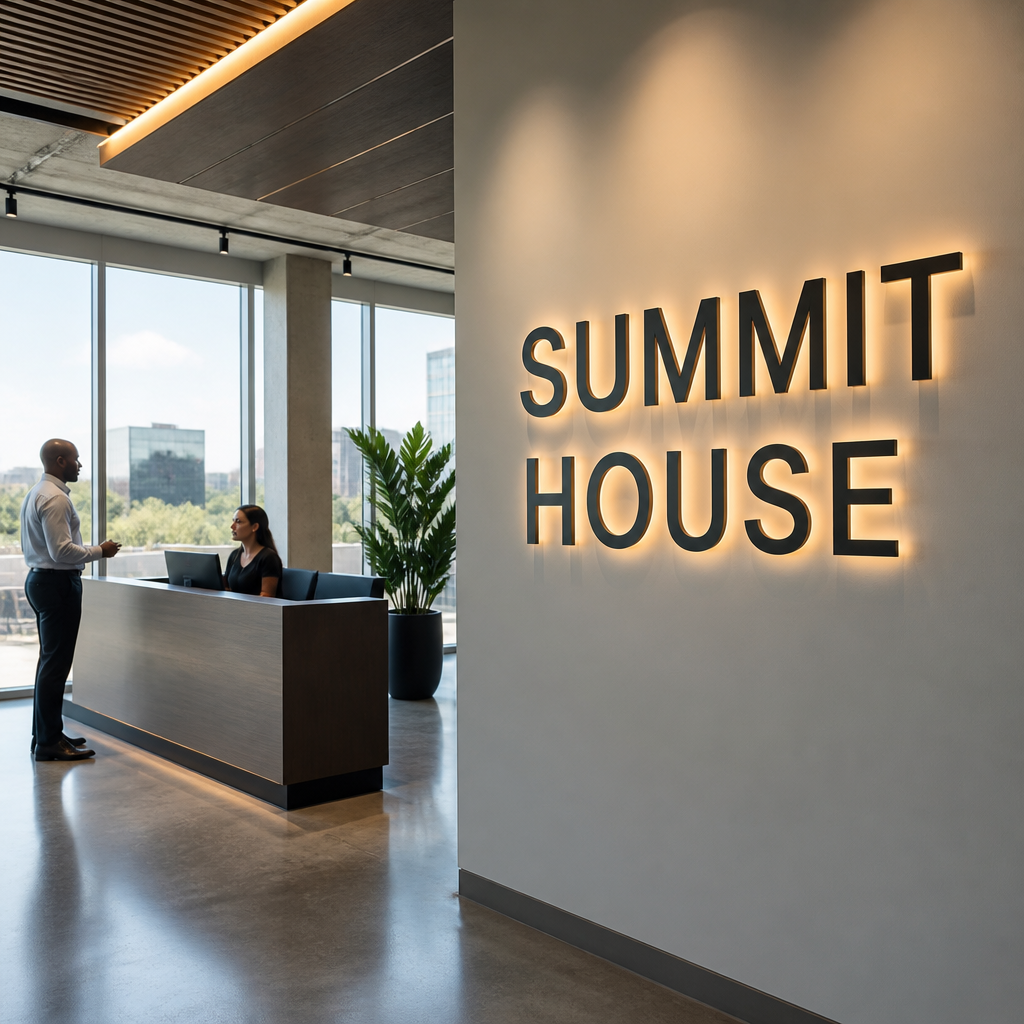
In practice, most reception signs fail on the first question. The business name is small, tucked above a wall of frosted glass, or set in a typeface that only works at close range. Someone standing at the security gate cannot tell whether the building belongs to the company they are visiting.
Reading Distance and Viewing Angle
Mount the main name at the height and distance where the visitor actually stands, not at the height that looks good on a render. Walk the route from the entrance door to the reception desk with a tape measure and a paper mock-up before anything is drilled. A panel that reads comfortably from the desk can become a blur from the revolving door, and the mock-up will show you that before the installer does.
Why the Sign Speaks Before the Receptionist
Your receptionist may be the first person a visitor talks to, but the sign is the first message they receive. That message arrives before the greeting, before the coffee and before the visitor has decided whether to trust the place. Treat the sign as the first piece of customer service, and write the brief accordingly.
A lobby sign is the only part of your business that speaks before anyone is ready to listen.
Good reception signage is quiet about what it says and loud about who said it. The name, the logo and one line of positioning are usually enough. Anything more belongs on the desk, the screen or the printed material a visitor picks up on the way.
Pro tip: Photograph the entrance from the parking area and from the lift lobby on a bright afternoon, then judge the sign using those photos. Visitors rarely arrive in ideal conditions, and the photos will show glare, shadow and clutter that a design file hides.
Choosing Sign Types for Reception Walls
There is no single best sign type for every lobby. The right choice depends on the building, the wall construction, your budget and how often the wording has to change. A head office on a shared-tenant floor faces different limits from a standalone franchise store with its own street frontage, and the design brief should reflect that difference from the start.
Channel Letters and Dimensional Name Signs
Dimensional letters, lit or unlit, give a reception wall depth and shadow that flat print cannot match. They suit a company name that will not change for years. The trade-off is weight, fixing points and a more involved installation, so confirm the wall construction and the fixing method with the building manager before the design is signed off.
Keep the lettering short. A name plus a single strapline reads well from a distance. Long lists of services make the wall hard to read and look cluttered once the lights are on.
Reception Desk and Feature Wall Lettering
The desk is where people stop, so the signage there should carry the department or service name and nothing more. A feature wall behind the desk can carry the logo at full scale, provided it is the approved version for that background colour. Many brand manuals specify which logo version works on dark surfaces, and the lobby is where that rule gets tested hardest.
Comparing the Main Options
The table below compares three approaches that come up most often in reception projects. Use it as a starting point for the conversation with your building owner and your sign team, not as a substitute for a site survey.
| Sign Option | Best Used For | Trade-off to Plan For |
|---|---|---|
| Illuminated channel letters | Corporate head office entrances and main reception walls | Needs a power point, a fixing plan and careful installation. Gives the highest visual impact. |
| Backlit acrylic logo panel | Feature walls behind reception desks | Needs even lighting and regular cleaning of the face. Less suitable for long lines of text. |
| Vinyl or etched lettering on glass | Office entrance doors and glass partitions | Easy to update and low cost to install, but vinyl can lift in strong sun and needs periodic replacement. |
Corporate Identity Standards in Practice
Corporate clients and franchise owners usually have a brand manual, and reception is where that manual gets stress-tested. The logo gets stretched to fit a narrow panel, the blue drifts toward a shade nobody approved, and a local designer swaps the typeface because the original font is not installed on their computer. Each change looks small on its own. Together they make a head office look unmanaged.
One industry article on professional lobby signs makes the point that consistent logos and brand colours help clients recognise and remember a brand. That only works when the sign in the lobby matches the one on the website and the letterhead.
Where Franchise Signage Goes Wrong
Franchise owners often inherit a brand pack and then adapt it for their site. The mistake is adapting the wrong things. Moving a sign to clear a column is usually acceptable if the franchisor agrees. Changing logo proportions or colour values usually is not. Get written sign-off for any variation, even a small one, because a franchise audit will check the lobby as carefully as the storefront.
Pro tip: Ask the brand owner for exact colour references in the form the fabricator needs, such as print and paint specifications. A colour on a monitor is not a colour on a painted panel, and reception walls show every mismatch.
Building the Sign-Off Chain
A reliable approval path has three stops: the brand or marketing owner, the facilities manager who controls the wall, and the local authority where a permit is required. Missing the third stop is expensive. Many lobby and facade signs need approval under local by-laws, and the rules differ between municipalities, so confirm requirements before ordering rather than after the panel is on the wall.
Write the approval chain into the project brief at the start. When a sign has three owners and nobody holds the final say, the result is a compromise that nobody wanted and everybody has to live with.
Lighting, Materials and Durability
Lighting decides whether a reception sign reads clearly at the end of the working day or disappears into the wall. The same panel can look premium under even, warm light and cheap under harsh spotlights. Lobbies are usually designed around ceilings and flooring first, so sign lighting tends to be added late and set wrong.

Front-Lit, Back-Lit and Edge-Lit Panels
Front-lit panels project light onto the face of the sign and suit solid or textured materials. Back-lit acrylic or aluminium panels glow evenly and suit logos with simple shapes, but they show every dust mark on the face. Edge-lit panels keep the profile slim, though the lettering needs to be simple for the effect to read cleanly.
Choose the lighting method only after you know the visitor's line of sight. Test brightness at the time of day when the lobby is busiest, because a sign that looks right in the morning can be washed out by afternoon light coming through the glass.
Materials That Hold Up in a Busy Lobby
Reception walls take knocks from trolleys, bags and cleaning equipment. Choose surfaces that tolerate wiping with ordinary cleaners, and avoid high-gloss finishes on any panel within hand height, where fingerprints and scuffs show first. Ask the fabricator which cleaning products are safe for the face material before the sign goes up.
Pro tip: Specify a matte or satin finish on panels within reach of visitors. It hides fingerprints and reduces the number of cleaning call-outs your facilities team receives.
Most reception signs are judged in the evening, when the lights are on and the room is quiet. Design for that moment, not for the daytime showroom.
Digital Screens in the Reception Area
Digital screens have become a common request in corporate lobbies, and for good reason. A screen can show a welcome message, today's meeting list, emergency directions or a campaign for a new service. Market research on South African digital signage lists advertising, promotions, wayfinding, corporate communication and public information displays among the main applications, which matches what we see in reception projects.
Content That Earns Its Screen Time
A screen that cycles the same three slides for months teaches visitors to ignore it. Build a content plan with a fixed core, such as the company name, opening hours and directions, plus a rotating layer that changes at least every few weeks. Avoid live news or market-data feeds unless someone monitors them, because a frozen ticker looks worse than a blank wall.
Who Owns the Screen After Installation
Most screens fail on administration, not hardware. Name one owner who can change content, set a backup image for when the feed drops, and check the display every week. If the owner is a receptionist who already has a full desk, move the content job to marketing and keep the receptionist for the physical welcome.
A static panel with a clear message beats a screen that shows nothing useful. Choose a screen when you will update it, and a static sign when you will not.
Wayfinding Where Visitors Hesitate
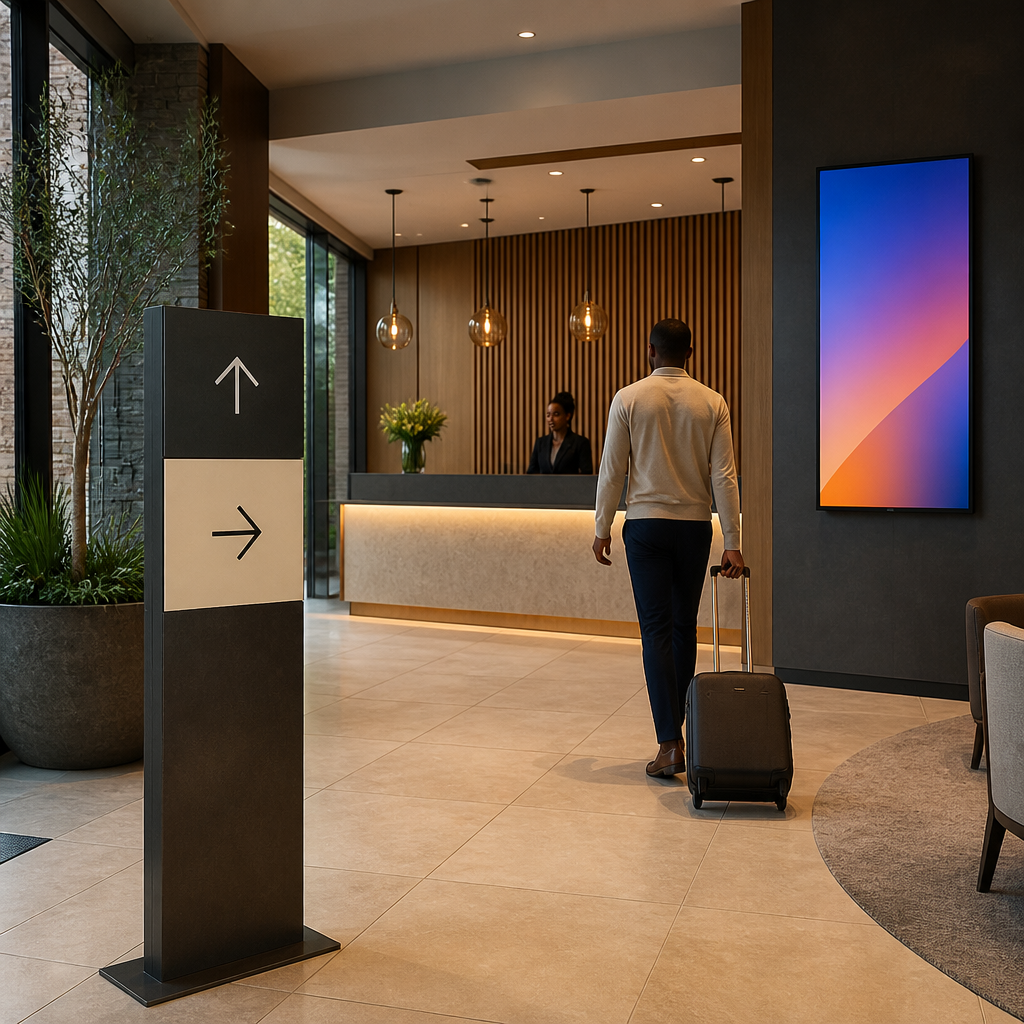
Wayfinding is the most underrated part of a lobby sign package. A clear directory and well placed arrows reduce the number of visitors who wander into the wrong corridor, and they reduce the number who stop the nearest staff member to ask the way. Those interruptions cost your team time every single day.
Placing Directional Signs at Decision Points
Signs belong where a visitor has to choose: directly after the entrance, at a lift lobby and at any corridor split. Putting a sign on every wall creates visual noise and teaches people to ignore signs altogether. Walk the route as a first-time visitor and mark only the points where you hesitate.
Wording Directions Visitors Actually Understand
Use the words a visitor would use, not internal department names. "Accounts" is clearer than "Finance Shared Services" for a supplier arriving with an invoice. Keep arrows consistent with the direction of travel, and use the same terms on the directory, the door signs and any screen you run.
Pro tip: Ask two people from outside your business to find the boardroom using only the signs. Whatever they miss is the sign you need to add or move.
Maintenance, Power and Keeping the Sign Right
A reception sign is only as good as its last maintenance visit. Dirty lettering, a failed LED module or a flickering panel tells visitors the company has stopped paying attention. The fix is not expensive, but it needs a plan and a named person to carry it out.
Power Planning for Backlit and LED Signs
Every illuminated sign needs a dedicated power point, a switch that staff can reach, and a plan for outages. In South Africa, load shedding has made backup power a design question rather than a luxury. Ask the electrician whether the sign circuit sits on the building's backup supply, and decide in advance whether the sign should go dark or stay on a small backup supply when power drops.
A Simple Inspection Schedule
Check the sign once a month. Look for dust build-up, loose fixings, failing lights and damp near power connections. Clean the face with an approved product and log what you found. A short log helps when a franchisor or a corporate auditor asks how the site is maintained.
Keep a spare LED module or spare panel if the sign uses a standard size. Waiting weeks for a replacement is the most visible failure a reception area can show, and it is avoidable with a small amount of planning.
Frequently Asked Questions
How much should a lobby sign cost in South Africa?
The price depends on size, lighting, material and the amount of structural work, so there is no single figure that applies to every site. Ask for a site visit and a written quote that separates design, fabrication, installation and any permit costs, so you can compare like with like.
Do I need approval before installing a lobby sign?
In many cases, yes. Lobby and facade signs can fall under local by-laws, and the building owner may have separate rules on fixings and placement. Check both before ordering fabrication.
What is the difference between reception area signs and wayfinding signs?
Reception signs identify your business and welcome visitors, usually on the main wall or the desk. Wayfinding signs guide people to specific places, such as departments, boardrooms or lift lobbies. Most reception areas need both, and they should be designed as one system so the wording and typography match.
Should a franchise store follow the corporate brand pack exactly?
Follow the core elements exactly, including logo proportions, colours and typeface. Local adaptations such as sign position or layout can often be agreed with the franchisor, but any change to brand assets should be approved in writing first.
How often should reception signs be replaced?
There is no fixed interval. Replace or refresh a sign when the brand changes, when the lettering fades or is damaged, or when the panel no longer meets the standard in your brand manual. Regular cleaning and inspection extend the life of most installations.
Is a digital screen better than a printed sign for a reception area?
Not automatically. A screen works when someone updates it regularly and the content adds value for visitors. If nobody will manage the content, a well made static sign will look more professional and cost less to keep running.
What is the one sign in your reception area you would change first, and what has stopped you from changing it so far? Share your experience with us.