



Franchise Signage South Africa: Why CI Compliance Matters
Walk into any branch of a well-known South African franchise and you expect the same colours on the fascia board, the same font on the menu board, and the same finish on the reception lettering. The moment one branch looks different, customers notice, even if they cannot articulate why. That subtle wrongness is exactly what happens when franchise signage in South Africa is produced without strict corporate identity compliance. And for franchise networks operating across Gauteng and beyond, the damage flows in two directions: the individual franchisee loses credibility locally, and the parent brand takes a hit across every location in the network. This article explains what CI compliance actually means in practice, why so many franchisees underestimate the risk, and how to get it right from the first sign to the last installation.
Table of Contents
- What CI Compliance in Signage Actually Means
- Why Non-Compliance Costs More Than Compliance
- The Most Common CI Signage Failures in Franchise Networks
- Signage Types and Their CI Requirements
- Comparing Approaches to Franchise Signage Procurement
- How to Brief a Signage Supplier for CI Compliance
- Frequently Asked Questions
- References
What CI Compliance in Signage Actually Means
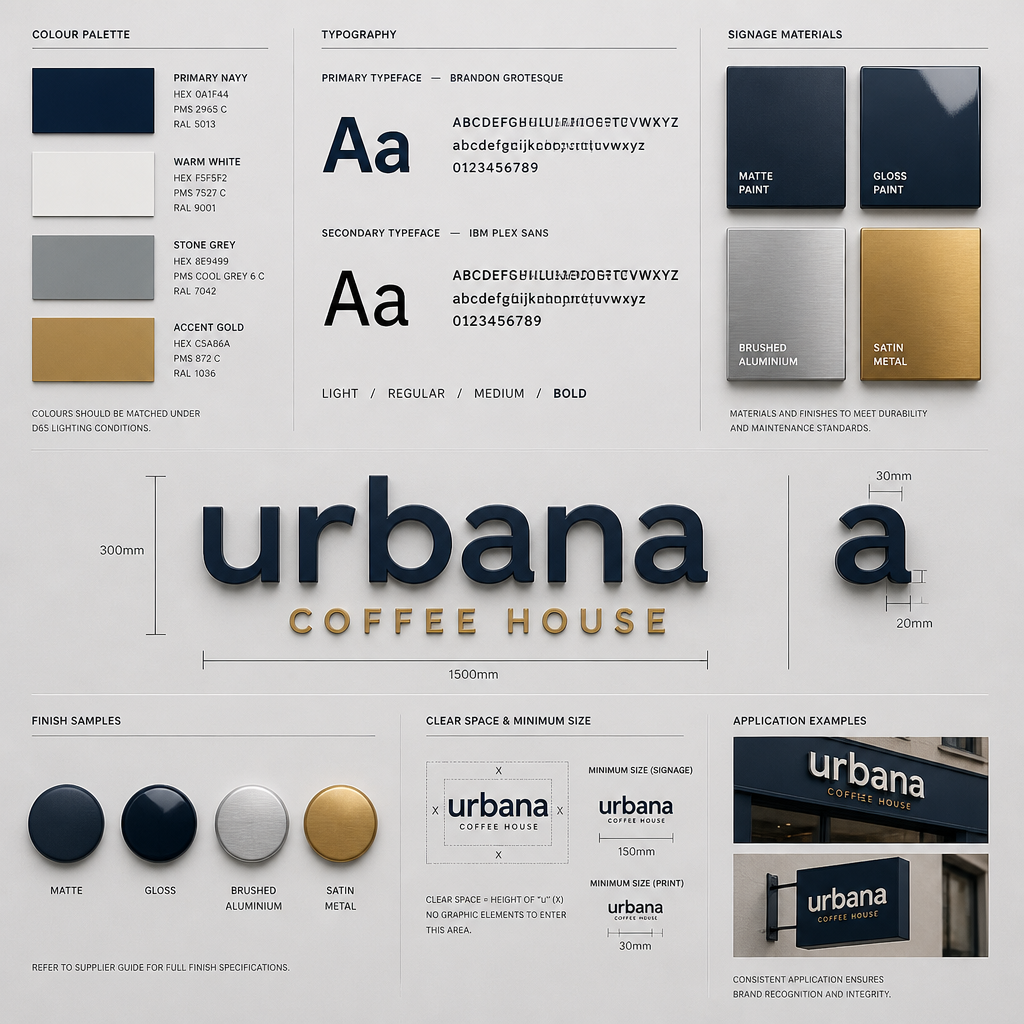
Corporate identity compliance in signage is not about aesthetics alone. It is a contractual and commercial obligation. When a franchisee signs a franchise agreement, they typically agree to reproduce the brand exactly as specified in the franchisor's CI manual. That manual dictates Pantone colour codes, minimum logo clearance zones, approved typefaces, material specifications, and often even the exact illumination method required for exterior signage.
The CI manual is the law of the brand. A franchisee who installs a pylon sign in a slightly different shade of red, or who uses a cheaper flat-cut lettering instead of the specified illuminated channel letters, is technically in breach of that agreement, regardless of whether the deviation looks minor to the untrained eye.
In practice, corporate identity signage covers every physical touchpoint where the brand appears: exterior fascia boards, pylon or totem signs, window graphics, interior wayfinding, reception wall branding, menu boards, and promotional display stands. Each of these must be specified, produced, and installed to the same standard across every location in the network.
Pro tip: Request a copy of your franchisor's CI manual before approaching any signage supplier. A supplier who does not ask for it, or who does not reference it during the briefing, is not equipped to deliver CI-compliant signage.
Why Non-Compliance Costs More Than Compliance
The argument for cutting corners on signage is usually about upfront cost. A franchisee who saves R8,000 by using a non-approved supplier quickly discovers that the saving disappears when the franchisor mandates a full replacement at the franchisee's expense. This is a common outcome, and it is written into most South African franchise agreements as a franchisor remedy for brand protection.
An errant or non-compliant franchisee may cause damage to the brand and to the value of all franchised businesses in the franchise system. If the franchisor enjoys sufficient rights, it is able to protect the brand, the rights of the franchisor and franchise system, and thereby maintain the reputation and value of the franchised businesses in that system.
Beyond contractual consequences, the commercial cost of non-compliance is real. Brand non-compliance at the location level erodes the trust that customers place in a franchise network. Inconsistent signage signals inconsistent standards, and inconsistent standards drive customers to competitors who look and feel more reliable. For franchisors managing networks across South Africa's major metros, this reputational risk multiplies with every non-compliant location.
The legal dimension in South Africa
South Africa's Consumer Protection Act places specific obligations on franchisors around disclosure and brand representation. While signage non-compliance is not always a direct CPA offence in isolation, it intersects with trade mark law. If a franchisee displays signage that distorts a registered trade mark, even unintentionally, the franchisor may face challenges protecting that mark in future disputes. A weakened trade mark is a weakened franchise.
Pro tip: If your franchise agreement has a CI schedule attached, treat it as equally binding as the financial clauses. Signage deviations are among the most visible and most audited forms of non-compliance in franchise networks.
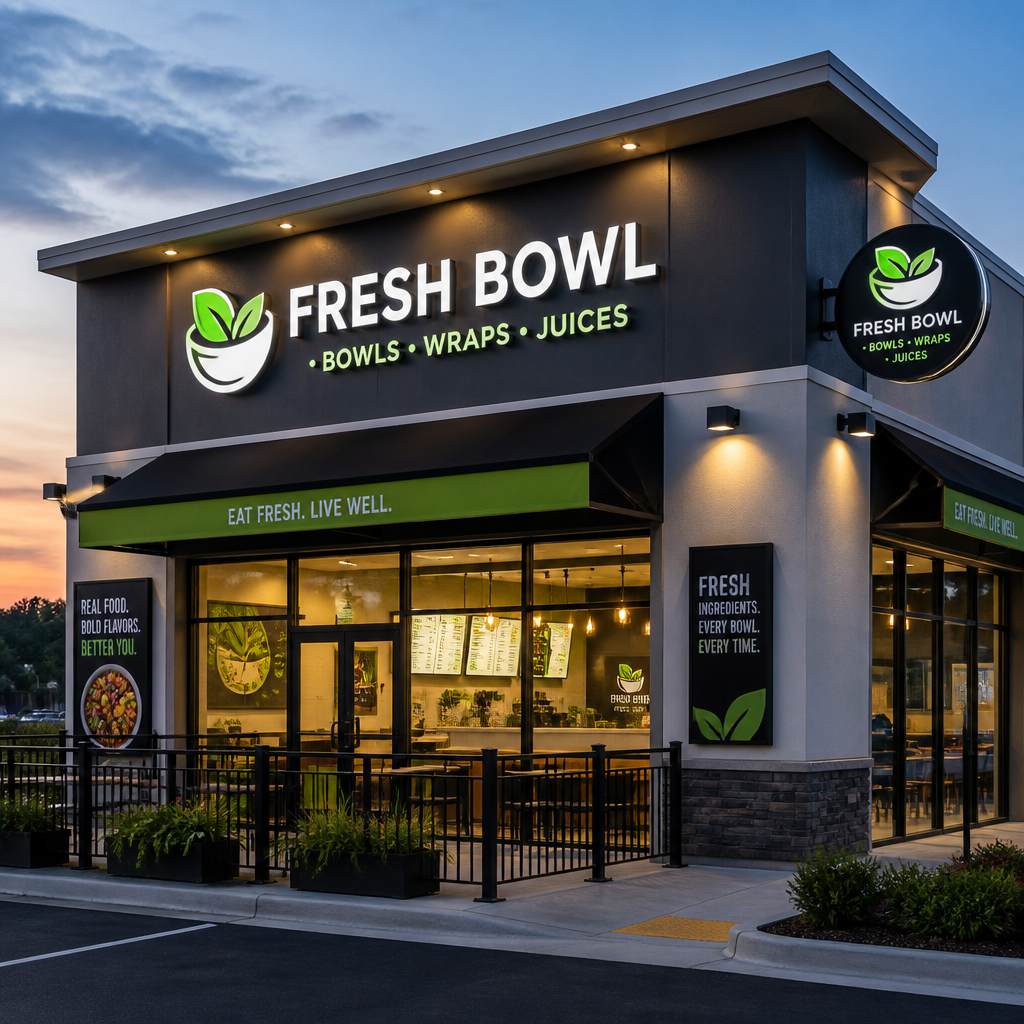
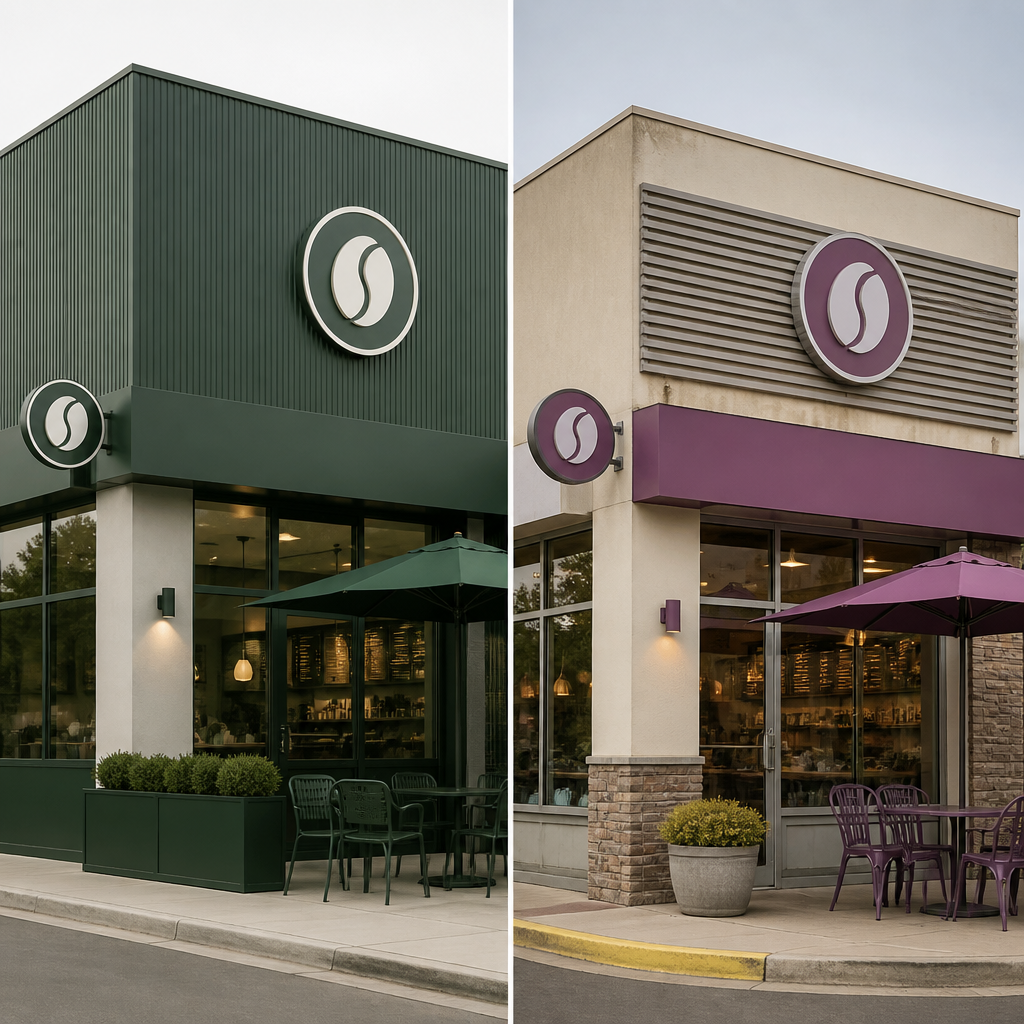
The Most Common CI Signage Failures in Franchise Networks
After working with corporate clients and franchise networks across Gauteng and the wider South African market, the same failure patterns appear repeatedly. Knowing them makes it possible to catch them before they become expensive problems.
Wrong colour output from the wrong production process
A CI manual specifies Pantone colours for good reason: Pantone values are production-neutral. The problem arises when a supplier converts those Pantone values to CMYK for print or to RGB for digital output without proper colour management. The result is a sign that looks correct in isolation but reads as a different shade next to a correctly produced sign at another branch. This is not a minor visual issue. In a retail strip with multiple franchise locations, mismatched colour is immediately obvious to any customer walking past.
Incorrect logo clearance and sizing
Every CI manual specifies a minimum exclusion zone around the logo, the space that must remain free of any other graphic element. On signage, this zone is frequently ignored or misunderstood, particularly when a supplier is trying to fit branding into an awkward fascia space. The result is a logo that appears cramped, unbalanced, or partially obscured, all of which undermine the brand equity the franchisor has invested in building.
Substituting signage types to reduce cost
A common mistake is replacing specified illuminated channel letters with non-illuminated flat-cut letters, or substituting an LED-backlit sign with a standard printed panel. The visual difference is significant, especially at night, and the substitution immediately signals to customers that this location does not operate to the same standard as the rest of the network. For a restaurant or hotel franchise, night-time visibility is not optional.
Using outdated artwork
Franchise brands refresh their CI periodically. A franchisee who opens a new location using artwork downloaded months or years earlier may be producing signage to an outdated specification. This is particularly common when franchisees source their own artwork rather than requesting current files directly from the franchisor's brand team or an approved supplier who is kept current.
Signage Types and Their CI Requirements
Different signage types carry different CI risks. Understanding which types are most prone to specification drift helps franchisees and franchisors prioritise their compliance focus.
Exterior fascia and pylon signage
Pylon and totem signage is the highest-visibility element in most franchise identities. It is also the element most likely to be specified in detail in the CI manual, covering post dimensions, panel material, illumination type, and brand panel layout. Because pylon signs require structural installation and municipal approvals in many South African municipalities, they are expensive to redo. Getting the specification right before fabrication is essential.
Channel lettering and illuminated signs
Channel lettering is a preferred exterior signage format for retail and hospitality franchises because it creates a three-dimensional, premium finish that flat printed signage cannot replicate. CI manuals for brands that specify channel letters will define letter depth, illumination colour (which may be different from the exterior letter colour), and the acceptable illumination technology. LED-backlit signs are frequently specified as the required light source, and substituting fluorescent or other technologies is a common compliance failure.
Interior branding and wayfinding
Interior signage, including reception wall branding, wayfinding systems, and menu boards, must maintain the same material finishes and typographic standards as exterior signage. A brand that specifies brushed aluminium lettering on its reception wall cannot be represented with vinyl cut lettering on a painted surface without breaking CI. For fitness centres, hotels, and restaurants, the interior brand experience is as commercially important as the exterior.
Display stands and promotional signage
Display stands and promotional banners are often treated as informal and temporary, which is exactly why they become a compliance problem. A Pull-Up Banner produced by a local print shop using the wrong font or an unapproved promotional layout can undo the brand impression created by a correctly installed fascia. CI compliance applies to every piece of brand material a customer sees.
Comparing Approaches to Franchise Signage Procurement
Franchise networks in South Africa typically use one of three approaches to procure signage for new and existing locations. Each has meaningful trade-offs in terms of CI compliance risk, cost control, and speed.
| Procurement Approach | CI Compliance Risk | Best Suited For |
|---|---|---|
| Approved supplier network (franchisor pre-qualifies one or more signage suppliers with CI knowledge) | Low. Supplier already holds approved artwork, material specs, and production standards. Deviations are caught before fabrication. | Established franchise networks with 10 or more locations and regular roll-outs across provinces. |
| Franchisee-sourced local supplier (franchisee finds their own supplier, provides the CI manual) | High. Local suppliers without franchise experience frequently misinterpret CI manuals or substitute materials. Compliance depends entirely on the franchisee's ability to manage the supplier. | Only appropriate for very small items (e.g., a single A-frame board) where the risk and cost of non-compliance are genuinely low. |
| Specialist franchise signage provider (supplier with documented franchise CI experience manages specification, production, and installation) | Very low. Supplier's process is built around CI adherence. Pre-installation mock-ups and colour-matched proofing reduce risk before anything is fabricated. | New franchise openings, brand refreshes, and multi-location roll-outs where consistency across sites is a core requirement. |
The approved supplier network and specialist franchise signage provider approaches deliver the most reliable CI outcomes. The franchisee-sourced local supplier approach introduces production risk at every stage and is rarely cost-effective once rework is factored in.
How to Brief a Signage Supplier for CI Compliance
A thorough brief is the single most effective tool a franchisee or franchisor has for ensuring CI-compliant signage. A vague brief produces variable results. A specific brief produces consistent ones.
What a CI-compliant signage brief must include
The brief must specify: the current version of the CI manual (with the version date), approved artwork files in vector format (not JPEG or PNG screen captures), Pantone colour references for all brand colours, the exact signage type required (not just "a sign for the front"), material and finish specifications, illumination method and colour temperature where applicable, installation requirements including substrate and any structural constraints, and the municipality or landlord approvals process if relevant.
Any signage supplier who does not ask for most of these items upfront is not operating at the level a franchise client requires. A supplier who works regularly with CI compliance signs will treat the CI manual as the primary project document, not as a reference to be consulted if something looks wrong.
Requesting colour-matched proofs before fabrication
For any new franchise location or brand refresh, insist on a physical colour-matched proof or a detailed digital mock-up showing the sign in situ before fabrication begins. This is standard practice for experienced franchise signage suppliers and it is the single checkpoint that catches most specification errors before they become installed and expensive to fix. A mock-up also allows the franchisor's brand team to sign off before production, which protects the franchisee if a dispute arises later.
Managing signage for multi-location roll-outs
For franchisors rolling out signage across multiple locations simultaneously, the brief must also define who holds final sign-off authority for each location, what the escalation path is if a site presents installation challenges, and how the supplier will document completed installations for the compliance record. In South Africa, where franchise networks often span Gauteng, the Western Cape, and KwaZulu-Natal simultaneously, centralised project management by the signage supplier is not optional. It is the only way to maintain consistency across geographically dispersed sites.
Pro tip: For franchise roll-outs across multiple provinces, ask your signage supplier to provide a site-by-site installation checklist with photographic sign-off at each location. This documentation protects both the franchisor and the franchisee if compliance is questioned during a brand audit.
Frequently Asked Questions
What does a CI manual typically specify for signage?
A corporate identity manual for signage typically specifies Pantone colour codes for all brand colours, minimum logo size and clearance zones, approved typefaces and their permitted weights, material and finish requirements for different signage types, illumination methods (such as LED channel letters or LED-backlit panels), and sometimes even the approved suppliers or production technologies. More detailed CI manuals will include scaled drawings of key signage elements showing exact proportions and positioning.
Can a franchisee use any signage supplier, or must they use one approved by the franchisor?
This depends on the specific franchise agreement. Many franchisors specify one or more approved signage suppliers who have been vetted for CI compliance. Where the agreement does not mandate an approved supplier, the franchisee is still contractually required to produce signage that meets the CI manual specifications. Using an unapproved supplier does not exempt the franchisee from that obligation, and if the resulting signage fails a brand audit, the cost of replacement falls on the franchisee.
What are the consequences of signage non-compliance for a South African franchisee?
Consequences typically include a formal notice from the franchisor requiring the non-compliant signage to be replaced at the franchisee's cost within a specified timeframe. Repeated or uncorrected non-compliance can escalate to breach of agreement proceedings, which in South Africa's Consumer Protection Act framework gives the franchisor grounds to take enforcement action. Beyond the contractual consequences, non-compliant signage damages the franchisee's local brand credibility and may reduce foot traffic compared to correctly branded locations in the same network.
How often should franchise signage be audited for CI compliance?
Most franchise networks conduct formal brand audits at least once a year, with some high-volume retail and fast food franchises auditing quarterly. Signage is typically one of the first items on the audit checklist because it is immediately visible and easy to assess objectively against the CI manual. Franchisees who maintain their signage proactively rather than waiting for audit findings reduce the risk of forced replacement and the associated cost and disruption.
What is the difference between a neon sign and an LED-backlit sign for CI purposes?
For CI purposes, the distinction matters if the CI manual specifies one or the other. Traditional neon signs produce a warm, slightly diffuse glow and a hand-crafted aesthetic that some brand identities are built around. LED-backlit signs and LED channel letters produce a crisper, more uniform illumination and are significantly more energy-efficient. If the CI manual specifies LED illumination, substituting neon is a compliance failure regardless of how similar they might look from a distance. If the CI manual specifies neon, substituting LED requires franchisor approval before installation.
Does CI compliance apply to temporary and rental signage?
Yes. Whether signage is permanent, temporary, or rented for an event or short-term activation, it must still represent the brand to the standard defined in the CI manual. This is particularly relevant for franchises using signage at trade shows, pop-up activations, or seasonal promotions. Rental signage solutions, where a franchisee rents branded signage rather than purchasing it outright, can actually reduce CI compliance risk because the rental provider maintains the signage to specification and replaces it when the brand standards change.
Have you navigated a CI compliance challenge with your franchise signage? Share what worked or what you wish you had known before your first installation.
References
- Key legal aspects of South African franchising law and brand protection obligations
- Multi-location signage standardisation and brand consistency across franchise networks
- The franchise brand manager's guide to marketing and signage compliance
- Franchise brand compliance: visual identity, signage, and asset governance
- Custom signage solutions for franchises maintaining brand consistency across locations