


Restaurant Signage South Africa: Drive More Footfall
Most South African eateries lose customers before a single plate leaves the kitchen. A potential diner walks past your front door, glances up, sees nothing compelling, and keeps walking straight to the competitor two doors down who invested in proper signage. Restaurant signage in South Africa is not a cosmetic afterthought. It is, in practical terms, your most affordable and persistent sales tool, working 24 hours a day whether your kitchen staff are there or not. This guide breaks down exactly what types of signs drive real footfall, where they should go, and how South African eateries in Gauteng and beyond can build a signage strategy that converts curious passersby into paying regulars.
Table of Contents
- Quick Takeaways
- Why Signage Directly Drives Restaurant Revenue
- Outdoor Signage Types Every South African Eatery Needs
- Indoor Signage That Keeps Customers Spending
- Signage for Cafes: Getting the Coffee Crowd Through Your Door
- Food Business Signs in Gauteng: Navigating the Local Landscape
- Comparing Signage Approaches for South African Restaurants
- Franchise and Corporate Restaurant Identity Standards
- Frequently Asked Questions
- References
Quick Takeaways
| Key Insight | Explanation |
|---|---|
| Signage shapes food perception before a fork is lifted | Research indicates 63% of diners believe a restaurant's signage reflects the quality of its food and service. A dated fascia sign tells passersby to expect a dated kitchen. |
| Impulse diners are a real, measurable segment | Studies suggest roughly 17% of customers who stop at a business had no prior intention of doing so. They were drawn in purely by signage. For restaurants on busy Gauteng roads, this is a significant opportunity. |
| LED-backlit signs outperform unlit signs after dark | A restaurant that relies on an unlit board after sunset effectively becomes invisible to evening diners. Illuminated channel lettering or LED lightboxes solve this completely. |
| Poor signage creates a measurable bad first impression | 73% of diners report forming a negative first impression because of signage quality. This is not an aesthetic preference. It directly impacts whether someone walks in or walks on. |
| A-frame boards on pavements capture pedestrian decision-makers | In high-footfall areas like shopping precincts and strip malls, a well-placed pavement board with a daily special converts foot traffic that your main fascia cannot reach. |
| Pylon signs make restaurants visible from main roads | For eateries set back from the street or inside a complex, an illuminated pylon sign on the road boundary is often the difference between being found and being missed entirely. |
| Consistent branding across all sign types builds trust fast | A restaurant whose outdoor sign, indoor menus, and window graphics all share the same fonts and colour palette reads as professional. Inconsistency signals disorganisation to first-time visitors. |
Why Signage Directly Drives Restaurant Revenue
The hospitality sector in South Africa is growing faster than the broader economy. When more people are dining out, competition intensifies, and the ability to capture an unplanned decision becomes more valuable. The question is not whether good signage matters. The question is whether yours is doing its job right now.
Signage works through three distinct mechanisms. First, it creates awareness for diners who have never heard of your restaurant. Second, it triggers recall for people who have eaten there before and are deciding where to go again. Third, it influences the split-second decision at street level, the moment a person on foot or in a car decides to stop or keep going. Each mechanism requires a different type of sign, placed in a different position, with a different message priority.
A restaurant's sign is not just a label. It is a first conversation with every person who passes your door, and like most first conversations, it only gets one chance to make an impression worth remembering.
The most common mistake South African restaurant owners make is treating signage as a once-off setup cost rather than a live marketing asset. A sign that was correct at opening can become a liability three years later if the brand has evolved, the vinyl has faded, or the lighting has partially failed. Signage maintenance is part of the revenue equation, not a separate operational nicety.
Pro tip: Walk past your own restaurant at night, at 7 pm on a weeknight, when foot traffic and vehicle traffic are both active. If you cannot read your business name and understand your food offer within three seconds from the opposite pavement, your current signage is losing you covers every evening service.
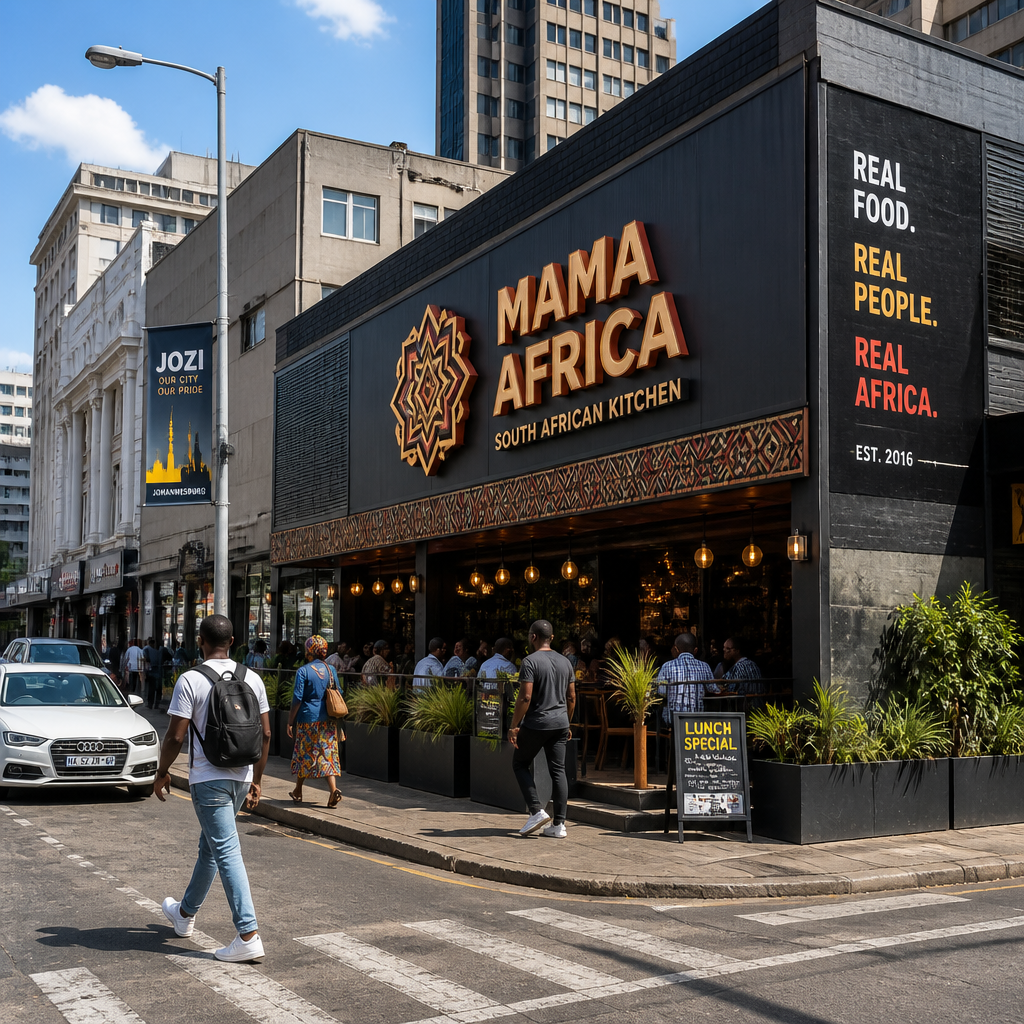
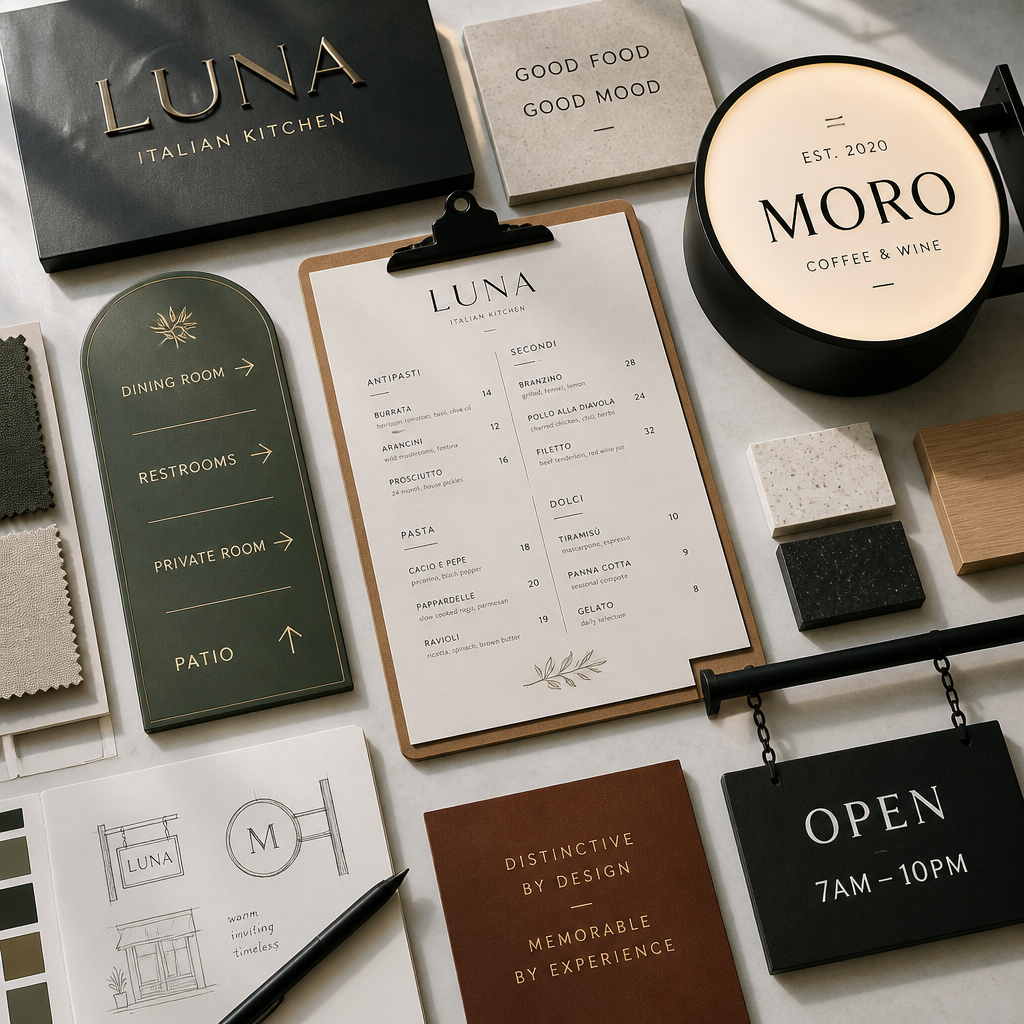
Outdoor Signage Types Every South African Eatery Needs
Not every restaurant needs every type of sign. But most South African eateries are underpowered in their outdoor signage, relying on a single fascia sign and nothing else. The problem with that approach is that a single sign only works for people who are already positioned in front of your building at the right angle. That is a small fraction of your potential audience.
Channel Lettering and LED-Backlit Fascia Signs
Channel lettering is the single most effective fascia sign format for restaurants. Each letter is individually fabricated and lit from within, which means your restaurant name is visible in daylight, at dusk, and at night without any additional lighting infrastructure. For South African eateries that rely on evening trade, this is non-negotiable. Front-lit and halo-lit combinations are particularly effective because they produce a premium, upscale visual effect that elevates the perceived quality of the establishment before a customer steps inside.
LED-backlit lightbox signs are a practical alternative, especially for eateries in shopping centres or strip malls where a consistent format is expected. They allow for logos, imagery, and text in a single panel, and modern LED technology keeps running costs low compared to older fluorescent systems.
Pylon Signs for Road Visibility
Any restaurant that is not directly on the street edge needs a pylon sign. This applies particularly to eateries inside commercial complexes, set back from the road in parking areas, or located in business parks across Gauteng. An illuminated pylon at the road boundary announces your presence to drivers who would otherwise not know you exist. Tenant directory pylons serve the same function for multi-restaurant complexes, listing all eateries in one tall, roadside structure.
The detail that most operators overlook with pylon signs is that double-sided illumination is not optional. A pylon sign that can only be read from one direction of traffic cuts your potential audience in half.
A-Frame Pavement Boards
A-frame boards are underused in South African restaurant marketing, particularly among eateries that sit inside malls or on busy pedestrian strips. A well-positioned A-frame three to five metres from your entrance, featuring your daily special or a limited-time offer, intercepts the decision-making moment of someone who is already walking with lunch or dinner in mind. The message must be concise, specific, and readable from a walking pace. "Lunch special R89 - wood-fired pizza" outperforms "Great food, great value" every time.
Window Graphics and Vinyl Decals
Your windows are paid-for advertising space that most restaurants either underuse or clutter. A well-designed vinyl decal on your window can display your trading hours, cuisine type, accepted payment methods, and even a QR code linking to your menu. For corner-facing restaurants or those on pedestrian routes, double-sided window graphics visible from the interior and exterior maximise this space further.
Pro tip: For restaurants near taxi ranks, train stations, or busy transport corridors across Gauteng, consider a bold "Open Now" or "Kitchen Open Until [time]" window sign in the evening hours. The decision to stop for a meal is often driven by uncertainty about whether a place is still serving. Removing that uncertainty with clear signage directly converts foot traffic into tables.
Indoor Signage That Keeps Customers Spending
Outdoor signage gets people through the door. Indoor signage determines what they order, how much they spend, and whether they feel comfortable enough to return. These are not small outcomes. They have a direct bearing on your average spend per cover and your repeat visit rate.
Menu Boards and Digital Display Screens
For quick-service restaurants, takeaways, and cafes in South Africa, a well-lit, clearly legible menu board is the highest-impact indoor sign you have. Customers make ordering decisions fast, often under mild social pressure not to hold up the queue. A menu board that is hard to read, poorly organised, or missing prices creates friction at the exact moment you want flow. Digital display screens have become increasingly accessible for single-site restaurants across Gauteng and allow for menu rotation, promotional offers, and upsell prompts without reprinting costs.
Table Talkers and Promotional Signage
Once a customer is seated, the conversation continues through table talkers, tent cards, and wall-mounted promotional signs. These are your tools for increasing average spend. A well-designed table talker promoting a dessert, an add-on side, or a monthly cocktail special generates incremental revenue with zero additional staffing cost. The rule for table talkers is the same as for all signage: one clear message per piece. A table talker trying to promote five things simultaneously promotes nothing.
Directional and Wayfinding Signs
Larger restaurant spaces, multi-floor venues, and eateries with outdoor seating sections frequently underestimate wayfinding. Customers who feel lost, unsure where to seat themselves, or uncertain about where the bathrooms are, experience low-grade anxiety that reduces their enjoyment and their likelihood of returning. Clear directional signage solves a real operational problem and contributes to the overall perception of a well-run establishment.
Signage for Cafes: Getting the Coffee Crowd Through Your Door
Cafe signage operates under a different set of pressures than full-service restaurant signage. The purchase decision cycle is shorter. Cafe customers are often making a decision in motion, on their way somewhere else, with a narrow time window. Your signage needs to work faster and communicate a tighter message.
The most effective signage strategy for cafes centres on three points. First, the exterior must communicate that you are open and what you specialise in, whether that is specialty coffee, all-day breakfast, or a specific cultural food identity. Second, the window space should be used to show something that triggers appetite or desire, whether that is a chalk-style specials board, an image-led display, or a neon sign with a coffee-related message that functions as both branding and atmosphere. Third, the counter or order-point signage must make the decision process fast. A customer who cannot decide within twenty seconds of approaching your counter is a customer experiencing friction, and friction loses you the next person in the queue.
Neon signs have become a particularly strong tool for cafes and casual eateries because they communicate personality and Instagram-worthiness simultaneously. A well-placed neon sign above your coffee bar does not just illuminate. It becomes part of your brand identity and generates organic social media visibility every time a customer photographs their flat white.
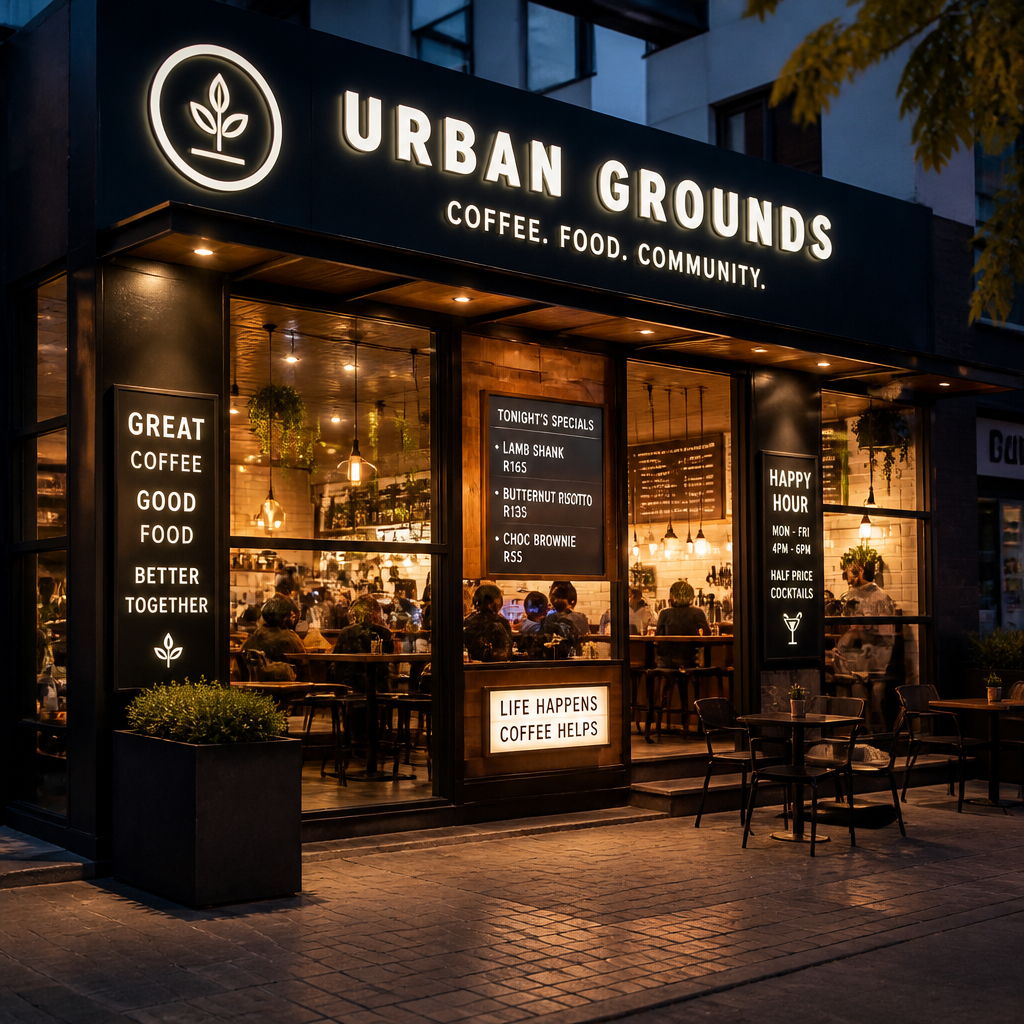
Food Business Signs in Gauteng: Navigating the Local Landscape
Gauteng presents a specific set of conditions that shape how food business signs need to perform. The province has a high vehicle-dependency culture, with many dining decisions made from a moving car rather than on foot. This means that roadside legibility at speed is a priority that does not exist in the same way in pedestrian-dominant environments. Your restaurant name and core offer must be readable in under three seconds at 60 km/h.
Shopping mall and strip mall settings dominate the Gauteng restaurant landscape. In these environments, you are competing visually with every other tenant for the attention of someone who has already parked and is now on foot. Here, the layered approach works best: a well-lit fascia sign to establish identity, an A-frame on the walkway to trigger the immediate decision, and a window graphic to confirm the food type and current offers.
Weather and Durability Considerations in Gauteng
Gauteng's climate is not forgiving to substandard signage. Summer afternoon storms are intense, UV exposure is high throughout the year, and temperature variation between seasons puts stress on materials and fixings. A vinyl banner that looks sharp in March may be bleached and torn by October if the material specification was wrong. For outdoor signage in Gauteng, UV-resistant materials, powder-coated metal frames, and weatherproof electrical components are minimum requirements, not premium upgrades.
Restaurants on open sites, near highways, or in exposed areas should specifically discuss wind load ratings with their signage provider. A pylon sign or projecting wall sign that has not been engineered for Gauteng wind conditions is a liability, not a marketing asset.
Signage for Township and High-Density Eateries
High-density residential areas and township commercial strips across Gauteng have their own signage dynamics. Foot traffic volumes are high, but dwell time per location is short. Bold, high-contrast colour schemes, large format text, and localised messaging in appropriate languages are most effective in these contexts. The standard corporate-minimalist approach that works in a Sandton or Rosebank setting does not necessarily translate to a Soweto or Tembisa food court. Signage should speak the visual language of its immediate environment while still maintaining brand integrity.
Comparing Signage Approaches for South African Restaurants
Choosing the right signage format is not a one-size-fits-all decision. The type of establishment, the location, the budget, and the dining occasion all shape what will work. Below is a direct comparison of the three most common signage approaches used by South African eateries, with an honest assessment of where each approach performs and where it falls short.
| Signage Approach | Best Suited For | Key Strengths and Limitations |
|---|---|---|
| Illuminated Channel Lettering with Pylon | Standalone restaurants, roadside eateries, and food parks in Gauteng with vehicle-based foot traffic | Maximum visibility day and night. High perceived brand quality. Higher upfront fabrication cost. Requires professional installation and periodic maintenance. Best long-term return on investment for permanent sites. |
| LED Lightbox with A-Frame Pavement Board | Mall tenants, strip mall restaurants, cafes, and quick-service food outlets with pedestrian traffic | Cost-effective for leased premises. Easy to update. A-frame adds flexibility for daily specials. Lightboxes can appear generic if design execution is weak. Pavement boards require a permit in some municipalities. |
| Neon or LED Neon with Digital Menu Board | Cafes, casual dining spots, bars, and eateries targeting younger demographics in urban Gauteng centres | Strong social media pull. Communicates personality instantly. Digital menu boards reduce print costs and allow real-time updates. Neon aesthetic may not suit formal or fine-dining positioning. Digital screens require reliable power and occasional software management. |
In practice, the strongest restaurant signage setups combine elements from more than one approach. A roadside pylon paired with an LED lightbox fascia and an interior neon feature wall covers the full customer journey from the road to the seat. SignShopper's range covers all three approaches, which matters when you need consistent brand execution across multiple sign types from a single provider. Their LED-backlit signs, pylon signage, and neon signs can be coordinated as a unified system rather than assembled piecemeal from multiple suppliers with no consistency guarantee.
Franchise and Corporate Restaurant Identity Standards
Franchise restaurant operators face a specific challenge that independent eateries do not: the signage must be exactly right, not approximately right. Franchise agreements specify colour values, typeface weights, logo clearance zones, and material specifications. A single non-compliant sign at one branch can trigger a compliance process that costs more in management time than the sign itself.
The practical implication is that franchise operators need a signage provider that can produce from approved artwork files, work to exact specification, and document material compliance if required by the franchisor. This is not a capability all signage companies can reliably deliver. When evaluating providers for franchise rollouts across Gauteng or multi-province deployments, ask specifically about their track record with corporate identity standards, not just their general fabrication capability.
For restaurant groups managing multiple branches, the rental signage model is worth evaluating seriously. Rather than a capital expenditure per branch, a rental arrangement provides a predictable monthly cost, maintenance responsibility transferred to the provider, and easier brand refresh when the group updates its identity. SignShopper's signage rental solutions are specifically designed for this type of multi-site commercial deployment.
New franchise locations also need signage under time pressure. A new branch opening without its full signage suite looks unfinished and loses revenue during the period when launch marketing spend is highest. Building a relationship with a signage provider before lease signing, rather than scrambling after occupation, is one of the most consistently overlooked parts of a successful restaurant launch in South Africa.
Pro tip: If you are rolling out a restaurant franchise across multiple Gauteng locations, standardise your signage specification document before the second branch signs its lease. The cost of correcting a non-compliant sign at an existing branch is always higher than building the specification correctly from the start.
Frequently Asked Questions
What types of outdoor signs work best for restaurants on busy Gauteng roads?
For high-speed road exposure, illuminated pylon signs at the road boundary are the most effective because they are visible from a distance and from both directions of traffic. Combined with an LED-backlit fascia sign at building level, this gives you both long-range identification and close-range brand confirmation. For restaurants on roads with 60 km/h speed limits, the sign text must be large enough to be read comfortably at speed, which typically means a minimum letter height of 200mm for the business name.
How much does restaurant signage cost in South Africa?
Signage costs vary considerably depending on the type, size, material specification, and whether installation is included. A basic vinyl banner or pavement board is a low entry cost. Fabricated channel lettering with LED illumination is a more significant investment, as is a structural pylon sign. The most accurate approach is to request a detailed quote from a Gauteng-based signage provider, specifying your exact requirements. Costs also differ between a rental arrangement and an outright purchase, and for multi-site restaurant groups, rental can significantly reduce the capital requirement per branch.
Do I need council permission for restaurant signage in Gauteng?
Most municipalities in Gauteng require sign-off for permanent external signage, and some require formal bylaw applications for illuminated signs, pylon signs above a certain height, and projecting wall signs. Requirements vary between the City of Johannesburg, City of Tshwane, Ekurhuleni, and other local authorities. A reputable signage company operating in Gauteng should be able to advise you on the relevant requirements for your specific location and assist with the application process.
Can signage genuinely increase footfall, or is that just marketing spin?
The evidence is consistent across multiple studies. Research indicates that well-placed signage influences the buying decisions of a significant majority of in-store customers. Studies also show that roughly one in six people stop at a business they had no intention of visiting because the signage caught their attention. For restaurants, the effect is amplified because the product is consumed immediately, which means impulse decisions translate directly into same-day revenue. Signage is not the whole marketing picture, but it is the part that works at the exact moment the customer is physically present and making a decision.
What is the difference between a lightbox sign and channel lettering for a restaurant?
A lightbox sign is a flat illuminated panel, usually a rectangular frame containing a printed or backlit graphic that includes your logo, name, and sometimes imagery. Channel lettering refers to individually fabricated three-dimensional letters, each with its own depth and lighting. Channel lettering tends to look more premium and has more visual presence, especially at night, because each letter stands out from the wall with shadow depth. Lightbox signs are generally more cost-effective and allow for easier image or graphic updates. For restaurant fascias on high-footfall strips, channel lettering tends to perform better in terms of perceived brand quality.
How should a cafe approach its signage differently from a full-service restaurant?
Cafes should prioritise fast communication because the customer decision cycle is shorter. The exterior sign needs to establish identity immediately. The window space should show something that creates desire, whether that is a specials board, a neon coffee feature, or a clear visual of your signature product. At the counter, the menu board must be scannable in seconds. Full-service restaurants have slightly more time to work with because customers generally intend to sit down, but cafes are competing for walking decisions, so every element of signage must be faster, bolder, and more immediately clear.
What has been the biggest difference-maker in your restaurant's signage, and what would you change if you were starting the signage setup from scratch? Share your experience in the comments.
References
- Restaurant signage statistics: how signs influence diner first impressions and dining decisions
- Research on how business signage drives impulse foot traffic and shapes quality perceptions
- A guide to the most effective sign types for restaurants, cafes, and food service businesses
- Digital signage trends in South Africa, including adoption by single-site restaurants and retail
- South African restaurant industry context including hospitality sector growth data