


Hotel Signage South Africa: The Complete Property Checklist
A guest's first opinion of your hotel is formed before they even reach the front desk. It is formed the moment they pull into your driveway and look for somewhere to park, when they search for the lift on a long corridor, and when they need to find the pool at 9 PM. Poor hotel signage in South Africa does not just frustrate guests. It creates liability, damages your brand, and costs you repeat business. This checklist covers every sign your property needs, from the entrance gate to the emergency exit, and explains why each one matters.
Table of Contents
- Quick Takeaways
- Exterior Signage: The First Impression Before the Front Door
- Lobby and Reception Signage: Setting the Tone at Check-In
- Wayfinding and Directional Signs: Moving Guests Through Your Property
- Room and Floor Identification Signs
- Amenity Signage: Restaurant, Pool, Gym, and Spa
- Safety and Regulatory Signage: Compliance is Non-Negotiable
- Signage Materials and Format Comparison
- Franchise and Corporate Identity Signage
- Frequently Asked Questions
- References
Quick Takeaways
| Key Insight | Explanation |
|---|---|
| Exterior signs set expectations before entry | Your property name sign, monument sign, and parking directionals shape the first impression before any staff interaction occurs. |
| Directional signs reduce pressure on front desk staff | When wayfinding signage is clear throughout the property, guests self-navigate and staff field fewer repetitive questions during peak check-in periods. |
| Safety signage is a legal requirement, not a preference | Exit signs, fire assembly point markers, and evacuation route maps are regulated in South Africa and must comply with SANS standards. |
| Room number signs must be consistent throughout | Inconsistent numbering or font changes between floors cause genuine confusion. A unified system matters more than individual design flair. |
| Pool and gym signs carry liability implications | Rules signs near pools and fitness centres are not optional branding. They document safety protocols and limit your liability if incidents occur. |
| LED-backlit signs extend usability into evening hours | Unlit signs become invisible after dark. Illuminated signage at entrances, parking areas, and key amenities is essential for late-arriving guests. |
| Brand consistency across all signs builds trust | Franchise properties in particular must match corporate identity standards across every sign type, from reception to the back-of-house fire exit. |
Most hotels in Gauteng treat signage as an afterthought, something to commission once construction is done and receptionists are already fielding phone calls from guests who cannot find their rooms. That is the wrong approach. Signage should be planned as an integrated system, not assembled piecemeal. The checklist below follows the actual journey of a guest from arrival to departure.
Exterior Signage: The First Impression Before the Front Door
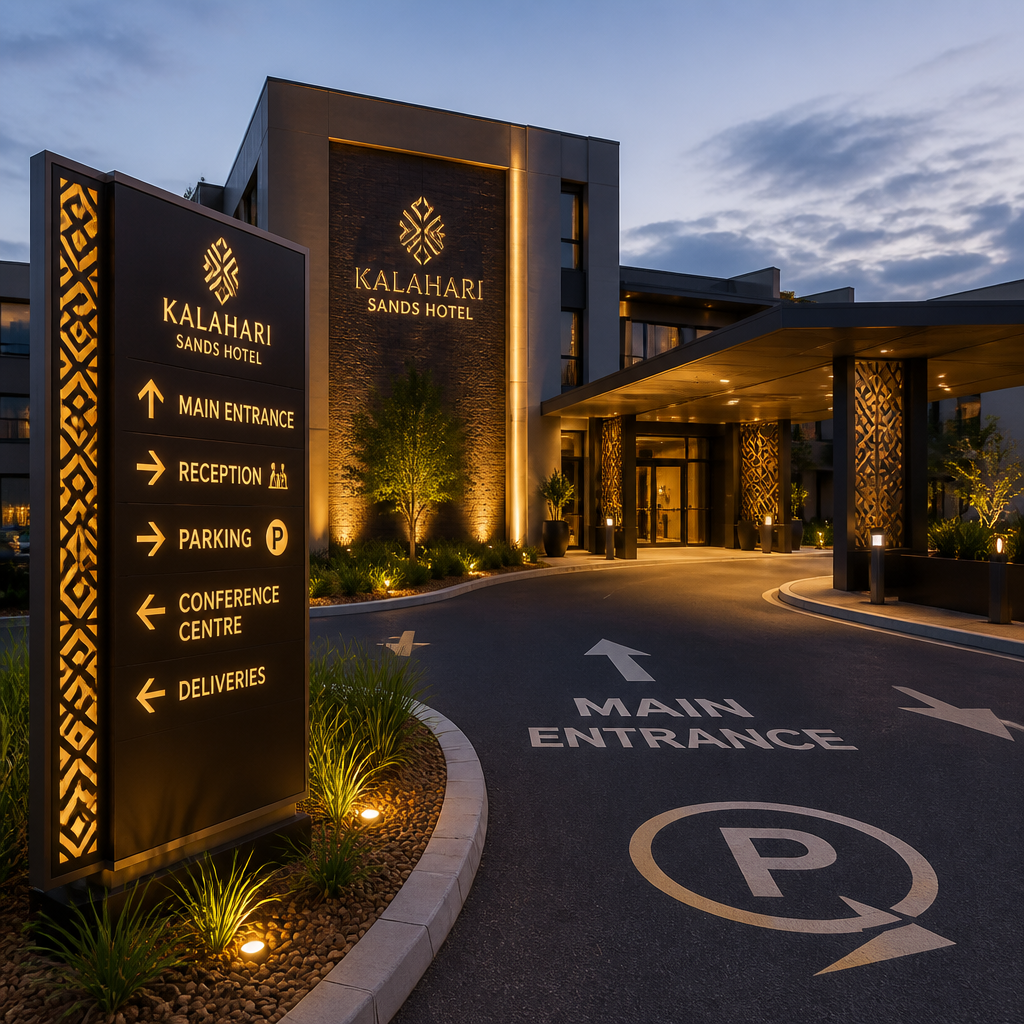
Exterior hotel signage has to do two things simultaneously: it must identify your property clearly from a distance, and it must guide arriving guests in the right direction without causing them to overshoot the entrance or block traffic while searching for parking. In South Africa, where many hotel properties sit on large plots with multiple access points, this is not a trivial challenge.
Property Identification Signs
Your main property identification sign, whether a freestanding pylon sign, a monument sign at the driveway entrance, or large-format channel lettering on the building facade, must be visible both during daylight and after dark. LED backlighting or halo-lit channel letters solve the visibility problem for late-arriving guests and are especially important for airport hotels or properties near highways where guests may arrive at any hour.
A common mistake is sizing the main sign for the kerb view only. If your property is set back from the road or accessible from a fast-moving arterial, the sign needs to be readable at speed. Consider letter height relative to viewing distance as part of the brief when working with your signage supplier.
Parking and Vehicle Directional Signs
Parking directional signs belong in your exterior checklist even when parking feels obvious to you as the property manager. To a guest arriving after a long drive, clear arrows distinguishing guest parking from staff parking, delivery areas, and valet zones prevent genuine frustration. Include entrance and exit markings, height restriction notices for covered parking, and disabled parking indicators in compliance with South African building regulations.
Pro tip: Place a low-profile directional sign at the entrance gate pointing separately to "Check-In" and "Parking" before the driveway splits. Guests arriving for the first time have no mental map of your layout and will follow signage rather than intuition.
Perimeter and Boundary Signage
For larger hotel properties, perimeter signs marking guest-only areas, private entrances, and service access routes are necessary both for security and for guest confidence. Nothing undermines a luxury experience faster than accidentally walking into a service corridor because nothing indicated otherwise.
Lobby and Reception Signage: Setting the Tone at Check-In
The lobby is where your brand identity speaks most loudly, and it is also the navigation hub of the entire property. The signage here needs to balance aesthetics with function, two requirements that sometimes pull in opposite directions but should not.
Reception and Check-In Identification
A surprising number of hotel lobbies have no visible sign indicating where the front desk is. In large open-plan lobbies, particularly those with multiple counters for check-in, concierge, and business services, each counter must be clearly labelled. Backlit acrylic or stainless steel lettering mounted above or behind the desk works well and can be designed to integrate with your brand palette without looking utilitarian.
Welcome and Brand Signage
Lobby brand signage, including your logo rendered in three-dimensional channel lettering or a backlit feature wall panel, is not decoration. It tells guests they are in the right place and reinforces the brand promise from the first moment inside the building. For franchise hotels, this is non-negotiable. Corporate identity standards for most major franchise groups specify exact sizes, materials, and placement for lobby brand elements.
Digital display boards in the lobby are increasingly common for event schedules, welcome messages for conference groups, and daily specials at on-site restaurants. These complement static signage and should be part of the overall signage plan rather than installed as an afterthought on a spare wall.
Policy and Notices at Reception
Check-in policy signs covering check-in and check-out times, pet policies, and smoking rules are required at most properties and are best displayed in a compact, branded format near the desk rather than as a printed A4 sheet taped to the counter.
Pro tip: Commission your lobby policy signs in the same material and finish as your wayfinding system. Mismatched materials in the reception area, such as a sleek reception counter next to a printed paper notice in a plastic frame, signal a lack of attention to detail that guests notice even if they cannot articulate why.
Wayfinding and Directional Signs: Moving Guests Through Your Property
Wayfinding signage is arguably the most functional category on this checklist, and the one that directly affects day-to-day guest satisfaction on a property. Directional signs for hotels guide guests to where they need to go without requiring them to ask for help, which means they need to appear exactly where a guest is most likely to be uncertain about their next step.
The best wayfinding systems are invisible in the sense that guests never consciously notice them. What they notice is the absence: when signs are missing or ambiguous, the property feels disorganised and the stay feels harder than it should.
Corridor and Lift Lobby Directional Signs
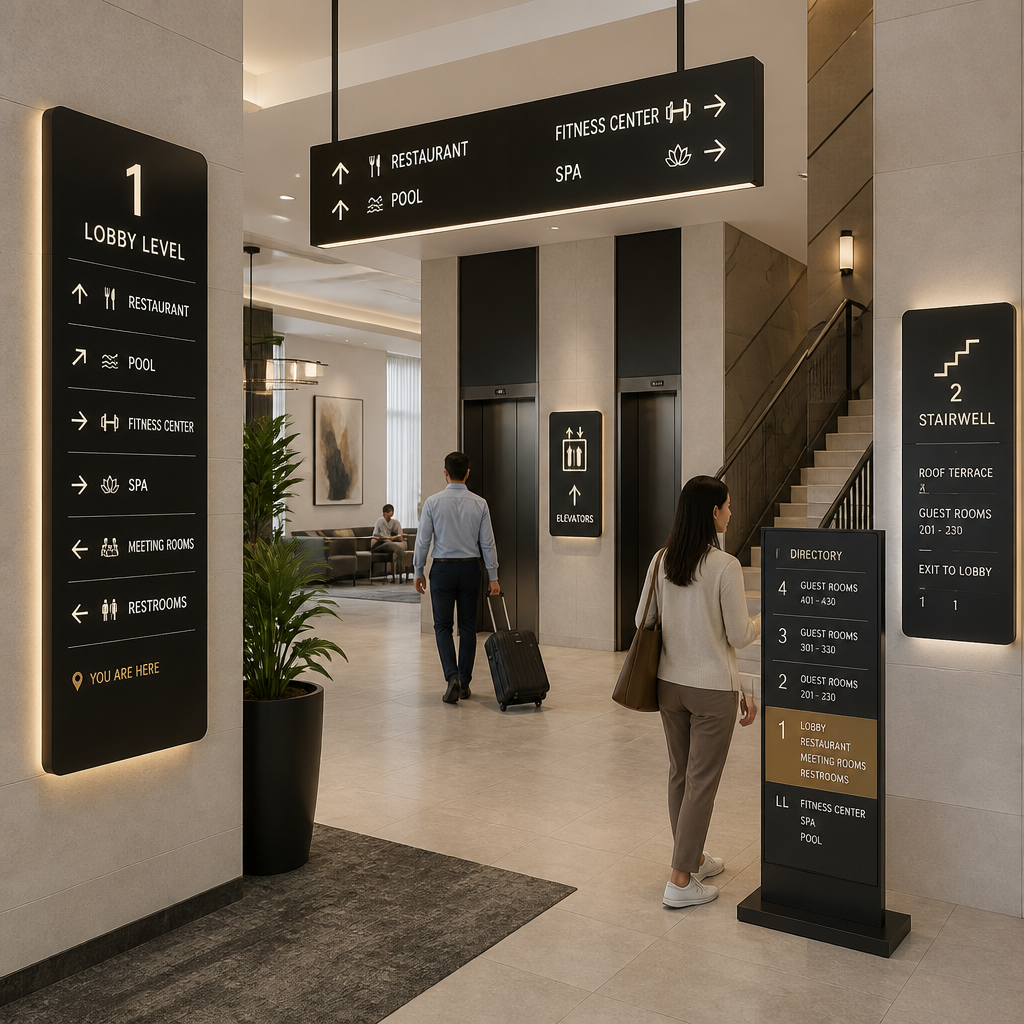
Every main corridor and lift lobby should carry directional signs pointing to guest room ranges (for example, "Rooms 101 to 150"), the restaurant, the pool, the gym, the business centre, and the nearest exit. The key design discipline here is placement at decision points. A decision point is any location where a guest must choose between two or more paths. Signs should appear at the exact moment of decision, not ten metres before or after it.
Floor Identification
Floor identification signs at stairwell doors and lift landings are often overlooked in smaller properties. Every guest should be able to confirm which floor they are on without opening a door and walking in to check. Floor numbers rendered large and clearly on the wall opposite each lift door is a simple fix that eliminates one of the most common guest complaints.
Outdoor Pathway Signs
Resorts and larger hotel properties with multiple buildings or outdoor amenity areas require outdoor pathway directional signs. These must be weather-resistant, adequately illuminated for night use, and placed at intervals that prevent guests from feeling lost between sign points. In Gauteng's climate, UV resistance and corrosion resistance are relevant material considerations, particularly for signs in garden areas or near pools.
Room and Floor Identification Signs
Room number signs are the most numerous sign type on any hotel property, and because they are numerous, inconsistency becomes immediately visible. A guest who notices that the sign on Room 214 is a different size from the sign on Room 215 will rightly wonder what else on the property has been assembled without a plan.
Room Number Plaques
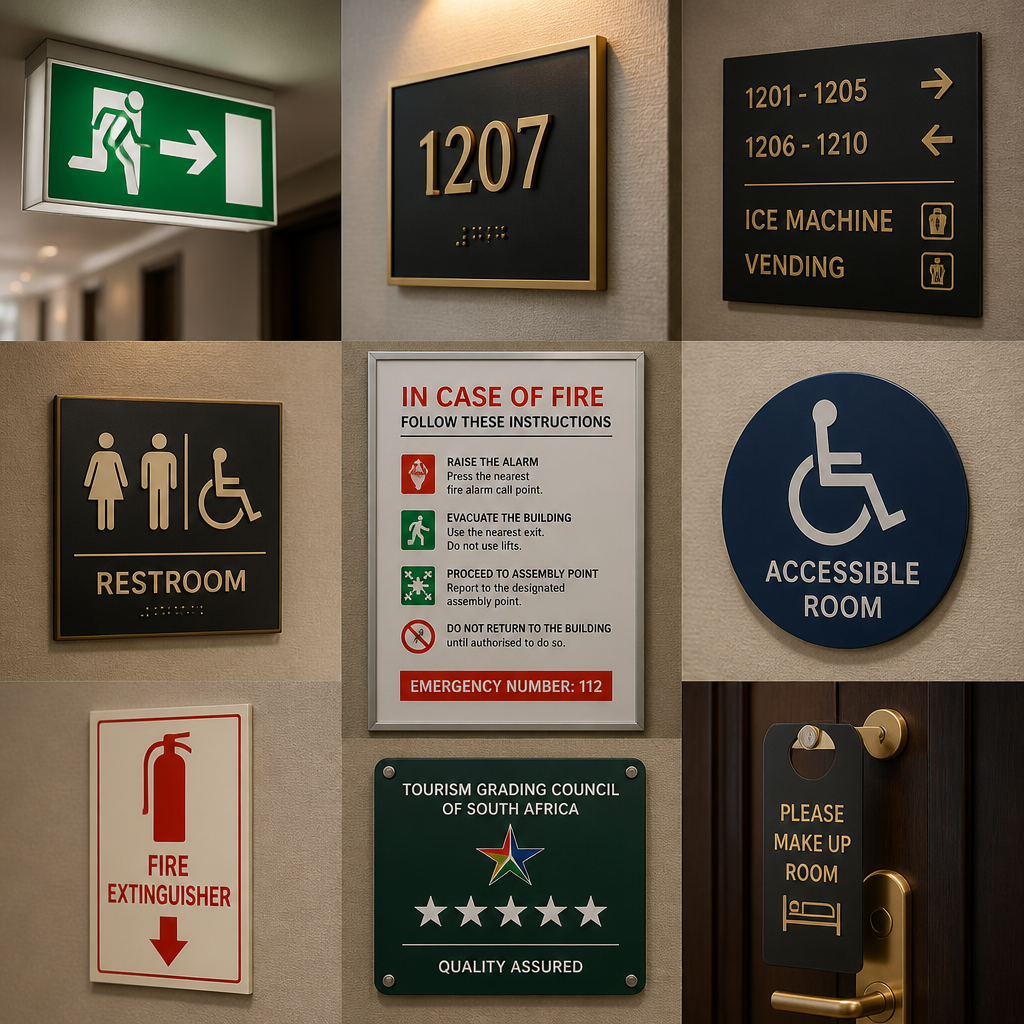
Room number plaques should be mounted at a consistent height, in a consistent position relative to the door frame, on every room throughout the property. The standard mounting position is on the latch side of the door, at eye level. Materials range from brushed aluminium and acrylic to brass and backlit panels, depending on your property tier and brand standards. The key requirement is durability, since these signs are touched repeatedly and must withstand years of cleaning products without fading or corroding.
Accessible Room and Amenity Signs
Signs for accessible rooms require additional consideration. South African building regulations require clear identification of accessible facilities, and internationally affiliated properties may carry additional requirements from their franchise standards. Braille additions to room number signs and amenity signs are standard on internationally branded properties and increasingly expected at premium local properties.
Do Not Disturb and In-Room Door Signs
Door hangers and in-room door signs for "Do Not Disturb" and "Please Service Room" are functional items but remain brand touchpoints. Commission them in the same colour palette and typeface as your broader signage system.
Amenity Signage: Restaurant, Pool, Gym, and Spa
Hospitality signage in Gauteng at amenity areas serves a dual purpose: it guides guests to the facility and communicates the rules and atmosphere of that space. A spa sign in a five-star property should feel nothing like a pool rules sign at a budget guesthouse, even though both are communicating information.
Restaurant and Bar Signage
Restaurant and bar signs include identification signs above the entrance, menu display stands or boards, table numbers, and any promotional signage for daily specials. Menu display is particularly important for hotels where guests may be evaluating whether to eat on-site versus leaving the property. Well-designed menu boards or display stands placed near the lift lobby or along the main corridor to the restaurant are an effective way to drive internal food and beverage revenue.
Pool Area Signage
Pool signage is among the highest-stakes sign categories on a hotel property. Pool rules signs must display safety guidelines clearly, including rules on diving, running, and supervision of children. They must also indicate operating hours and emergency contact procedures. In South Africa, these requirements intersect with the Occupational Health and Safety Act and with any franchise brand standards your property operates under. Unclear or missing pool rules signage creates genuine liability exposure.
Gym and Fitness Centre Signs
Fitness centre signs cover equipment usage instructions, operating hours, rules for the space, and emergency procedures. Equipment instruction placards mounted near individual machines are standard practice at any managed property. They reduce equipment misuse and reduce front desk queries about how to operate the treadmill or adjust the cable machine.
Spa and Wellness Signage
Spa signage requires a quieter visual register than other amenity signs. Direction signs to the spa should still be clear and functional, but the identity sign for the spa itself and the treatment room identification can adopt materials and finishes, such as frosted acrylic, timber veneer, or brushed rose gold lettering, that signal the nature of the experience rather than simply labelling a door.
Safety and Regulatory Signage: Compliance is Non-Negotiable
Safety and regulatory signage is the category that hotel managers most frequently underinvest in, presumably because it is not guest-facing in the way that lobby branding is. That is a misunderstanding of both the function and the legal weight of this sign category.
Exit and Fire Escape Signs
Exit signs must be illuminated and positioned so that a guest in any corridor or public space can see the nearest exit without searching. In South Africa, the SANS (South African National Standards) regulations govern fire safety signage requirements for public buildings, including hotels. Every guest room floor, function room, and public area requires compliant exit signage. This is not a design decision. It is a compliance requirement with inspection and liability consequences.
Evacuation Route Maps
Evacuation route maps are required in each guest room, at each lift lobby, and at key decision points along escape routes. These must be current, accurate, and must reflect the actual layout of the floor or area they cover. A common compliance failure is posting outdated maps after a renovation that changed the floor plan.
Fire Assembly Point Signs
Outdoor fire assembly point signs tell guests and staff where to gather in the event of an evacuation. These must be clearly visible from the building exits and should be illuminated or made from reflective materials for night visibility. On large properties with multiple exits, multiple assembly point signs may be required.
Health and Safety Notices
Beyond fire safety, hotel properties require signs covering wet floor hazards, no-smoking zones (per the South African Tobacco Products Control Act), food hygiene notices in F&B areas, and staff access restrictions. These are operational signs, but they carry regulatory weight and should be produced to the same standard as the rest of your signage rather than printed on standard office paper and laminated.
Signage Materials and Format Comparison
Choosing the right material for each sign type is as important as getting the design right. The wrong material in the wrong location will deteriorate, lose legibility, or simply look inappropriate for the property tier. The table below covers the three primary material categories used in hotel signage and where each performs best.
| Sign Material / Format | Best Applications in Hotel Signage | Key Advantages and Limitations |
|---|---|---|
| LED-Backlit Acrylic and Channel Lettering | Main property identification, lobby brand signs, restaurant entrance, amenity identification signs | Excellent visibility day and night, strong visual impact, suits premium and franchise properties. Higher upfront cost than non-illuminated options. Requires power supply and periodic LED maintenance. |
| Brushed Aluminium and Stainless Steel Plaques | Room number signs, amenity identification, directional sign housings, spa and reception signs | Highly durable, professional finish across all property tiers, resistant to cleaning products. Not internally illuminated unless combined with backlit mounting. Ideal for interior applications where durability and brand alignment are priorities. |
| High-Density Foam Board and Aluminium Composite (ACM) | Temporary event signage, conference directionals, promotional menu boards, seasonal notices | Cost-effective for short-term use, lightweight and easy to reposition. Not suitable for permanent or prestige applications. Useful for properties that host frequent events and need flexible, rebrandable signage options. |
In practice, most hotel properties use a combination of all three material categories, with illuminated solutions for high-visibility and brand-critical positions, durable metal finishes for permanent identification signs throughout the property, and lighter-format materials for event and temporary applications. SignShopper's range across LED-backlit signs, channel lettering, and display stands covers all three categories for hospitality clients in Gauteng and across South Africa.
Franchise and Corporate Identity Signage
For franchise hotel operators, every sign on the property is a brand compliance item, not just a wayfinding or safety tool. Franchise agreements typically specify exact requirements for sign dimensions, materials, illumination standards, logo proportions, and typefaces. Deviations from these standards, even minor ones, can trigger compliance reviews and the cost of replacement.
The practical implication is that franchise hotel signage projects require a supplier who understands corporate identity documentation and can manufacture to specification, not just to visual approximation. This is particularly relevant in Gauteng where many franchise hotel operators are managing multiple properties under the same brand and need consistent output across all sites.
Working with a signage company that has experience in brand rollouts is essential for franchise operators. SignShopper's approach to corporate identity signage is built around maintaining brand consistency across multiple sites, which is precisely what franchise hotel groups require when updating or opening properties.
Independent hotel operators have more design freedom, but the discipline of treating signage as a coherent system rather than individual items still applies. A consistent sign family across a property, with unified materials, finishes, and typefaces, signals professionalism to guests in a way that a mixed collection of individually ordered signs simply does not.
Rental signage is a practical consideration for hotel properties hosting events, conferences, or seasonal promotions. Rather than investing in permanent signage for temporary needs, rental solutions for display stands, banner frames, and directional sign systems allow properties to maintain a professional appearance for events without the capital cost of permanent installation. This is an option worth discussing with your signage provider if your property runs a high volume of corporate events or functions.
Frequently Asked Questions
How many directional signs does a typical hotel floor need?
There is no fixed number, but the guiding principle is to place a sign at every decision point where a guest could take a wrong turn. On a straight corridor with rooms on both sides and lifts at one end, you may need only one sign at the lift lobby. On a floor with a corner, a fire stairwell, and a vending area, you likely need three or four. Walk the floor as if you have never been there before and mark every point where you were uncertain which way to go. That is your placement map.
Are hotel exit signs regulated in South Africa?
Yes. South African National Standards (SANS) include requirements for fire safety signage in public buildings. Hotels are classified as public buildings and must comply with the relevant SANS standards for exit signs, evacuation maps, and fire assembly point markers. Non-compliance creates both safety risk and legal liability. Always use a signage supplier familiar with South African safety signage requirements to ensure your property meets current standards.
What is the difference between wayfinding signage and directional signage in a hotel context?
Directional signage refers specifically to signs that give directions using arrows and text, pointing guests toward specific destinations. Wayfinding is the broader system that encompasses directional signs, identification signs, room numbers, floor indicators, and any other sign that helps a guest understand where they are and how to get where they want to go. Good wayfinding means the complete system works as a whole. Directional signs are one component of it.
How do I ensure signage matches our franchise brand standards?
Request the brand standards documentation from your franchise group before briefing any signage supplier. This document will specify permitted materials, colours (usually with Pantone or RAL references), typefaces, minimum and maximum dimensions, and installation requirements. Give this document directly to your signage supplier at the briefing stage. A supplier experienced in franchise work will know how to interpret it. If your supplier cannot work from brand standards documentation, find one who can before the project starts rather than after the first signs come back wrong.
What signage do I need specifically for a hotel pool area?
A hotel pool area requires at minimum: a pool rules sign covering safety rules, depth markers, no-diving zones, and supervision requirements; operating hours signage; emergency contact and first aid information; and no-entry signs for areas outside the guest perimeter. If the pool is accessible to children, specific rules around unsupervised minors are required. Properties with multiple pools or pool-adjacent amenities such as a pool bar or changing rooms will need directional signs and identification signs for each area. All pool signage should be produced in weather-resistant materials with UV-stable printing for Gauteng's high UV environment.
Can SignShopper handle signage for a hotel property across multiple sites in South Africa?
Yes. SignShopper operates across South Africa and into neighbouring countries including Botswana, Zimbabwe, and Mozambique. For hotel groups or franchise operators managing multiple properties, they offer corporate identity rollout services that maintain consistency across all sites. This includes design, manufacture, and installation managed from their Gauteng base with project coordination across all locations. Contact SignShopper directly at signshopper.co.za to discuss multi-site hotel projects.
What is the best material for outdoor hotel signs in Gauteng?
For outdoor use in Gauteng, the key environmental factors are high UV exposure, periodic heavy rain, and wind load for larger freestanding signs. Aluminium composite material (ACM) and powder-coated aluminium frames are the standard for outdoor sign structures. LED modules used in illuminated signs should be rated for outdoor use. Vinyl graphics on outdoor signs must use UV-resistant cast vinyl rather than calendered vinyl, which will shrink and lift within one to two years of outdoor exposure. For premium identification signs, powder-coated steel or stainless steel with halo-lit channel lettering provides the best combination of durability and visual impact.
If you manage a hotel property in Gauteng or anywhere in South Africa, we would love to know which sign category you found most useful in this checklist or where your current property has gaps. Share your experience in the comments or reach out directly.
We would love your feedback and any insights you would share with others. What perspective would you add?
References
- Hospitality signage ideas and how entrance and wayfinding signs improve the guest experience
- A guide to hotel wayfinding and directional sign placement best practices
- Complete guide to hospitality signage types for hotels and resorts, from exterior to interior
- The essential sign types every hotel property needs, including pool, gym, and safety signs
- How directional and wayfinding signs improve hotel guest navigation and satisfaction