




Outdoor vs. Indoor Signage: Right Materials for SA
Pick the wrong signage material in South Africa and you will pay for it twice: once when you buy it, and again when you replace it six months later. Outdoor signage South Africa businesses rely on faces a combination of intense Highveld UV radiation, violent summer hailstorms, and abrupt temperature swings that simply do not exist in most markets where signage materials are rated and tested. Indoor signage has its own rules, driven by aesthetics, fire ratings, and corporate identity precision. Getting this decision right matters for franchises and corporates especially, where a faded fascia sign or a warped lobby panel is a brand compliance failure, not just a maintenance issue.
Table of Contents
- Quick Takeaways
- Why the South African Climate Changes Everything
- Outdoor Signage Materials: What Actually Survives
- Indoor Signage Materials: Precision Over Resilience
- Material Comparison: Outdoor vs. Indoor Applications
- Common Mistakes That Cost Businesses Money
- Corporate Identity and Franchise Compliance Across Both Environments
- Frequently Asked Questions
- References
Quick Takeaways
| Key Insight | Explanation |
|---|---|
| ACM is the go-to outdoor substrate in South Africa | Aluminium Composite Material resists UV, moisture, and warping, making it reliable for building fascias, pylons, and external branding panels in Gauteng's extreme conditions. |
| Standard PVC foam board fails outdoors within months | Non-UV-stabilised PVC yellows and becomes brittle under direct South African sun. Only UV-stabilised outdoor-grade PVC should be used externally, and even then only for short- to medium-term applications. |
| Chromadek offers proven corrosion resistance for outdoor signs | With a very low corrosion rate and enhanced UV resistance, Chromadek is a practical choice for outdoor signage in regions with diverse and unpredictable weather, including South Africa's Highveld. |
| Acrylic is ideal for indoor illuminated and dimensional signs | Cast acrylic is dimensionally stable, takes backlit LED light evenly, and holds colour well indoors. It is not the first choice for unprotected outdoor use without a UV-stabilised formulation. |
| Aluminium remains the benchmark for permanent outdoor signage | Raw or powder-coated aluminium does not rust, holds its shape under wind stress, and outlasts most competitors on a cost-per-year basis for fascia lettering and pylon signs. |
| Indoor signage materials must meet fire-retardant standards in commercial premises | FR-grade PVC, certain acrylics, and treated substrates are required in hotels, shopping centres, and restaurants to comply with South African building regulations. |
| Franchise and corporate identity signage demands consistency across both environments | A mismatched material choice between your outdoor fascia and indoor reception sign creates visible brand inconsistency. Both must be specified together, not treated as separate projects. |
Why the South African Climate Changes Everything
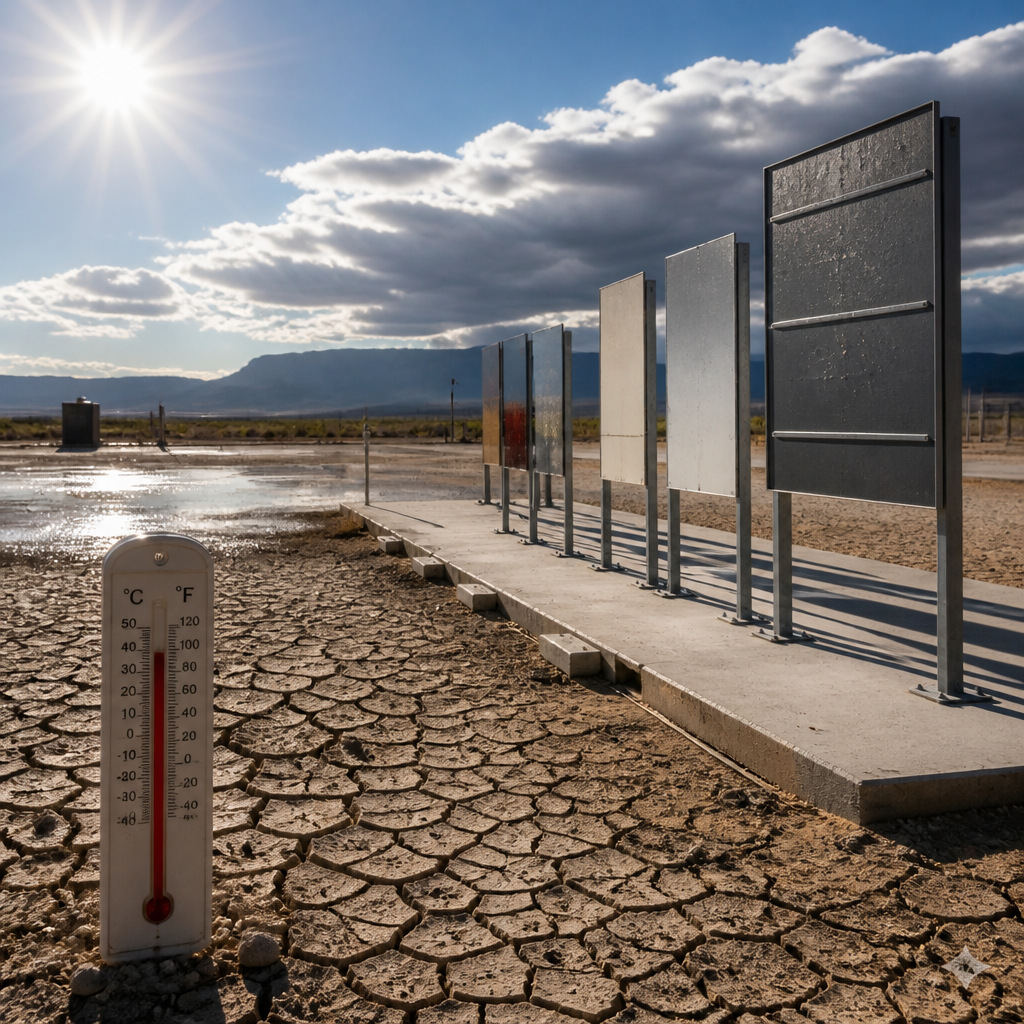
Gauteng is not a mild climate. It sits on an elevated plateau, which means higher UV intensity than coastal regions at the same latitude. Summer afternoons bring sudden, violent hailstorms that can puncture cheap sheet materials and crack acrylic panels not rated for impact. Strong storm-driven wind stresses mounting systems and tears flexible substrates. Then, almost immediately after the storm, the sun is back at full intensity.
The practical consequence is that signage material ratings from European or American manufacturers, tested in those markets, frequently underperform in South Africa. A vinyl wrap rated for five years in Germany may last two to three years on a north-facing fascia in Pretoria or Johannesburg. This is not a supplier problem. It is a physics problem, and specifying materials without accounting for it is one of the most common and expensive mistakes in commercial signage projects here.
The material that looks right in a catalogue is rarely the material that performs right on a Highveld building. UV exposure, hail impact, and thermal cycling must all be factored in before a single panel is ordered. Getting this specification wrong adds cost and damages brand presentation.
Indoor signage environments are more controlled but still carry their own demands. South African retail and hospitality interiors often have strong air conditioning, which creates temperature differentials and low-humidity conditions that can cause certain substrates to crack or delaminate over time. Fire ratings are also non-negotiable in hotels, restaurants, and shopping centres, making FR-grade material selection a compliance issue, not just a preference.
Outdoor Signage Materials: What Actually Survives
The South African outdoor signage market has effectively settled on a short list of materials that reliably survive the climate. Knowing which material to specify for which application is the difference between a sign that represents your brand and one that embarrasses it.
Aluminium Composite Material (ACM)
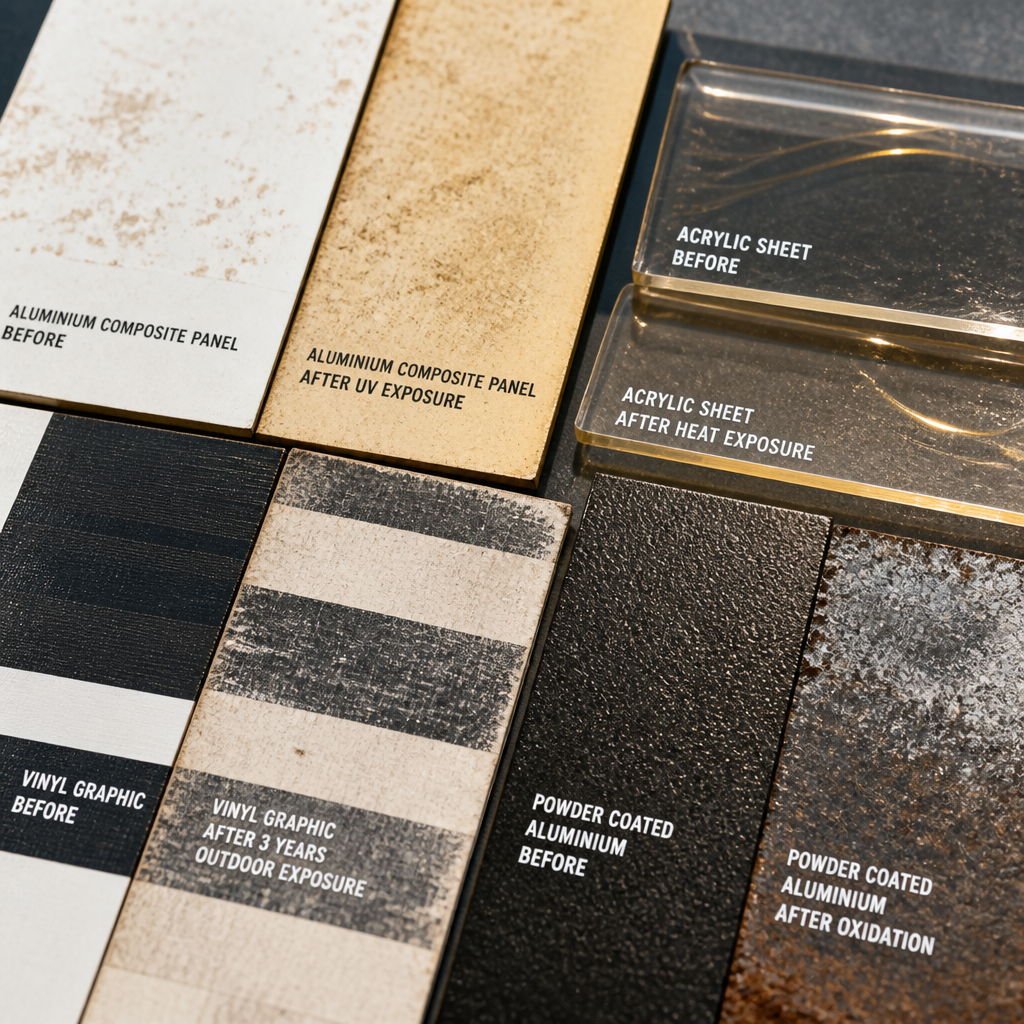
ACM is made from two aluminium sheets bonded to a polyethylene core. It is UV-resistant, waterproof, and does not warp or corrode, making it a benchmark material for South African outdoor use. ACM panels are available in 3mm and 4mm standard thicknesses for most fascia and external branding applications, with thicker panels used for structural or cladding work. With proper installation, ACM signs can last five to ten years or more in harsh outdoor environments. It also lays flatter than solid aluminium sheet, which means it does not develop the rippling or oil-canning effect you see on cheaper alternatives.
ACM is especially suited to building facades, retail shopfronts, pylon sign infills, and any application where a large, flat branded panel needs to hold its appearance over time. It can be cut into custom shapes, have vinyl graphics applied, or be directly printed on, and it pairs well with 3D lettering or backlit LED components.
Powder-Coated Aluminium
For channel letters, pylon structures, and dimensional fascia lettering, powder-coated aluminium is the material of choice. Aluminium does not rust, holds its structural integrity under wind loading, and responds well to quality powder coating, which adds UV protection and colour durability. The limitation is cost: fabricating aluminium channel letters or pylon structures costs more upfront than composite or printed alternatives. The payoff is longevity measured in decades rather than years.
Chromadek
Chromadek is a pre-painted galvanised steel product with a well-established track record in South African outdoor applications. It has a very low corrosion rate and enhanced UV resistance, making it a practical choice for outdoor signage in South Africa's unpredictable climate. It is commonly used for flat signage boards, estate agent boards, and smaller commercial signs where the structural properties of ACM are not required and cost management is a priority.
UV-Stabilised Vinyl
UV-stabilised vinyl applied over a solid substrate extends the outdoor lifespan of printed graphics meaningfully. Without UV stabilisation, vinyl graphics fade, peel, and bubble under South African sun. Quality cast vinyl with UV-resistant inks is the minimum specification for any outdoor printed panel that is expected to hold colour for more than eighteen months. Calendered vinyl, which is cheaper, simply does not hold up as a long-term outdoor solution on a Highveld building.
Pro tip: When specifying outdoor vinyl for a north-facing fascia in Gauteng, always request cast vinyl with UV-resistant inks rather than calendered vinyl. The price difference is modest, but the performance difference over two to three years is significant enough to justify it every time.
Indoor Signage Materials: Precision Over Resilience
Indoor signage is not about surviving the elements. It is about delivering brand precision, wayfinding clarity, and aesthetic quality in a controlled environment. The material choices reflect that: the priority shifts from weather resistance to finish quality, dimensional accuracy, and fire compliance.
Acrylic (Cast and Extruded)
Acrylic is the dominant material for indoor illuminated signage, reception signs, and dimensional lettering in South African corporate and retail environments. Cast acrylic distributes backlit LED light evenly, holds colour accurately, and is dimensionally stable in air-conditioned interiors. It can be laser-cut to very tight tolerances, which is critical for corporate identity work where letterforms and logo shapes must match brand standards exactly. Extruded acrylic is cheaper but has less optical clarity and is not recommended for premium illuminated applications.
PVC Foam Board
For most South African indoor retail signage and display applications, 3mm PVC foam sheet is the standard specification. It is lightweight, easy to cut and print on, and cost-effective for high-frequency replacement applications like promotional point-of-sale signage and event displays. The key distinction to understand is that standard indoor-grade PVC foam board is not suitable for outdoor use. UV degradation causes surface yellowing and brittleness over time when it is used externally without UV-stabilised formulations. Inside a well-lit retail or hospitality environment, standard PVC foam board performs well for years.
FR-grade PVC foam board is required in hotels, shopping centres, and restaurants to comply with fire safety standards in commercial premises. This is a non-negotiable specification, not an optional upgrade, and any signage supplier working in these environments should be recommending it without needing to be asked.
Dibond and Premium ACM for Interior Applications
Dibond is a premium brand of ACM that is increasingly specified for high-end interior applications: reception wall cladding, branded feature walls, and dimensional signage in hotel lobbies and corporate headquarters. It delivers the flat, rigid, premium appearance of ACM with tighter manufacturing tolerances, making it a natural choice where a brand demands flawless presentation.
Vinyl and UV-Resistant Inks for Printed Interior Signs
Printed interior signage using high-quality vinyl and UV-resistant inks on PVC or ACM substrates handles logo displays, directional signs, and promotional messaging without fading under the intense LED downlighting common in modern South African retail and hospitality fit-outs. The combination of the right ink specification and the right substrate matters as much indoors as it does outside, particularly in environments with strong artificial lighting.
Pro tip: For hotel and restaurant interior signage, always ask your signage supplier to confirm the fire-retardant rating of every substrate they propose. In a commercial interior, this is a compliance requirement, and discovering a non-compliant installation during a building inspection is a problem that costs far more than the upgrade would have.
Material Comparison: Outdoor vs. Indoor Applications
| Material | Best Application | South Africa Climate Suitability |
|---|---|---|
| ACM (Aluminium Composite Material) | Outdoor fascia panels, pylon infills, external cladding, building branding | Excellent outdoors. UV-resistant, waterproof, no warping. Lasts 5 to 10+ years outdoors in Gauteng conditions. |
| Powder-coated aluminium | Outdoor channel letters, pylon structures, dimensional fascia lettering, long-life installations | Excellent outdoors. Does not rust, withstands wind loading, decades of service life with quality coating. |
| Chromadek | Flat outdoor sign boards, commercial property signs, budget-conscious outdoor signage | Very good outdoors. Very low corrosion rate, enhanced UV resistance. Proven in South African weather conditions. |
| UV-stabilised cast vinyl | Outdoor printed graphics over rigid substrates, vehicle wraps, banner faces | Good outdoors when correctly specified. Cast vinyl with UV-resistant inks holds colour significantly longer than calendered vinyl under Highveld sun. |
| Cast acrylic | Indoor backlit signs, reception lettering, illuminated brand panels, dimensional lobby signage | Excellent indoors. Not recommended for unprotected outdoor use without UV-stabilised formulation. Dimensionally stable in air-conditioned interiors. |
| PVC foam board (standard grade) | Indoor retail point-of-sale, event displays, exhibition panels, short-cycle promotional signage | Good indoors only. Yellows and becomes brittle outdoors under South African UV. FR-grade required in hotels, restaurants, and shopping centres. |
| Dibond (premium ACM) | Interior feature walls, corporate reception cladding, premium branded environments | Excellent indoors. Tight manufacturing tolerances suit high-end brand environments. Also suitable for protected outdoor applications. |
Common Mistakes That Cost Businesses Money
The most expensive signage mistake in South Africa is not choosing the cheapest material. It is choosing the wrong material for the environment and then replacing it repeatedly. In practice, the businesses that spend the least over a five-year period are the ones that specified correctly at the start, not the ones that saved money on the first purchase.
Using Standard PVC Foam Board Outdoors
This is the most common mistake seen on South African shopfronts. Standard-grade PVC foam board is not recommended for outdoor use. UV degradation will cause surface yellowing and brittleness, and the sign will need to be replaced within one to two years in full Gauteng sun exposure. The fix is to specify UV-stabilised outdoor-grade PVC if budget is the constraint, or move up to ACM for anything expected to last more than two or three years.
Underestimating Hail Impact on Flat Panels
Intense Highveld summer hail can puncture cheap sheet materials. Thin acrylic panels used outdoors without adequate framing or impact protection are particularly vulnerable. For outdoor applications, ACM and powder-coated aluminium offer significantly better impact resistance than acrylic or standard PVC. If acrylic must be used outdoors, engineering-grade polycarbonate is a better substitution: it offers impact resistance many times greater than acrylic while maintaining optical clarity and UV stability.
Ignoring Fire-Retardant Requirements Indoors
Hospitality venues, shopping centres, and restaurants are required to use fire-retardant materials in their interior signage installations. Specifying standard-grade PVC foam board in these environments is a compliance failure. A reputable signage supplier will raise this proactively. If your supplier is not asking about the application environment before specifying materials, that is a signal about the quality of the advice you are receiving.
Treating Outdoor and Indoor Signage as Separate Projects
For corporate clients and franchise owners, brand consistency across the outdoor fascia and indoor reception or wayfinding signage is non-negotiable. A common mistake is briefing the outdoor fascia and the interior fit-out separately, resulting in colour mismatches, font inconsistencies, and material finishes that do not complement each other. Both environments should be designed and specified together, particularly where corporate identity standards define exact Pantone references or finish types.
Corporate Identity and Franchise Compliance Across Both Environments
For franchise networks and corporate brands operating across multiple sites in South Africa, material specification is not just a practical decision. It is a brand compliance decision. A franchisor that mandates a specific shade of blue on an external fascia cannot afford for that blue to shift after eighteen months of UV exposure, because one non-compliant site affects how the entire brand is perceived in that area.
This is why the material and ink specification for outdoor signage in Gauteng must account for UV-induced colour shift from the start. Powder-coated aluminium with colour-matched powder retains its specification better than vinyl wraps over long periods, which is why it is the preferred solution for permanent fascia lettering where corporate identity compliance is audited regularly.
Indoor corporate environments have a different challenge: precision. Reception signs and wayfinding panels in a hotel, fitness centre, or corporate head office need to match the brand standards manual exactly. Cast acrylic, with its optical consistency and capacity for precise laser-cut letterforms, is the material that delivers this level of accuracy reliably. Printed alternatives can get close but rarely hold up under close inspection at reception-desk proximity.
SignShopper's approach to franchise signage is built around this reality: the material specification, the colour matching, and the installation process all need to serve the franchisor's CI standards, not just the franchisee's budget preference. Signage rental solutions are also relevant here for businesses that need to deploy brand-compliant signage across events or temporary locations without the capital outlay of permanent installation.
When evaluating any signage supplier for corporate or franchise work in South Africa, the right question to ask is not "what materials do you use?" but "what materials do you specify for this specific application in this specific environment, and why?" A supplier who gives the same answer regardless of whether the sign is going on a north-facing Sandton fascia or inside an air-conditioned hotel lobby is not giving you expert advice.
Frequently Asked Questions
What is the best material for outdoor signage in Gauteng specifically?
ACM (Aluminium Composite Material) and powder-coated aluminium are the two most reliable materials for permanent outdoor signage in Gauteng. ACM is ideal for large flat panels, pylon infills, and building fascias. Powder-coated aluminium is the better choice for channel letters and structural pylon components. Both resist the UV intensity, hail, and thermal cycling typical of the Highveld climate. For budget-conscious short-term applications, Chromadek offers a proven alternative with strong corrosion and UV resistance.
Can I use the same signage material indoors and outdoors?
Some materials work in both environments, but the specification needs to change. ACM, for example, performs well both outdoors and as a premium interior surface. Standard-grade PVC foam board, however, should never be used outdoors in South Africa. Acrylic is excellent indoors but requires a UV-stabilised formulation for any outdoor application. The default answer is: specify for the most demanding environment the sign will face, not the average.
How long should outdoor signage last in South Africa?
Correctly specified ACM or aluminium outdoor signs should last five to ten years or more in Gauteng conditions. Chromadek boards, when properly maintained, have a similar lifespan. UV-stabilised vinyl graphics over rigid substrates typically last two to four years outdoors depending on orientation and sun exposure. Non-UV-stabilised materials degrade significantly faster and should not be considered for permanent outdoor applications.
What indoor signage materials are required in South African hotels and restaurants?
Fire-retardant (FR) grade materials are required for interior signage in hotels, restaurants, and shopping centres in South Africa. This applies to substrates including PVC foam board and composite panels. Specifying standard-grade materials in these environments creates a compliance risk. Any signage supplier working in hospitality or retail interiors should proactively confirm the FR rating of every substrate they propose before production begins.
How does corporate identity compliance affect signage material choices?
Corporate identity standards typically define exact colours (often Pantone references), finish types (gloss, matte, brushed), and letterform specifications. These standards can only be met consistently if the right material and coating combination is chosen. Powder-coated aluminium retains colour accuracy over time outdoors better than vinyl wraps, which are more susceptible to UV-induced colour shift. Indoors, cast acrylic delivers the dimensional and optical precision needed to match brand standards at close viewing distances. For franchise networks, this is not a preference, it is a brand compliance requirement.
Is acrylic suitable for outdoor signage in South Africa?
Standard acrylic is not recommended as the primary material for unprotected outdoor signage in South Africa's climate. It is vulnerable to UV degradation, impact from hail, and thermal cycling over time. If optical clarity is needed in an outdoor application, engineering-grade polycarbonate is a better choice, offering far greater impact resistance while maintaining UV stability. UV-stabilised acrylic formulations exist for outdoor use but should be evaluated carefully for the specific exposure conditions of the installation site.
What is the difference between cast vinyl and calendered vinyl for outdoor signage?
Cast vinyl is manufactured using a casting process that produces a thinner, more dimensionally stable film that conforms better to surfaces and resists shrinkage over time. It is the correct specification for outdoor signage in South Africa, particularly on north-facing installations with maximum sun exposure. Calendered vinyl is cheaper but thicker and less stable, and it shrinks and peels faster under UV exposure. For any outdoor sign expected to look good for more than eighteen months, cast vinyl with UV-resistant inks is the minimum acceptable specification.
Have you run into signage material failures on a South African site, or do you have a question about what to specify for a specific application? Share your experience in the comments and we will give you a straight answer.
References
- PVC sheet grades and outdoor performance ratings for South African signage applications
- Overview of Chromadek signage and its UV and corrosion resistance in South African conditions
- ACM sign specifications, thickness options, and outdoor durability for South African climates
- Guide to selecting long-term outdoor sign materials and understanding UV, moisture, and wind challenges
- Highveld climate conditions including UV intensity, hail impact, and material performance considerations